
Lead
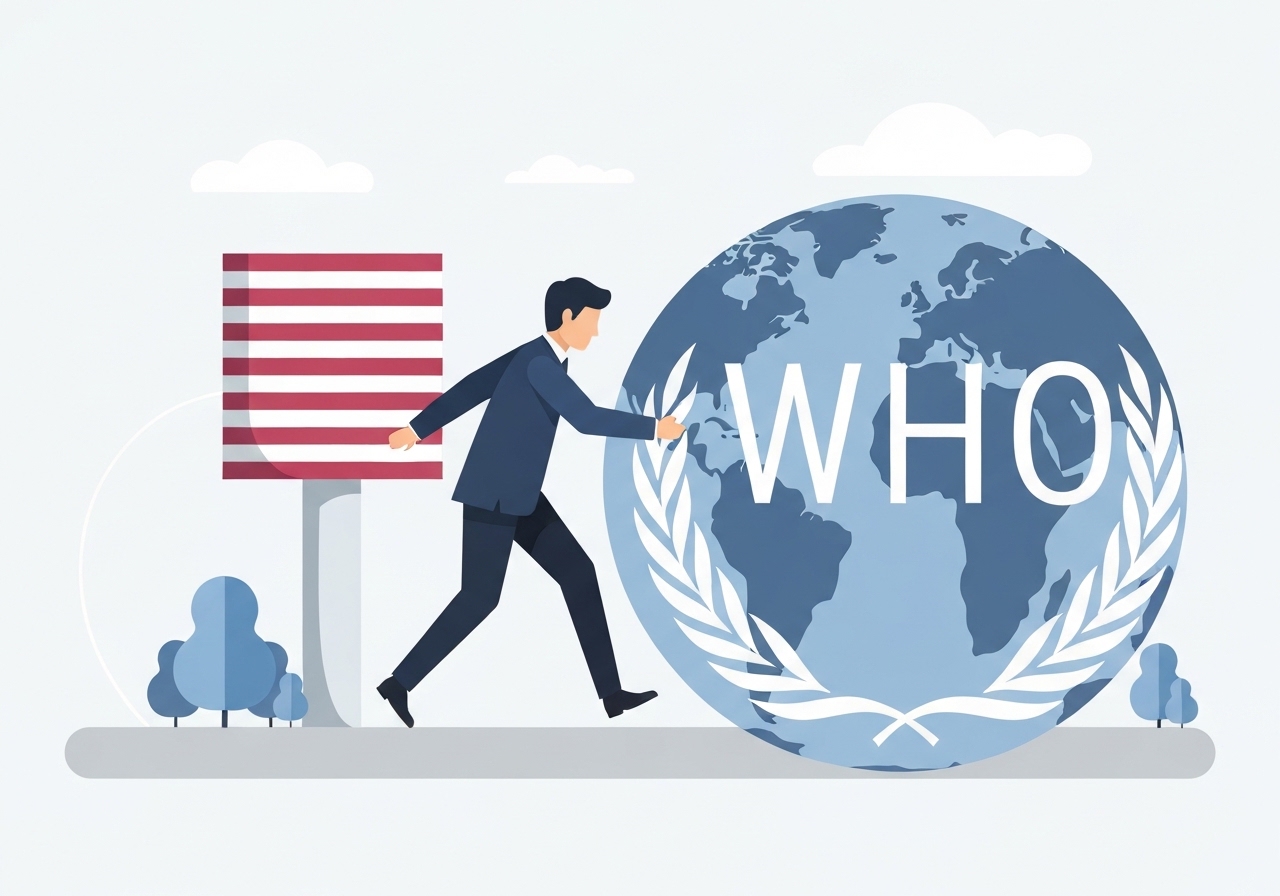
On January 22, 2026 the United States formally left the World Health Organization, executing a policy President Trump pledged on his first day in office. The administration announced termination of all U.S. government funding and the recall of assigned federal employees and contractors from WHO offices in Geneva and around the world. Officials said Washington may still engage narrowly with WHO disease networks that monitor pathogens such as influenza, but offered few details. Global health experts warned that the move could weaken international coordination for future outbreaks.
Key Takeaways
- The withdrawal took effect on January 22, 2026 and follows an earlier executive order from President Trump to leave WHO.
- The administration stated that all U.S. government funding to WHO has been terminated and that assigned staff and contractors were recalled from Geneva and field offices.
- A senior official at the Department of Health and Human Services said the United States is considering limited engagement with WHO global networks that track infectious diseases including influenza.
- As a WHO member, the U.S. historically placed CDC scientists in international decision making on flu vaccine strain selection; a WHO meeting on next year s vaccine is scheduled for February.
- Officials said Washington negotiated data sharing arrangements with other countries and plans to work with faith based groups and nongovernmental organizations on surveillance, but specifics were not provided.
- Public health experts cautioned that reduced ties to WHO could hamper early detection and coordinated responses to novel pathogens.
- Former CDC director Thomas R. Frieden publicly described the decision as a grave error for global and domestic health security.
Background
The World Health Organization serves as the primary U.N. agency coordinating international public health, including outbreak surveillance, technical guidance, and vaccine strain recommendations. Member states regularly contribute funding and second personnel, including scientists from the Centers for Disease Control and Prevention, to WHO technical committees and surveillance networks. In recent years WHO led coordinated responses to multiple epidemics and provided platforms for sharing clinical, laboratory and epidemiological data across borders. President Trump cited what he described as WHO s mishandling of previous pandemics when announcing his intent to withdraw, framing the move as part of a broader policy shift toward bilateral and nongovernmental arrangements.
The United States has been one of WHO s largest governmental contributors in past decades and also supplied technical expertise through agencies such as CDC and academic partners. WHO s influenza vaccine strain selection process depends on contributions from national influenza centers and international laboratories, a process in which U.S. scientists have played a regular role. Health diplomacy and funding have long been intertwined; changes to membership or financing can alter WHO s capacity and the willingness of other countries to collaborate. The announced withdrawal therefore has implications well beyond budget lines, touching scientific cooperation and global trust in surveillance systems.
Main Event
On Thursday federal officials notified WHO that the United States was formally departing the organization, and contemporaneously informed staff assigned to WHO posts that they were being recalled. The administration also declared that U.S. government financial transfers to WHO would cease. Those operational steps fulfilled an earlier promise by the president and turned a previously announced intention into immediate administrative action.
Despite the formal exit, a senior Health and Human Services official told reporters the administration is exploring narrow avenues of continued contact, specifically with WHO disease surveillance networks that monitor influenza and other pathogens. The official said Washington had negotiated data sharing agreements with some WHO member states and planned to rely on nongovernmental partners to sustain some information flows, while declining to outline concrete mechanisms or timelines.
The status of technical activities tied to WHO, including participation in the February meeting to advise on next year s flu vaccine composition, was left uncertain. Historically, CDC and U.S. laboratories have contributed virus samples and analysis that inform those vaccine decisions. Administration statements suggested limited or ad hoc participation could continue, but left open whether the United States would have formal input in multilateral processes that shape vaccine strain selection.
Global health practitioners and public health officials reacted quickly. Some warned that withdrawing the United States from WHO weakens the global early warning system at a time when new zoonotic pathogens remain an ongoing threat. Others noted that work by NGOs and faith based organizations can mitigate some data gaps but cannot fully replace technical coordination provided by WHO member structures.
Analysis & Implications
Operationally, the withdrawal severs routine funding channels and formal lines of representation that the United States used to influence global health policy and scientific priorities. Without a government seat at WHO deliberations, U.S. agencies may lose advance visibility into consensus guidance, diagnostic standards, and coordinated research agendas. That loss could slow domestic readiness for emerging threats and complicate vaccine planning cycles that depend on multinational data streams.
In practical terms, influenza vaccine strain selection exemplifies the risks. The process relies on global sampling, sequence sharing, and consensus among national influenza centers and WHO panels. If U.S. participation is reduced or informal, decision makers could face gaps in virus surveillance or delays in accessing timely consensus advice, potentially affecting vaccine match and public protection in the following season.
Politically, the move changes the calculus of health diplomacy. Other countries may interpret the shift as a signal to decouple some collaborations from WHO frameworks or seek alternative multilateral arrangements. That could fragment global responses in ways that increase transaction costs for outbreak investigation and slow mobilization of resources during emergencies.
Financially and legally, ending contributions raises questions about budget reallocation and long term commitments. If the United States redirects funds to bilateral programs or nongovernmental intermediaries, coordination may become more complex and monitoring of outcomes more opaque. The administration s plan to negotiate data sharing bilaterally may preserve some surveillance capacity, but such agreements typically require time, trust, and sustained technical integration to approximate multilateral systems.
Reactions & Quotes
Public health figures and government officials offered immediate, contrasting assessments. Supporters of the administration framed the change as an assertion of U.S. sovereignty over health priorities, while many health experts warned of diminished global coordination.
The decision is a grave error that will weaken international cooperation and make Americans less safe
Dr Thomas R Frieden, former CDC director
Dr Frieden s comment captured a common expert sentiment that infectious threats cross borders and that cooperative surveillance strengthens national security. His view echoes long standing concerns among epidemiologists that fragmentation undermines early detection and response.
We are considering limited engagement with WHO networks that track infectious diseases including influenza
Senior Department of Health and Human Services official
The HHS remark signals an intent to retain some technical ties while abandoning formal membership. Officials framed alternative arrangements with other governments and nongovernmental organizations as stop gaps, but offered few details about how equivalently timely data and influence would be maintained.
Unconfirmed
- Exact terms and participating countries in the reported bilateral data sharing agreements have not been publicly disclosed and remain unverified.
- Whether the United States will take part, formally or informally, in the WHO February meeting on next year s influenza vaccine has not been confirmed.
- Details on how funds previously directed to WHO will be reallocated, including amounts and recipient organizations, were not released at the time of the announcement.
Bottom Line
The January 22, 2026 withdrawal transforms a long signaled political pledge into immediate administrative change, ending formal U.S. funding and representation at WHO. Though officials say selective technical ties may continue, the lack of clear, institutional pathways raises risks to coordinated surveillance and vaccine planning that have historically relied on multilateral frameworks.
For policy makers and public health practitioners, the coming weeks will test whether bilateral data sharing and partnerships with NGOs can substitute for the routine collaboration built through WHO membership. Observers should watch whether the administration provides detailed, transparent mechanisms for sustaining surveillance, and whether WHO member states or other multilateral actors move to fill gaps in global response capacity.
Sources
- The New York Times — news report on U.S. withdrawal and official statements