
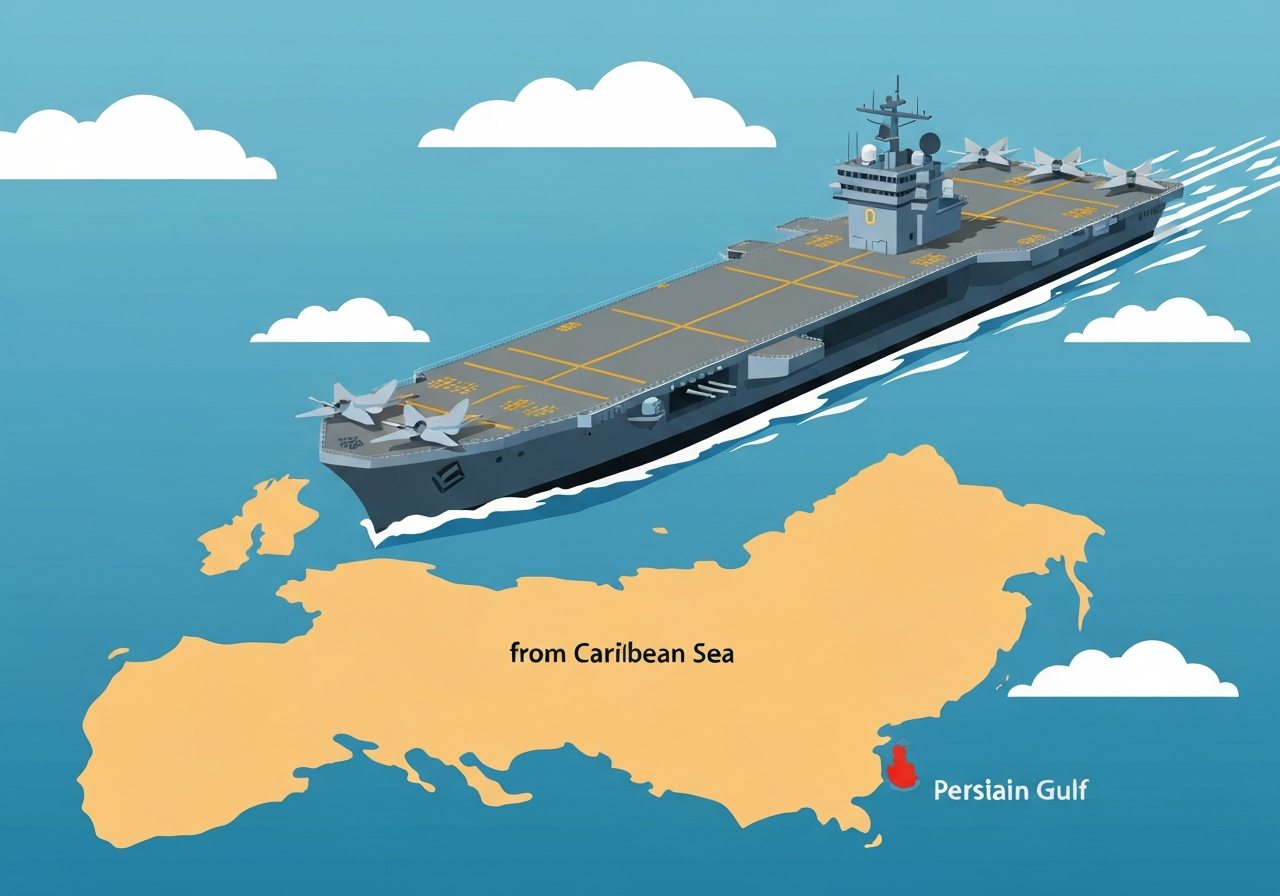
U.S. officials said on Feb. 12, 2026 that the aircraft carrier USS Gerald R. Ford and its escort ships, currently deployed in the Caribbean, have been ordered to the Persian Gulf and are not expected to return to their home ports until late April or early May. The ship’s crew was told of the change in orders on Thursday, according to four U.S. officials who spoke on the condition of anonymity. The Ford strike group will join the USS Abraham Lincoln carrier strike group in the Persian Gulf as part of a renewed U.S. pressure campaign toward Iran, officials said. The move interrupts a deployment that began June 24 from Norfolk, Va., and has already been extended once.
Key Takeaways
- The USS Gerald R. Ford left Norfolk, Va., on June 24 and was redirected from an initial European cruise to operations in the Caribbean.
- Four U.S. officials, speaking anonymously, said the Ford and its escorts will deploy to the Persian Gulf and join the USS Abraham Lincoln strike group.
- The carrier group’s return, previously expected in early March, has been pushed back to late April or early May, further extending a deployment already prolonged once.
- Ford airwing aircraft participated in the Jan. 3 operation in Caracas that resulted in the capture of President Nicolás Maduro, according to officials.
- The extended deployment risks delaying planned dry dock maintenance and major upgrades scheduled in Virginia.
- President Trump had publicly indicated earlier in the week a desire to send a second carrier to the region; the Navy and the White House did not name the craft at that time.
Background
Carrier strike groups are a principal instrument of U.S. maritime power projection and are routinely repositioned to convey deterrence, reassure partners, or prepare for contingency operations. The Gerald R. Ford, the Navy’s newest carrier class flagship, left Norfolk June 24 on a deployment that was originally intended for Europe before being sent to the Caribbean amid heightened U.S. pressure on Venezuela. In early January, aircraft assigned to the Ford’s strike group took part in an operation in Caracas that resulted in the capture of Venezuela’s president, Nicolás Maduro, according to U.S. officials.
Deployments of this length are exceptional for carriers that have scheduled maintenance windows; Ford was due to enter a dry dock in Virginia for major upgrades and repairs. Extending deployments can create a ripple effect across fleet maintenance schedules and training cycles, affecting both readiness and long-term sustainment. The shifting orders come against a wider geopolitical backdrop: the administration has signaled a tougher posture toward Iran while sustaining pressure on Venezuela, increasing demand for forward U.S. naval presence in multiple theaters simultaneously.
Main Event
According to officials briefed on the decision, the Ford strike group was notified on Thursday that it would transit from the Caribbean toward the Persian Gulf to reinforce the USS Abraham Lincoln carrier strike group. The redeployment follows an earlier redirection of the Ford from a Europe-bound cruise to Caribbean operations tied to U.S. pressure on Venezuela. Sailors had been preparing for a homecoming in early March after an earlier extension; the new orders push the expected return to late April or early May, lengthening time at sea.
The announced plan places the Ford alongside the Abraham Lincoln in the Persian Gulf, increasing carrier presence in the region amid rising tensions with Iran. Officials said the move is part of President Trump’s renewed campaign of pressure, though public operational details and legal authorities for any kinetic actions were not released. Naval leadership must now reconcile the extended deployment with the Ford’s maintenance backlog, crew rest requirements, and training timelines.
The extended deployment also alters force posture in the Atlantic and Caribbean, where the Ford and its escorts had conducted operations. U.S. partners and regional actors will be watching for both the timing of the Ford’s transit and any accompanying surface and submarine deployments that typically travel with a carrier strike group. The Navy has not released an official public statement summarizing the operational rationale or timeline at the time of reporting.
Analysis & Implications
Operationally, moving a carrier strike group from one theater to another on short notice places significant logistical demands on the fleet. Carriers depend on a network of escorts, supply ships, and shore-based logistics to sustain flight operations and spare-parts inventories; a long transit and prolonged on-station time increase consumption of critical consumables and accelerate wear. The Ford’s postponed dry dock threatens planned upgrades that are important for long-term readiness and for incorporating fixes to systems that have experienced delays since the ship’s commissioning.
Strategically, adding the Ford to the Persian Gulf raises the visible U.S. deterrent posture toward Iran and signals a willingness to escalate naval presence to influence Tehran’s calculus. That message can reassure regional partners but also increases the potential for miscalculation in a crowded maritime environment where Iranian, allied, and neutral ships operate in proximity. The decision to reassign a carrier engaged in Caribbean operations will be read by competitors as prioritization of one theater over another, complicating Washington’s ability to claim uniformly robust coverage.
Domestically, extended deployments can carry political costs. Sailors and their families face added strain from longer separations, and congressional overseers may press the Pentagon on maintenance trade-offs and the impact on force readiness. For the administration, the maneuver provides a visible demonstration of policy intent but also invites scrutiny about planning, sustainment, and the downstream consequences for carrier availability in future contingencies.
Comparison & Data
| Carrier | Homeport | Deployment Start | Original Return | Revised Return |
|---|---|---|---|---|
| USS Gerald R. Ford | Norfolk, Va. | June 24 | Early March | Late April–Early May |
| USS Abraham Lincoln | Sea-based (Persian Gulf) | Ongoing | N/A | N/A |
The table summarizes key deployment dates and the most recently reported return window for the Ford. The Ford’s June 24 departure and the shift from a Europe cruise to Caribbean operations are central to understanding how the ship’s schedule diverged from initial plans. Extended deployments are not unprecedented but do accumulate impacts on maintenance windows and personnel tempo that are measurable in months rather than weeks.
Reactions & Quotes
Officials and service members reacted cautiously to the announcement, emphasizing obedience to orders while noting the strains of prolonged deployment. Navy leadership and defense officials have declined to release detailed operational plans publicly, citing operational security.
“We will execute assigned missions and maintain readiness as directed,”
U.S. defense official (anonymous)
Sailors and families, who expected an early-March return after a prior extension, said the new delay is difficult but that crews remain focused on tasks at hand.
“The crew was informed and is preparing for an extended deployment,”
Crew member (anonymous)
Regional diplomats and analysts described the move as a signal to Iran while noting the operational trade-offs of shifting assets between theaters. Independent analysts cautioned that a visible buildup can deter aggression but also risks escalation if not paired with clear diplomatic channels.
“Repositioning a second carrier increases deterrence signaling, but it also raises the stakes for miscalculation,”
Naval analyst (anonymous)
Unconfirmed
- Whether the Ford’s revised arrival date in the Persian Gulf will require additional carrier or surface assets to transit with it has not been publicly confirmed.
- Public details on the specific legal authorities or targeting guidance tied to the deployment were not released at the time of reporting.
- Precise scheduling and scope of the Ford’s planned dry dock maintenance in Virginia following the extended deployment remain unannounced.
Bottom Line
The reassignment of the USS Gerald R. Ford from Caribbean operations to the Persian Gulf underscores the administration’s intent to project naval power across multiple flash points but places immediate strain on carrier maintenance and personnel cycles. The move increases U.S. maritime presence near Iran as part of a broader pressure campaign while complicating sustaining operations in the Atlantic and Caribbean.
Key things to watch are the official Navy timeline for the Ford’s transit, any public statements explaining operational objectives, and how the Navy adjusts maintenance schedules to absorb the delay. Congressional oversight, allied reactions, and indicators of escalation or de-escalation in the Persian Gulf will shape whether this repositioning achieves its intended deterrent effect without creating greater risk.
Sources
- The New York Times — news report summarizing anonymous U.S. officials (media)
- U.S. Navy — official service website for public ship and fleet information (official)
- U.S. Department of Defense — official Pentagon site for press releases and statements (official)