
Lead
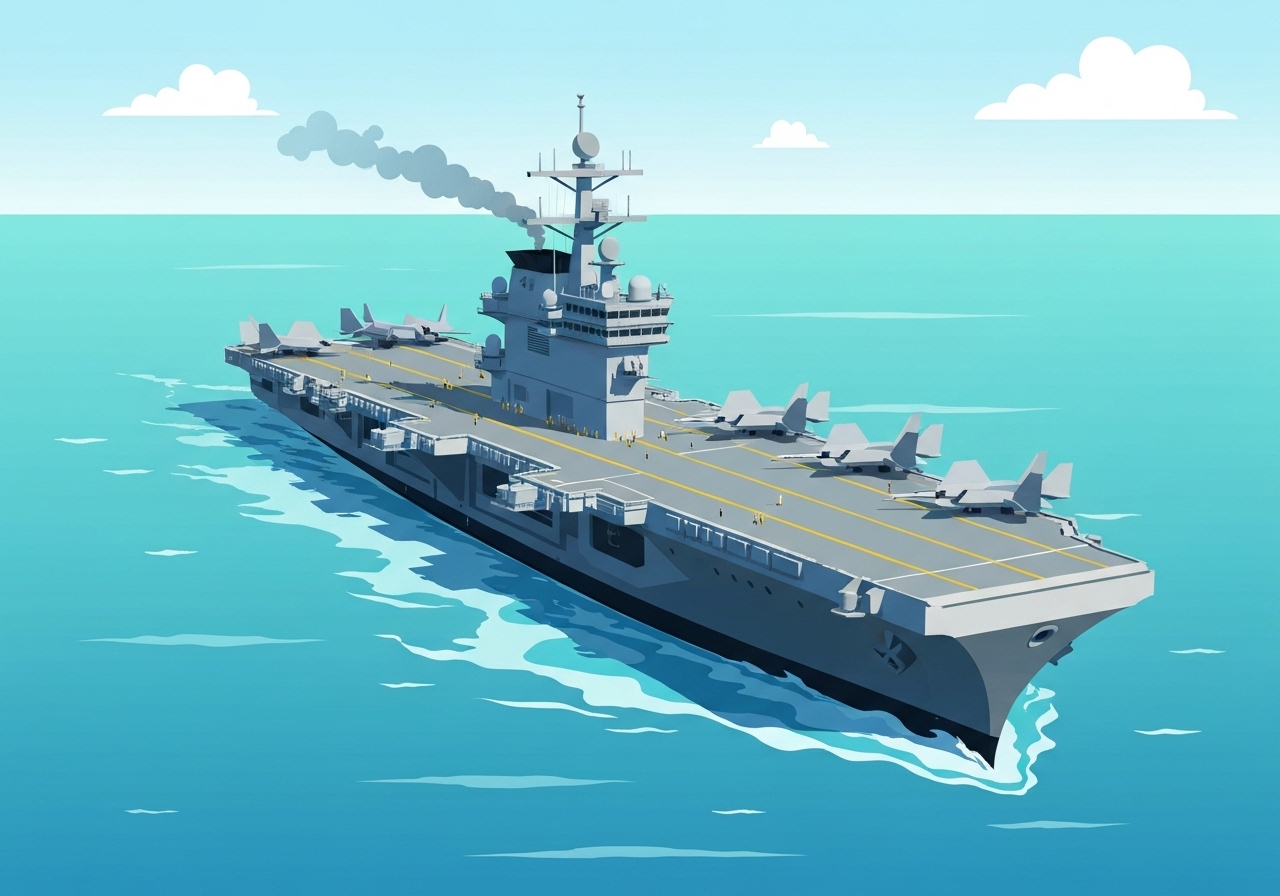
Over the weekend the USS Gerald R. Ford Carrier Strike Group entered the Caribbean Sea to support Operation Southern Spear, U.S. Southern Command said. The carrier arrived with roughly 4,000 sailors and “dozens” of aircraft aboard its flight deck. The deployment coincides with stepped-up U.S. pressure on Venezuelan leader Nicolás Maduro, who faces U.S. criminal charges dating to 2020 and a reported $50 million reward announced in August. U.S. officials describe the movement as part of a counternarcotics and regional-security effort.
Key Takeaways
- The USS Gerald R. Ford Carrier Strike Group has transited into the Caribbean and is operating in support of Operation Southern Spear, U.S. Southern Command announced.
- Approximately 4,000 sailors are embarked on the Ford, along with “dozens” of aircraft and nine carrier airwing squadrons as part of the strike group.
- The strike group is accompanied by two Arleigh Burke-class guided-missile destroyers and an integrated air and missile defense command ship.
- U.S. forces in the region now include nearly a dozen Navy ships and about 12,000 sailors and Marines, according to The Associated Press.
- The Ford was keel-laid in 2009, commissioned in 2017 and made its first combat deployment in 2023; the ship’s construction costs have topped $13 billion, per Navy figures.
- Ford-class carriers introduce 23 key technologies, including an electromagnetic aircraft launch system, and are designed for roughly 20% fewer crew than Nimitz-class ships.
- Legal and diplomatic questions have been raised after U.S. strikes on boats near Venezuela and about the broader escalation of U.S. military presence in the area.
Background
The Gerald R. Ford is the lead ship of a new class intended to succeed the Nimitz-class carriers. Her keel was laid in 2009 and she was commissioned in 2017; the platform incorporates dozens of technological changes the Navy calls improvements for the next generation of carrier operations. The ship did not embark on a full combat deployment until 2023, when it initially deployed for NATO exercises and was later redirected to the Mediterranean after the outbreak of war between Hamas and Israel.
The current deployment to the Caribbean sits against a stretched diplomatic backdrop between the United States and Venezuela. U.S. prosecutors charged Venezuelan President Nicolás Maduro in 2020 with narco-terrorism and related crimes, and the U.S. raised the reward for information leading to his arrest or conviction to $50 million in August. The Biden administration’s predecessors and contemporaries have alternated diplomatic pressure, sanctions, and occasional military signaling in the region, while U.S. officials point to illicit drug flows as a primary justification for stepped-up operations.
Main Event
U.S. Southern Command announced the Ford Carrier Strike Group had entered the Caribbean as part of Operation Southern Spear. Defense officials describe the operation as focused on disrupting narcotics trafficking and targeting so-called “narco-terrorists.” The Ford itself carries about 4,000 sailors and dozens of aircraft; the full strike group includes nine carrier airwing squadrons, two Arleigh Burke-class destroyers and an integrated air and missile defense command ship.
The carrier’s arrival complements other U.S. assets already in the region, notably the Iwo Jima Amphibious Ready Group and an embarked Marine Expeditionary Unit, bringing total regional U.S. forces to roughly 12,000 personnel across nearly a dozen ships, according to reporting by The Associated Press. U.S. defense leaders framed the buildup as a counternarcotics and homeland-protection mission. Officials have not released a detailed timeline of planned operations or specific targets tied to the carrier’s presence.
The deployment also follows a period of U.S. strikes on boats near Venezuela that U.S. authorities say were involved in drug smuggling; U.S. officials have not publicly released full evidence supporting those takedowns, and lawmakers and legal experts have questioned their legality under domestic and international law. At the same time, public messaging from the White House and senior officials has been deliberately general about next steps in Venezuela, leaving analysts to assess whether the carrier’s presence is coercive signaling, a deterrent posture, or preparation for direct action.
Domestically, the movement of the Ford is tied to a broader policy posture: senior U.S. figures have repeatedly emphasized drug interdiction and homeland security while also keeping open diplomatic and multilateral options. The carrier’s arrival therefore serves both operational and political purposes—projecting capability at sea while shaping the conversation in Washington and in capitals across the hemisphere.
Analysis & Implications
Operationally, the Ford adds a significant aviation and sensor capability to the U.S. inventory in the Caribbean, enabling sustained air operations and maritime surveillance over wide areas. With nine carrier airwing squadrons embarked, the strike group can conduct a mix of air superiority, surveillance, and strike missions; its escorts provide layered air and missile defense. For counternarcotics missions, aircraft and carrier-based sensors extend patrol range and interdiction options beyond traditional surface craft.
Politically, the deployment raises the stakes in an already tense U.S.–Venezuela relationship. The U.S. has labeled some Venezuelan actors as criminals tied to transnational organized crime, while Caracas sees expanded U.S. military presence as coercive. Nearby countries in the Caribbean and Latin America are watching closely; some may welcome increased enforcement against drug flows, while others worry about escalation and risks to regional stability.
There are legal and diplomatic risks tied to the recent use of force at sea near Venezuela and to any further actions that could be perceived as infringing on sovereignty. U.S. lawmakers and international lawyers have questioned the legality of strikes on vessels absent clear authorization or evidence. If the administration pursues kinetic operations beyond interdiction—especially against targets on or near Venezuelan territory—those moves would likely trigger intense scrutiny in domestic and international fora.
Comparison & Data
| Item | USS Gerald R. Ford | Nimitz-class (typical) |
|---|---|---|
| Approx. construction cost | $13+ billion | ~half of Ford-class (per analysis) |
| Crew size | ~20% fewer than Nimitz-class (designed) | Standard Nimitz-class crew size |
| Keel laid / Commissioned | Keel 2009 / Commissioned 2017 | First Nimitz launched 1972 |
| Next Ford-class delivery | USS John F. Kennedy delayed to early 2027 | — |
The Ford represents a major capital investment with novel technologies such as the electromagnetic aircraft launch system (EMALS) and expected reductions in crew requirements. Critics point to cost overruns and delays: the Ford’s price and the postponed delivery of the next Ford-class carrier, the USS John F. Kennedy, have drawn scrutiny about trade-offs between new capability and affordability.
Reactions & Quotes
Defense leadership framed the mission publicly in counternarcotics and homeland-defense language; media and analysts offered a mix of operational explanation and legal caution.
“This mission is to eliminate ‘narco‑terrorists’ and secure our Homeland from the drugs that are killing our people,”
Defense Secretary Pete Hegseth (public statement)
Hegseth’s remarks were presented as the stated purpose for Operation Southern Spear; officials cast the carrier presence as part of a broader interdiction campaign aimed at drug trafficking networks.
“I’ve sort of made up my mind,”
Former President Donald J. Trump (public remark)
That comment signaled that administration deliberations on Venezuela were ongoing; officials have otherwise offered limited public detail about operational objectives beyond counternarcotics.
“So in retrospect, that extra investment was probably not worth it,”
Bryan Clark, Hudson Institute (defense analyst)
Clark’s assessment reflects criticism from some defense analysts that the Ford’s cost and technical challenges have not clearly matched operational returns compared with the older Nimitz-class carriers.
Unconfirmed
- The specific targets, timelines, and rules of engagement for carrier-based operations in the Caribbean have not been publicly disclosed by U.S. authorities.
- U.S. claims that recent strikes on vessels near Venezuela were tied to specific smuggling operations have not been fully substantiated with public evidence as of this writing.
- Any direct U.S. plans to change the status of Venezuelan leadership or to conduct strikes on Venezuelan territory remain unannounced and speculative.
Bottom Line
The arrival of the USS Gerald R. Ford in the Caribbean is a clear demonstration of U.S. maritime capability and an intensification of operations framed by Washington as counternarcotics and homeland defense. The carrier brings substantial air, sensor and command resources to the theater, and its presence magnifies U.S. options for surveillance and interdiction across a broad maritime area.
At the same time, costs, technical complexity and legal questions shadow the deployment. Observers should watch for clarifying announcements about the strike group’s missions, any evidence tied to recent maritime strikes, and diplomatic signals from governments across Latin America—each will shape whether this deployment de‑escalates illicit flows or deepens regional tensions.