
Lead
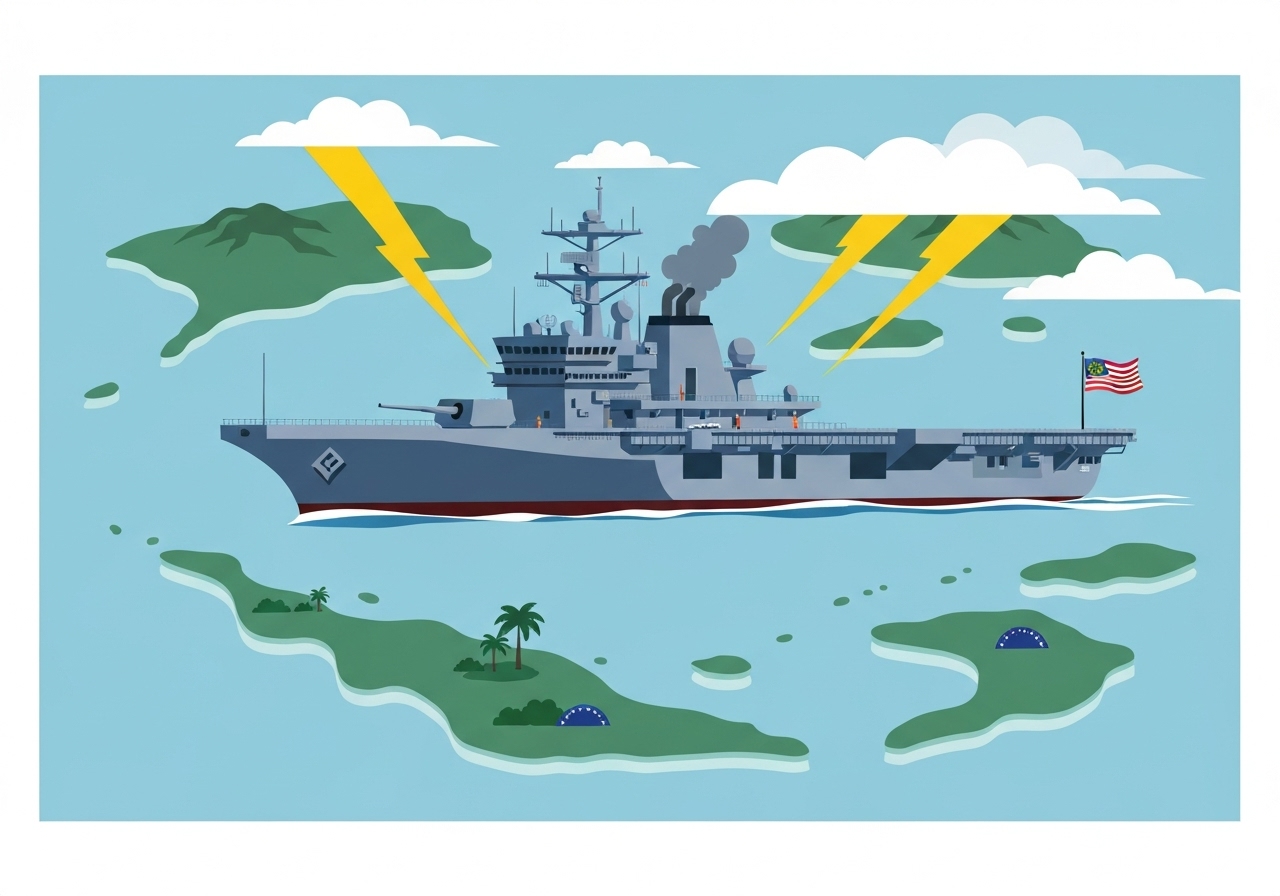
On November 16, 2025, the U.S. Navy said the aircraft carrier USS Gerald R. Ford entered the Caribbean Sea, joining the largest concentration of U.S. naval firepower in the region in generations. The administration frames the deployment as part of a counterdrug campaign, while critics view it as pressure on Venezuelan President Nicolás Maduro. Over the past two months U.S. forces say they have struck at least 22 vessels linked to drug trafficking, killing at least 83 people. The carrier’s arrival coincides with high-level White House deliberations about possible operations in Venezuela and Venezuela’s announcement of a large domestic military exercise.
Key Takeaways
- The USS Gerald R. Ford crossed into the Caribbean Sea on November 16, 2025, as part of a larger carrier strike group deployment.
- U.S. officials label the movement Operation Southern Spear and say the carrier strike group includes fighter squadrons and guided-missile destroyers.
- In the previous two months the U.S. military says it struck at least 22 vessels accused of ferrying drugs, with at least 83 people killed in those strikes.
- Venezuela announced a nationwide military exercise reportedly involving about 200,000 personnel in response to rising regional tensions.
- Senior U.S. leaders — including Vice President J.D. Vance, Defense Secretary Pete Hegseth, Joint Chiefs Chair Dan Caine and Secretary of State Marco Rubio — discussed options at the White House in mid-November 2025.
- President Trump has publicly signaled he has “made up his mind” about next steps in Venezuela but has not disclosed operational details.
- Regional leaders, the U.N. human rights office and some lawmakers have demanded more evidence and legal justification for U.S. strikes on maritime targets.
Background
The Gerald R. Ford is the U.S. Navy’s newest and most capable carrier, displacing roughly 100,000 tons and serving as the centerpiece of a modern carrier strike group. The Trump administration has characterized recent naval and air operations in the Caribbean as counterdrug initiatives, linking Venezuelan authorities and armed criminal groups to transnational smuggling networks. Venezuelan President Nicolás Maduro has denied those allegations, and many regional governments have voiced concern about escalation.
Over the last two months U.S. forces report having struck dozens of small vessels they say were moving narcotics toward the United States; authorities state those actions killed at least 83 people. U.S. Southern Command, which oversees operations in the Caribbean and South America, has framed the activity as protecting the Western Hemisphere from transnational threats. Critics contend the administration has not publicly provided the evidence underlying its characterization of the struck vessels or of Maduro’s alleged complicity.
Main Event
The Navy said the Gerald R. Ford’s carrier strike group transited the Anegada Passage near the British Virgin Islands on the morning of November 16, 2025, joining other U.S. warships already operating in the region. Rear Adm. Paul Lanzilotta, who leads the strike group, said the formation will augment an already sizable American presence intended to disrupt purported narco-trafficking networks and protect U.S. security interests.
Adm. Alvin Holsey, commander of U.S. Southern Command, framed the deployment as a demonstration of resolve. “Through unwavering commitment and the precise use of our forces, we stand ready to combat the transnational threats that seek to destabilize our region,” he said in a statement announcing the carrier’s arrival. U.S. officials have identified the deployment as part of Operation Southern Spear, a coordination of naval and air assets in the Caribbean.
President Trump has publicly suggested he has decided on next steps for Venezuela yet withheld operational specifics. Senior administration and military officials held repeated meetings at the White House in mid-November 2025 to consider potential options, including the possibility of strikes on land targets, according to sources familiar with the discussions. The administration has also said it authorized covert intelligence activities in Venezuela.
In Caracas, the government of Nicolás Maduro announced a sweeping military exercise beginning in mid-November that officials said would involve roughly 200,000 personnel. Venezuelan authorities and many domestic observers interpret the U.S. buildup as an effort to increase pressure on Maduro’s government and possibly hasten political change.
Analysis & Implications
The deployment of a 100,000-ton nuclear-powered carrier and its strike group marks a significant escalation in U.S. military posture in Latin America. Symbolically, the presence signals Washington’s willingness to bring high-end military assets closer to Venezuelan waters, which may alter regional threat perceptions and diplomatic calculations. For Caracas, the move provides a rallying point to justify large-scale domestic military exercises and to solicit international support.
Operationally, a carrier strike group expands options for surveillance, strike and logistical reach, but it also raises complex legal and political questions. U.S. officials justify recent maritime strikes under a counterdrug rationale and portray them as defensive measures against organized crime; however, critics insist on seeing evidence and legal bases, particularly if strikes shift from maritime interdiction to land-based operations inside another sovereign state.
Regionally, allied and nonaligned governments in Latin America are likely to reassess security and diplomatic stances. Some nations may endorse U.S. actions targeting traffickers, while others could view the carrier’s arrival as coercive. The presence of a carrier also heightens the risk of miscalculation at sea or in contested airspace, increasing the imperative for clear communication channels between militaries.
Comparison & Data
| Metric | Recent U.S. Claims |
|---|---|
| Vessels struck (past two months) | At least 22 |
| Deaths reported from strikes | At least 83 |
| Carrier displacement | ~100,000 tons |
| Venezuelan exercise reported size | ~200,000 personnel |
The table summarizes figures cited by U.S. and Venezuelan officials: the U.S. describes a maritime interdiction campaign that has targeted at least 22 vessels and resulted in at least 83 deaths, while Venezuela has announced a domestic exercise of roughly 200,000 forces. These numbers frame the scale of military activity but leave open questions about attribution, rules of engagement and verification mechanisms.
Reactions & Quotes
U.S. military leadership emphasized the mission’s defensive framing and regional security goals.
“The USS Gerald R. Ford Carrier Strike Group’s deployment represents a critical step in reinforcing our resolve to protect the security of the Western Hemisphere and the safety of the American Homeland.”
Adm. Alvin Holsey, U.S. Southern Command (official statement)
An independent analyst warned of regional anxiety and the symbolic weight of a carrier’s return to the area.
“This is the anchor of what it means to have U.S. military power once again in Latin America. It has raised a lot of anxieties in Venezuela and throughout the region.”
Elizabeth Dickinson, International Crisis Group (analyst)
President Trump has publicly signaled decision-making on Venezuela while withholding operational details.
“I sort of have made up my mind,”
President Donald J. Trump (interview excerpt)
Unconfirmed
- Whether the vessels struck were all directly tied to Venezuelan state actors remains unverified by publicly released evidence.
- Reports that U.S. strikes have targeted organized-terror groups operating the boats lack publicly disclosed intelligence corroborating that classification.
- Specific plans for potential U.S. strikes on land inside Venezuela have been discussed at the White House but no official operational orders have been confirmed.
Bottom Line
The arrival of the USS Gerald R. Ford in the Caribbean on November 16, 2025, both strengthens U.S. maritime capability in the region and escalates the political stakes surrounding Venezuela. U.S. officials present the deployment as part of a concerted counterdrug posture; critics and regional actors see it as increased pressure on President Nicolás Maduro. Key unresolved issues include public evidence for recent maritime strikes, the legal framework for future operations and how regional governments will respond diplomatically and militarily.
In the coming days, the situation will hinge on whether Washington publicly substantiates its counterdrug claims, whether Caracas escalates further, and whether regional and international institutions press for clarity or de-escalation. For observers and policymakers, the central questions are evidence, legal justification and measured avenues to reduce the risk of armed confrontation while addressing transnational criminal networks.
Sources
- CBS News (U.S. news organization, article and reporting)
- The Associated Press (news agency, photo and regional context)