
Lead
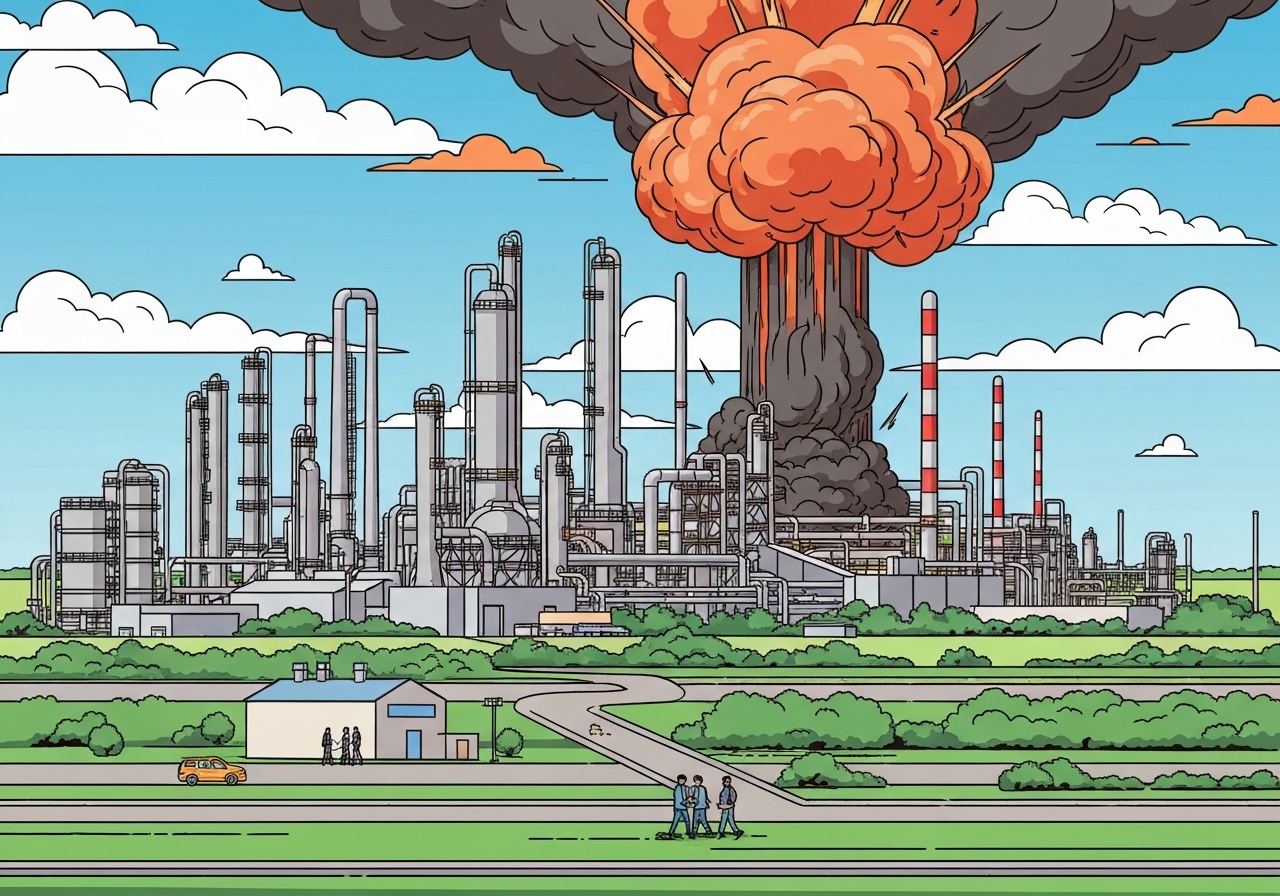
On Monday a powerful explosion rocked the Valero oil refinery in Port Arthur, Texas, sending a large plume of smoke into the sky and triggering shelter-in-place orders for nearby neighborhoods. Officials said there were no reported injuries and firefighters were on scene attempting to extinguish the blaze. City authorities told residents on parts of the west side to remain indoors while state environmental teams deployed air monitoring equipment. The incident occurred as global oil-market uncertainty tied to the Iran war has already pushed fuel prices higher.
Key Takeaways
- The blast occurred at Valero’s Port Arthur refinery on Monday; no injuries were reported by local officials.
- Port Arthur is about 90 miles (145 kilometers) east of Houston and the plant employs roughly 770 people.
- Valero’s Port Arthur refinery can process about 435,000 barrels per day and refines heavy sour crude into gasoline, diesel and jet fuel.
- City officials issued shelter-in-place guidance for parts of the west side and advised residents to wait for an official “All Clear.”
- The Texas Commission on Environmental Quality (TCEQ) arrived with air monitoring equipment and is coordinating with local and state partners.
- Local reports and social media showed large smoke plumes and residents described loud explosions and shaking windows.
- The event arrives amid a recent spike in gasoline prices linked to uncertainty over global oil supplies because of the Iran war.
Background
Valero’s Port Arthur complex is one of the larger refining sites on the Gulf Coast and plays a significant role in converting heavy sour crude into consumer fuels. The plant’s stated capacity of 435,000 barrels per day and a workforce of about 770 make it a substantial regional employer and supply source for refined products. Coastal Texas hosts a dense cluster of refining and petrochemical facilities that together supply a large share of U.S. gasoline, diesel and jet fuel; outages in the region can ripple through supply chains. In recent months, market attention on the Middle East — notably the Iran war — has amplified price sensitivity to disruptions at major refineries.
Refinery incidents range from small equipment failures to larger unit damage; regulators and emergency responders typically focus on immediate containment, air-quality monitoring and public safety notifications. Municipal emergency-management teams coordinate shelter-in-place orders when plumes, smoke or potential releases might affect neighborhoods. At the same time, companies and state regulators conduct rapid assessments to identify causes and isolate impacted process units, while communicating potential impacts to the public and markets.
Main Event
Shortly after the explosion, images and video posted online showed thick black smoke and visible flames rising from the refinery complex. City of Port Arthur officials posted a public safety message asking residents in affected zones to remain inside until emergency personnel issued an all-clear. Mayor Charlotte M. Moses confirmed to local officials that responders had arrived and that, at the time of her statement, everyone was reported safe.
Residents reported hearing a loud boom and feeling windows rattle; those accounts were consistent across multiple social posts and eyewitness reports. Firefighting crews and local emergency teams focused on suppressing the fire and securing the scene, while the Texas Commission on Environmental Quality deployed air monitoring equipment to sample for pollutants and protect public health. Valero did not immediately respond to media requests for comment seeking technical details about the cause or the status of processing units.
The shelter-in-place guidance specifically covered portions of the city’s west side, and officials emphasized keeping doors and windows closed and avoiding outdoor activity. Emergency personnel said the timeline for an all-clear would depend on fire containment and air-monitoring results. State and local agencies said they would provide updates as conditions changed and as more technical information about the unit involved became available.
Analysis & Implications
An incident at a refinery with 435,000 bpd capacity can have both immediate local consequences and broader market implications, depending on the extent and duration of damage. Short outages can tighten regional fuel availability temporarily, contributing to price volatility—a concern made more acute while oil-market uncertainties tied to the Iran war remain elevated. If processing units are taken offline for repairs, distribution and blending hubs may need to reallocate supplies from other plants, potentially raising logistics costs and delivery times.
Public-health and environmental impacts hinge on the materials released and the duration of airborne emissions; smoke plumes from heavy-crude processing can carry particulate matter and combustion byproducts that pose short-term respiratory risks. Rapid deployment of TCEQ air monitors is a standard mitigation step to determine whether concentrations exceed safety thresholds and to guide public advisories. Data from those monitors will shape next steps for cleanup, community notifications, and potential regulatory follow-up.
Regulators and the company will also face questions about maintenance, safety protocols and inspection records if the event proves to stem from equipment failure or human error. For local economies, prolonged downtime could affect jobs indirectly through reduced feedstock movement and temporary cutbacks in supporting services. For national markets, the loss of a single refinery unit is often absorbed, but a longer outage at a complex of this size would be more consequential.
Comparison & Data
| Site | Employees | Processing Capacity (barrels/day) |
|---|---|---|
| Valero — Port Arthur | ≈770 | ≈435,000 |
The table above summarizes the publicly reported staffing and throughput figures for the Port Arthur refinery; those numbers are consistent with company statements on capacity and employment. A refinery with roughly 435,000 bpd ranks among larger U.S. facilities by single-site throughput, underscoring why incidents there draw rapid regulatory and market attention. Quantifying the outage’s market impact depends on how many processing units are affected, repair timelines and seasonal fuel demand patterns.
Reactions & Quotes
Local officials prioritized immediate safety messaging and coordination with state environmental teams. Their public comments focused on resident protection, response activities and the need for monitoring.
“There’s been an explosion, yes, but we’re OK; everybody’s OK. They’re trying to put the fire out as quickly as possible.”
Charlotte M. Moses, Mayor of Port Arthur
The mayor’s comment was delivered to reassure residents that emergency services were engaged and that, as of her statement, there were no reported injuries. City social channels complemented that statement with specific shelter-in-place instructions for affected neighborhoods.
“For your safety please remain in place until the ‘All Clear’ is given by emergency personnel.”
City of Port Arthur (public advisory)
The city advisory spelled out immediate protective actions—staying indoors and awaiting official clearance—which is a common public-safety measure during industrial fires with uncertain emissions. Officials indicated updates would follow pending air-monitoring results.
“Please limit outdoor activity, keep windows and doors closed, and follow guidance from local officials.”
Texas State Rep. Christian Manuel
State representatives and environmental agencies emphasized monitoring and coordination; TCEQ teams on scene were cited as taking air samples to inform any additional public-health guidance. Those samples will determine whether further protective steps are necessary.
Unconfirmed
- The exact root cause of the explosion has not been publicly confirmed; investigations are ongoing and company statements are pending.
- The scope of damage to specific processing units and the expected repair timeline remain unclear at this stage.
- Any long-term impact on regional fuel supply and precise contribution to price changes has not been verified and depends on repair duration and operational adjustments elsewhere.
Bottom Line
The Port Arthur explosion prompted swift local shelter-in-place orders and deployment of state air-monitoring teams; crucially, officials reported no injuries. Immediate public-safety priorities are containing the fire, protecting residents from smoke exposure and gathering air-quality data to guide further steps.
For markets and supply chains, the short-term impact will depend on how extensive the operational disruptions are and how quickly Valero and regulators can assess and repair affected units. While a single-site incident of this size is significant, broader price effects will hinge on outage duration amid an already sensitive market influenced by geopolitical tensions.
Sources
- NBC News — (news report)
- City of Port Arthur Facebook page — (official municipal advisory)
- Texas Commission on Environmental Quality (TCEQ) — (state environmental regulator)
- Valero Energy Corporation — (company website with refinery data)