
Lead
Former Venezuelan President Nicolás Maduro was captured by U.S. forces over the weekend and is currently in U.S. custody after a federal court appearance in Manhattan, while senior Trump administration officials briefed congressional leaders on Monday. The operation, which U.S. officials say involved roughly 200 American personnel and strikes to neutralize air defenses, has prompted regional alarm and mixed reactions in Washington. Delcy Rodríguez has been sworn in as acting president in Caracas, raising immediate questions about governance, legal authority and diplomatic repercussions. Lawmakers were invited to a classified Senate briefing on Wednesday as the administration outlines its next steps for Venezuela.
Key Takeaways
- Maduro detained: Nicolás Maduro and his wife were flown from a Brooklyn federal jail to Manhattan and pleaded not guilty in a court appearance; U.S. prosecutors have lodged charges against him.
- Operation scale: Defense officials described an overnight raid involving about 200 U.S. personnel, fighter-jet and bomber strikes on air defenses, and close-quarters action by special operations forces.
- Congressional briefings: Top Trump administration officials—including Secretary of State Marco Rubio and Defense Secretary Pete Hegseth—briefed select congressional leaders Monday; a full Senate briefing is scheduled Wednesday at 10 a.m. in a SCIF.
- Regional fallout: Colombia summoned a U.S. diplomat over perceived threats from President Trump; Mexico called for a fair trial; China, Russia, Iran and Cuba condemned the U.S. action as a sovereignty violation.
- Domestic politics split: Democrats criticized the plan as vague and potentially illegal without Congress’ approval; Republicans defended the action as decisive and limited in scope.
- Energy implications: Major oil firms (Chevron, ConocoPhillips, ExxonMobil) are set to meet the administration, which is pressing companies to consider re-entry into Venezuela’s oil sector and discussing possible reimbursement mechanisms.
- Leadership contest: In Caracas, Vice President Delcy Rodríguez has assumed acting presidency, while opposition figure María Corina Machado seeks to return and has urged the release of political prisoners.
Background
Tensions between Washington and Caracas have been escalating for years over allegations of corruption, repression and narcotics trafficking tied to Venezuelan leadership. The Trump administration framed prior actions as pressure campaigns—sanctions and diplomatic isolation—aimed at weakening Nicolás Maduro’s hold on power. Those measures intensified after disputed elections and a deepening humanitarian crisis, producing a prolonged standoff with allied states such as Russia, China, Iran and Cuba that maintained political and commercial ties with Maduro’s government.
Ahead of the raid, U.S. officials publicly linked Venezuela to transnational narcotics flows and cited national-security concerns; privately, administration aides signaled a willingness to use military options. The capture marks a rare kinetic intervention in Latin America by U.S. forces and follows an administration posture the Eurasia Group and some analysts have labeled risk-prone, warning of policy overreach and unintended consequences. Within Venezuela, institutional decay and factionalism have produced competing centers of authority, setting the stage for a high-stakes contest over who can claim legitimacy after Maduro’s removal.
Main Event
According to U.S. accounts, special operations teams conducted a nighttime raid on Maduro’s Caracas residence. Defense Secretary Pete Hegseth described a complex mission in which air assets suppressed air defenses and commandos moved in by helicopter; U.S. officials said Maduro’s household did not receive prior warning. Reports indicate heavy small-arms fire during the insertion and at least one helicopter sustained damage but returned with personnel aboard.
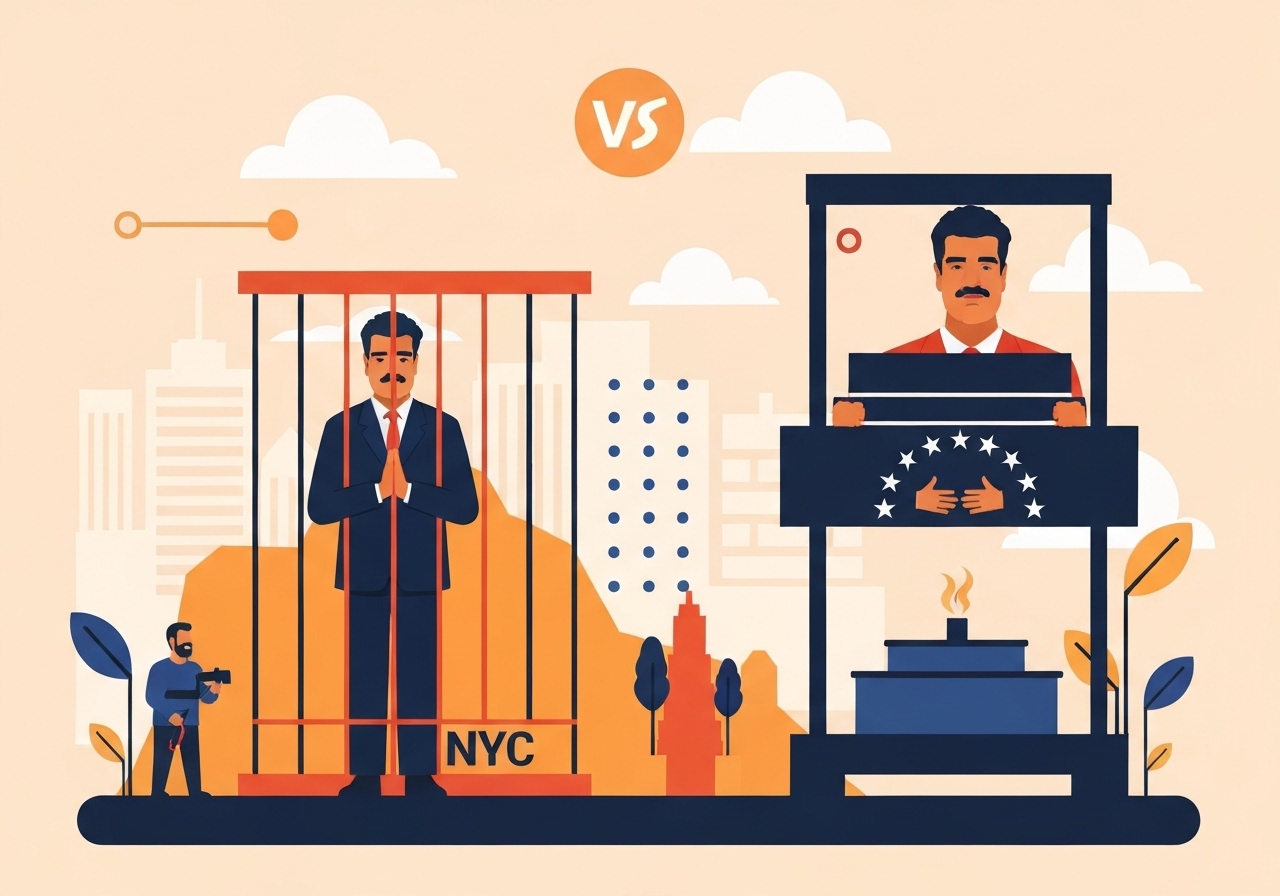
Maduro and his wife, Cilia Flores, were transferred to the United States and held at a federal facility in Brooklyn before a Manhattan court appearance. Under heavy guard, Maduro entered the courthouse shackled and wearing a prison uniform. He told the judge—through a translator—that he remained the legitimate president of Venezuela and pleaded not guilty; U.S. District Judge Alvin K. Hellerstein conducted routine identity and rights advisories.
In Caracas, Delcy Rodríguez—Maduro’s handpicked vice president and long-time regime loyalist—was sworn in as acting president and has attempted to balance denunciations of the capture as a kidnapping with calls for a working relationship in areas such as security. Opposition leader María Corina Machado, recently awarded the Nobel Peace Prize, has hailed the capture and signaled plans to return to Venezuela, though she remains outside the country and not installed in power.
Analysis & Implications
Legal and diplomatic ramifications are immediate. The United Nations rights office warned the operation risked undermining international law’s prohibition on the use of force against another state’s territorial integrity; the U.N. secretary-general expressed deep concern about whether established rules were respected. Such criticisms come from major powers that have economic and military links to Caracas, amplifying the risk of diplomatic rupture and retaliatory measures in multilateral forums.
Regionally, governments are recalibrating. Colombia—already sensitive to spillover from Venezuela—protested remarks from President Trump that were interpreted as threatening; Mexico pressed for due process. If the U.S. pursues stronger economic leverage (notably oil export controls) or broader political management of transition, neighbors may see a destabilizing precedent that could fuel migration, cross-border crime, and economic dislocation.
Domestically, the episode sharpens a constitutional debate over the executive’s authority to order foreign military actions without explicit congressional authorization. Several Democrats have signaled intent to seek votes to block further military steps, while many Republicans argue the mission was limited and lawful. The partisan split complicates a clear legislative path and increases uncertainty about sustained U.S. involvement.
Comparison & Data
| When | Event |
|---|---|
| Weekend prior to Monday | U.S. operation results in Maduro’s capture and transfer to U.S. custody |
| Monday | Senior officials brief congressional leaders; Maduro appears in Manhattan court |
| Wednesday 10:00 a.m. | Full Senate briefing scheduled in SCIF |
The table above places the core timeline in context: a rapid operational phase followed by near-immediate diplomatic and legislative engagement. That cadence—action, judicial processing, then congressional briefings—frames how U.S. policy will be scrutinized domestically and abroad over the coming days.
Reactions & Quotes
White House and congressional responses diverged sharply. Supporters framed the operation as a necessary, targeted action against a criminal regime; critics warned of unclear objectives and legal risks. International bodies and regional governments urged restraint and adherence to legal norms.
“The United States proved once again that we have the most powerful, most lethal, most sophisticated… military on planet Earth.”
President Donald J. Trump (remarks to House Republican retreat)
The president publicly celebrated the operation’s military success, stressing U.S. lethality and deterrence—remarks that underscore a posture of strength but risk inflaming international partners.
“States must not threaten or use force against the territorial integrity or political independence of any state.”
Ravina Shamdasani, U.N. rights office (Geneva briefing)
The U.N. rights office flagged possible breaches of international law and warned of broader implications for global norms on the use of force, a point likely to inform legal scrutiny and diplomatic replies from Russia, China and other allies of Caracas.
“Now that President Maduro has been detained, what we are asking for is a fair trial, as always.”
Mexican President Claudia Sheinbaum (press briefing)
Regional leaders emphasized due process even while condemning external intervention, seeking to preserve diplomatic channels and avoid further escalation.
Unconfirmed
- Extent of U.S. civilian administration in Venezuela: the degree and duration of any U.S. role in running Venezuelan institutions remain undefined and publicly unconfirmed.
- Oil-company reimbursement guarantees: reports that the U.S. would reimburse firms for Venezuelan investment lack formal, public documentation of mechanisms or commitments.
- Threats to Colombia: while President Trump made provocative remarks, formal plans for military action against Colombia have not been confirmed by the U.S. government.
- Exact casualty and damage figures from the raid: the administration provided operational details, but independent verification of casualties or infrastructure damage has not been released.
Bottom Line
The capture of Nicolás Maduro by U.S. forces and his transfer to New York mark a dramatic escalation in Western Hemisphere security policy, with immediate legal, diplomatic and regional consequences. The U.S. is now balancing operational success against questions about international law, congressional authority, and the practicalities of political transition in Caracas.
Over the coming days, three dynamics will shape outcomes: concerted congressional scrutiny and potential votes, diplomatic pushback from states allied with Venezuela, and the practical contest in Caracas between Delcy Rodríguez’s interim authority and opposition figures like María Corina Machado. Observers should expect intense negotiations over oil, sanctions, and legal process that will determine whether the episode stabilizes Venezuela or deepens regional instability.
Sources
- CBS News — live coverage and reporting (media)
- Reuters — reporting on U.N. statements and international reactions (media)
- United Nations — Office of the High Commissioner for Human Rights statements (official)
- Center for Strategic and International Studies — analysis of great-power implications (think tank)