
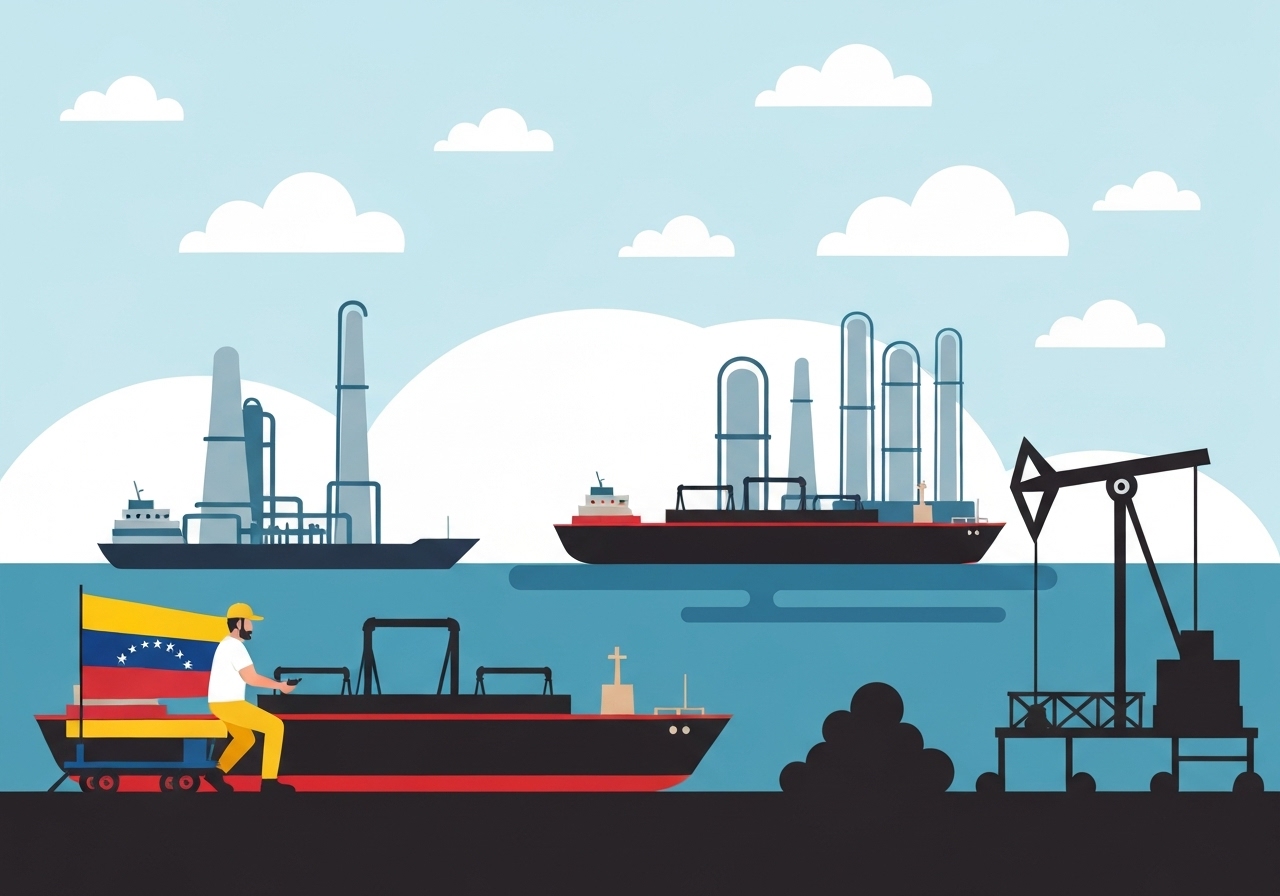
On Jan. 3, 2026, analysts told CNBC that President Donald Trump’s removal of Nicolás Maduro in Venezuela is unlikely to cause an immediate shock to global energy markets. The action took place against the backdrop of Venezuela’s long-standing production decline and a world oil market currently marked by oversupply and weak demand. Market participants had already priced in the possibility of disruptions to Venezuelan exports, limiting the immediate price response. Analysts forecast only modest near-term moves in Brent futures when trading reopens.
Key takeaways
- Venezuela holds the world’s largest proven oil reserves but produced under 1 million barrels per day in 2025, representing less than 1% of global output, according to analysts.
- About 500,000 barrels per day of that production were exported before the regime change, roughly half of the country’s output.
- Global benchmark Brent closed at $60.75 on Friday; short-term analyst estimates put any opening futures bump at roughly $1–$2 or less.
- Brent and U.S. crude logged steep annual declines in 2025—about 19% and nearly 20% respectively—reflecting a soft demand environment.
- U.S. oil production stood at just over 13.8 million barrels per day, adding to global supply resilience.
- Some analysts assess roughly one-third of Venezuela’s output was at risk immediately after the intervention, though a full cut-off was not expected to meaningfully disrupt markets in the short term.
- In the medium term, if sanctions were lifted and foreign investment returned, exports could rise materially; one estimate put potential exports near 3 million barrels per day under favorable conditions.
Background
Venezuela is a founding OPEC member and sits atop the largest estimated proven crude reserves globally, a fact that has drawn repeated foreign investment interest despite chronic underinvestment and operational decline. Decades of political turmoil, nationalizations in the early 2000s and subsequent sanctions have reduced production capacity and degraded refinery and export infrastructure, leaving output far below the country’s geological potential.
By 2025 the country was producing less than 1 million barrels per day, a steep fall from historic levels when foreign firms operated extensive upstream projects. At the same time, OPEC+ returned to a looser production stance after multi-year cuts, and the U.S. increased output to record levels, leaving global markets more supplied and less sensitive to a single-country shock. Those structural supply and demand dynamics shaped traders’ expectations ahead of the overthrow.
Main event
The U.S. action to remove President Maduro unfolded amid limited market surprise because traders had already modeled disruption scenarios. Analysts said the immediate operational impact focused on export flows and refinery operations at facilities such as El Palito near Puerto Cabello, which had been photographed on Dec. 21, 2025 in visible decline.
Arne Lohmann Rasmussen of A/S Global Risk Management told CNBC that markets had discounted a Venezuelan conflict ahead of weekend trading and that the broader oversupply environment would blunt price spikes. He highlighted Venezuela’s current production level at under 1 million b/d and exports near 500,000 b/d as key reasons for muted market reaction.
Rapidan Energy’s Bob McNally advised clients that about a third of Venezuelan output was at risk, but he did not expect a complete cutoff to cause a sustained price crisis. Other analysts noted that immediate logistical disruptions could ripple locally but would likely be absorbed by global inventories and alternative flows in the near term.
President Trump said the U.S. embargo on Venezuelan oil remained in force at a Saturday press conference and announced plans for U.S. oil company investment to rebuild the energy sector, though he gave no operational or contractual details. Officials also referenced a temporary governance arrangement for the country’s operations without elaborating on mechanics.
Analysis & implications
Short-term market resilience reflects three principal factors: Venezuela’s low current output, elevated global inventories after 2025 supply growth, and robust production elsewhere—particularly in the U.S. Taken together, these limit how far prices can surge from a Venezuelan shock alone. Analysts therefore expect only small, transitory price moves when trading resumes.
Medium-term implications are more complex and hinge on political outcomes and sanctions policy. If an interim or successor government secures sanction relief and attracts foreign capital, Venezuela’s vast reserves could prompt a substantial supply expansion—but only after years and billions of dollars of investment to restore wells, pipelines and refineries.
Consultants and former officials caution that investor appetite will depend on legal certainty and contractual terms. Historical memory of past expropriations and outstanding creditor claims—companies still seek repayment from Venezuela and PDVSA—means many firms will demand clear guarantees before committing large sums.
Broader energy-policy shifts also matter. Some market participants had expected oil demand growth to plateau within a few years due to electric vehicle uptake and climate policies, reducing the need for new heavy investments. However, softer policy ambition and slower EV adoption in large markets have reopened debate about longer-term demand, making large resource plays like Venezuela potentially more attractive to investors over time.
Comparison & data
| Metric | Value |
|---|---|
| Venezuela production (2025) | <1,000,000 b/d |
| Venezuela exports (2025) | ~500,000 b/d |
| U.S. production (2025) | ~13.8 million b/d |
| Brent year change (2025) | ≈ -19% |
| U.S. crude year change (2025) | ≈ -20% |
The table shows why a Venezuelan supply hit is less disruptive today than in past decades: U.S. production and OPEC+ output increases in 2025 left the market with more spare capacity and higher inventories, reducing vulnerability to a single-country shock. Restoring Venezuela to multi-million-barrel export levels would require prolonged capital inflows and operational rehabilitation.
Reactions & quotes
Officials, analysts and industry figures offered measured commentary emphasizing uncertainty and longer-term opportunity rather than immediate market panic.
“There is still too much oil in the market, and that’s why oil prices will not go ballistic,”
Arne Lohmann Rasmussen, A/S Global Risk Management (chief analyst)
Rasmussen stressed market oversupply and the relatively small size of Venezuela’s current flows as limiting factors for sustained price spikes.
“Access to the world’s largest reserves would be tantalizing if sanctions lift, but transitions are hard and investment will depend on the terms,”
David Goldwyn, energy consultant, former State Department energy official
Goldwyn warned that legal, fiscal and political clarity are prerequisites for major upstream investment and noted the long lead times and capital intensity involved in restoring Venezuelan production.
Unconfirmed
- Which specific U.S. oil companies will commit to multi‑billion dollar investments in Venezuela remains unannounced and speculative.
- The timeline for any recovery to a potential 3 million b/d export level is uncertain and depends on sanction policy, contract terms and years of capital expenditure.
- Details on the proposed temporary U.S. arrangement to “run Venezuela with a group” were not provided and remain unclear.
Bottom line
In the near term, markets are likely to absorb the Venezuelan regime change without a severe price shock because current Venezuelan flows are small relative to global supply and inventories remain ample. Traders and analysts expect only modest, short‑lived moves in Brent when markets reopen.
Over the medium to long term, the story depends on politics and policy: sanction relief and credible investment frameworks could unlock Venezuela’s huge reserve base, adding significant supply—but only after years and large capital commitments. For now, markets will watch political signals and sanctions pathways rather than immediate barrels on tankers.
Sources
- CNBC (news report)
- U.S. Energy Information Administration (EIA) (official government energy statistics)
- OPEC (official organization data and statements)
- Rapidan Energy (industry analysis)
- Petróleos de Venezuela, S.A. (PDVSA) (state oil company)