
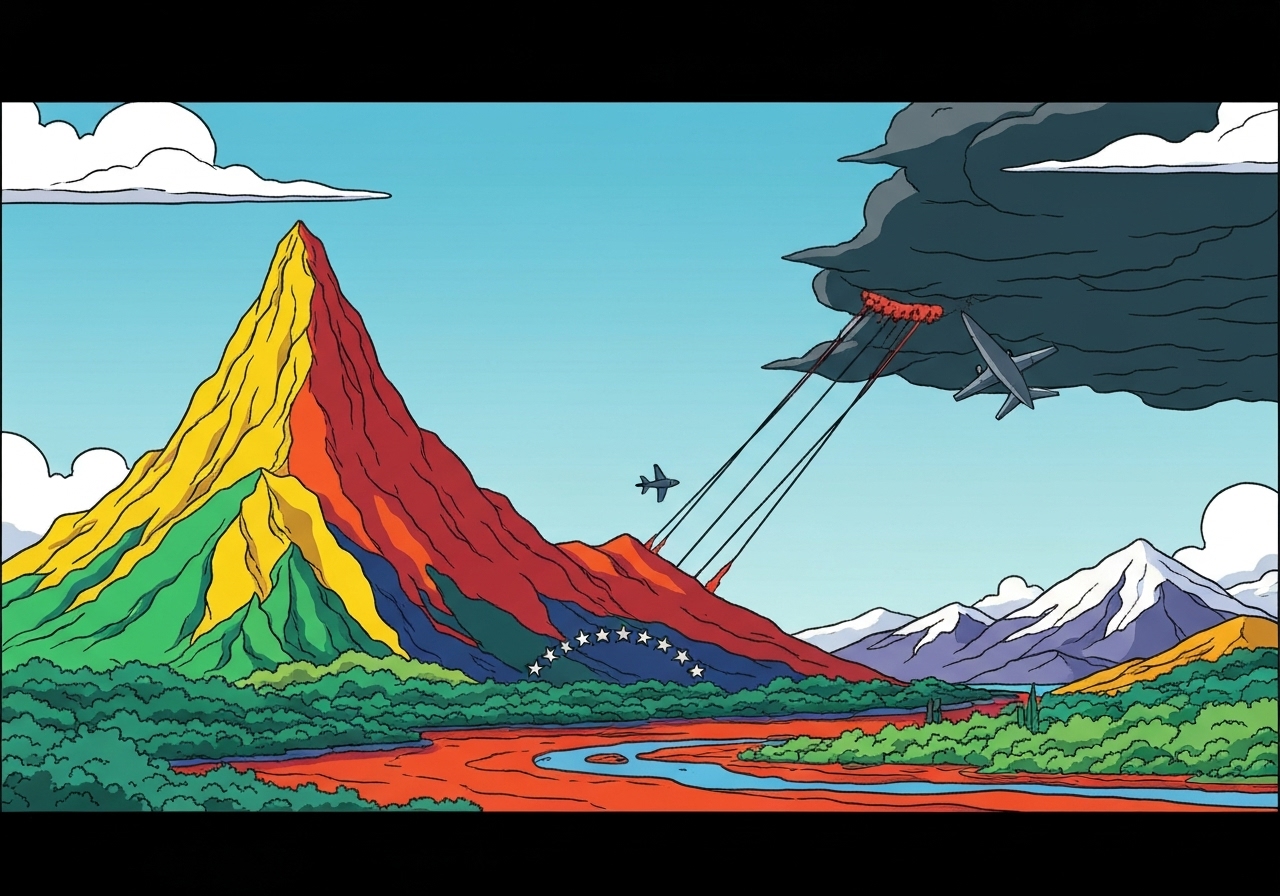
Venezuela accused former US President Donald Trump of issuing a “colonialist threat” after he posted that the airspace around the country should be treated as closed. The statement, published on Truth Social, came amid an expanded US military presence near Venezuela and a Federal Aviation Administration advisory warning airlines of “heightened military activity in and around Venezuela.” Caracas’s foreign ministry condemned the post as an “extravagant, illegal and unjustified aggression,” and said Washington had unilaterally suspended weekly migrant repatriation flights. The exchange has raised immediate travel uncertainty and diplomatic tensions between Caracas and Washington.
Key Takeaways
- Donald Trump posted on Truth Social that the airspace “above and surrounding Venezuela” should be considered closed, prompting a strong Venezuelan diplomatic protest.
- Venezuela’s foreign ministry described the post as “another extravagant, illegal and unjustified aggression” and reported US suspension of weekly migrant repatriation flights.
- The US Federal Aviation Administration warned airlines of “heightened military activity” around Venezuela, increasing operational uncertainty for carriers.
- Venezuela banned six international carriers—Iberia, TAP Portugal, Gol, Latam, Avianca and Turkish Airlines—after they missed a 48‑hour deadline to resume flights.
- The US has deployed the aircraft carrier USS Gerald Ford and roughly 15,000 troops to the region; officials say the build-up is intended to counter drug trafficking.
- US forces have carried out at least 21 strikes on vessels they said were transporting drugs, with reports of more than 80 fatalities; US authorities have not publicly produced conclusive evidence of narcotics on those boats.
- The US designated the so‑called Cartel de los Soles as a foreign terrorist organization, a move Venezuela’s government has rejected outright.
Background
Relations between the US and Venezuela have been strained for years, centered on political rivalries, sanctions, and mutual accusations of illegitimacy. Nicolás Maduro’s 2024 re‑election was widely condemned by Venezuelan opposition groups and numerous foreign governments as flawed, deepening Caracas’s isolation from Washington. In recent months the US has emphasized a regional security focus, citing drug trafficking as the primary justification for heightened naval and troop deployments to the Caribbean and northern South America.
Venezuela rejects US allegations that its government or security services are complicit in large‑scale drug trafficking and views increased US military posture in the Caribbean as a threat to sovereignty. The administration in Caracas has repeatedly characterized Washington’s actions as aimed at regime change rather than law enforcement, while US officials point to alleged corruption and the emergence of the so‑called Cartel de los Soles as evidence of illicit networks within Venezuela’s institutions. Commercial aviation has been affected: airlines have altered routes and some carriers face operational bans after missed scheduling deadlines.
Main Event
The immediate flashpoint was a Truth Social post by Donald Trump explicitly telling airlines, pilots and others to “please consider THE AIRSPACE ABOVE AND SURROUNDING VENEZUELA TO BE CLOSED IN ITS ENTIRETY.” Caracas’s foreign ministry responded sharply, accusing the former president of issuing a “colonialist threat” and calling on the international community and multilateral organizations to condemn the statement. The Venezuelan statement also said the US had unilaterally suspended weekly migrant repatriation flights, a move that the ministry framed as punitive.
Separately, the US Federal Aviation Administration issued advisories warning carriers of heightened military activity in and around Venezuelan airspace, a development that typically prompts airlines to alter routes or temporarily suspend services. Venezuela subsequently announced a ban on six airlines—Iberia, TAP Portugal, Gol, Latam, Avianca and Turkish Airlines—after they did not meet a 48‑hour deadline to resume flights to the country. That decision affects major transatlantic and regional connections and could reshape passenger and cargo flows.
Washington has moved substantial assets into the Caribbean theatre, including the USS Gerald Ford carrier strike group and approximately 15,000 military personnel. US officials frame that deployment as focused on counter‑narcotics operations, and US forces have reported at least 21 strikes on vessels they say were carrying drugs, with reports of over 80 deaths. Venezuelan authorities counter that such actions lack transparency and are part of pressure to remove Maduro, a charge US officials deny.
Analysis & Implications
The episode highlights the limits of unilateral declarations about another state’s airspace. International law gives sovereignty over airspace to the state concerned, and a social‑media post has no legal force to close foreign airspace; however, high‑profile statements by ex‑presidents can influence airline risk assessments and insurer decisions, producing practical consequences that resemble a de facto restriction. Airlines, already sensitive to crew and passenger safety and regulatory exposure, may reduce or suspend routes in response to perceived escalation.
Regionally, the US military build‑up is the most significant American deployment in the area since the 1989 Panama operation, raising concerns among Caribbean and South American states about escalation and precedent. If Washington and Caracas continue to treat each other as existential adversaries, there is a risk of miscalculation at sea or in the air that could draw in third parties, including commercial carriers. Multilateral institutions and neighboring countries may be pressured to mediate or at least publicly register positions to manage fallout.
Economically, disruptions to air links and further sanctions or counter‑measures by Caracas could deepen Venezuela’s isolation and hinder trade and migration management. The ban on six carriers will affect connectivity and could drive travelers to routings through third countries, increasing costs and complicating family reunification and cargo flows. Politically, the US designation of Cartel de los Soles and Venezuela’s categorical rejection of that label crystallizes the narrative divide: Washington emphasizes illicit finance and security, while Caracas emphasizes sovereignty and anti‑intervention.
Comparison & Data
| Metric | Reported Value | Context |
|---|---|---|
| US troop deployment | ~15,000 | Largest US regional deployment since 1989 (Panama) |
| Aircraft carrier | USS Gerald Ford | Carrier strike group positioned within striking distance |
| Strikes on boats | At least 21 | US says boats were carrying drugs; evidence not publicly released |
| Reported deaths in strikes | More than 80 | Death toll reported by US operations; details remain limited |
| Airlines banned by Venezuela | 6 carriers | Iberia, TAP, Gol, Latam, Avianca, Turkish Airlines |
The table aggregates the principal numerical elements reported so far and shows how military, operational, and commercial measures are converging. The reported casualty and strike figures underline the human cost and the need for transparent investigation. Airlines and insurers will watch these numbers closely when setting operational advisories and route permissions.
Reactions & Quotes
Venezuela’s foreign ministry framed Trump’s post as an unlawful provocation and called on the international community to denounce it. The ministry also accused the US of suspending repatriation flights as part of coercive measures against Caracas.
“To all Airlines, Pilots, Drug Dealers, and Human Traffickers, please consider THE AIRSPACE ABOVE AND SURROUNDING VENEZUELA TO BE CLOSED IN ITS ENTIRETY.”
Donald Trump, Truth Social post
US aviation regulators issued their own, shorter advisory that focuses narrowly on safety and the operational environment; that advisory does not have the force to close foreign airspace but signals heightened risk to carriers.
“Heightened military activity in and around Venezuela”
Federal Aviation Administration (advisory language)
Venezuelan officials explicitly rejected the US designation of the Cartel de los Soles and characterized US actions as aimed at political destabilization rather than criminal interdiction.
“Another extravagant, illegal and unjustified aggression against the Venezuelan people.”
Venezuelan Foreign Ministry (official statement)
Unconfirmed
- Whether the vessels struck by US forces were definitively carrying narcotics has not been publicly substantiated with verifiable evidence.
- The Venezuelan government’s claim that US moves are intended to depose President Nicolás Maduro reflects its interpretation but is not an acknowledged US objective.
- Attribution of leadership or direct command of the Cartel de los Soles to specific Venezuelan officials, including President Maduro, remains contested and is disputed by Caracas.
Bottom Line
This episode underscores how statements by prominent figures, military deployments, and regulatory advisories can interact to produce rapid practical effects on aviation, diplomacy, and regional security even without formal legal changes. Airlines and passengers face immediate operational uncertainty, while governments and multilateral organizations may be compelled to respond to the diplomatic escalation. The human costs reported from maritime strikes and the broader pattern of accusations between Washington and Caracas increase the urgency of independent verification and transparent investigation.
Looking ahead, de‑escalation will require clearer communication channels, verified intelligence sharing on narcotics operations, and engagement by regional actors to mediate tensions. For the moment, the principal risks are further disruptions to civilian travel, miscalculation between military actors at sea or in the air, and a deepening political impasse that will complicate humanitarian and migration management in the region.
Sources
- BBC News — international news report summarizing official statements and developments