
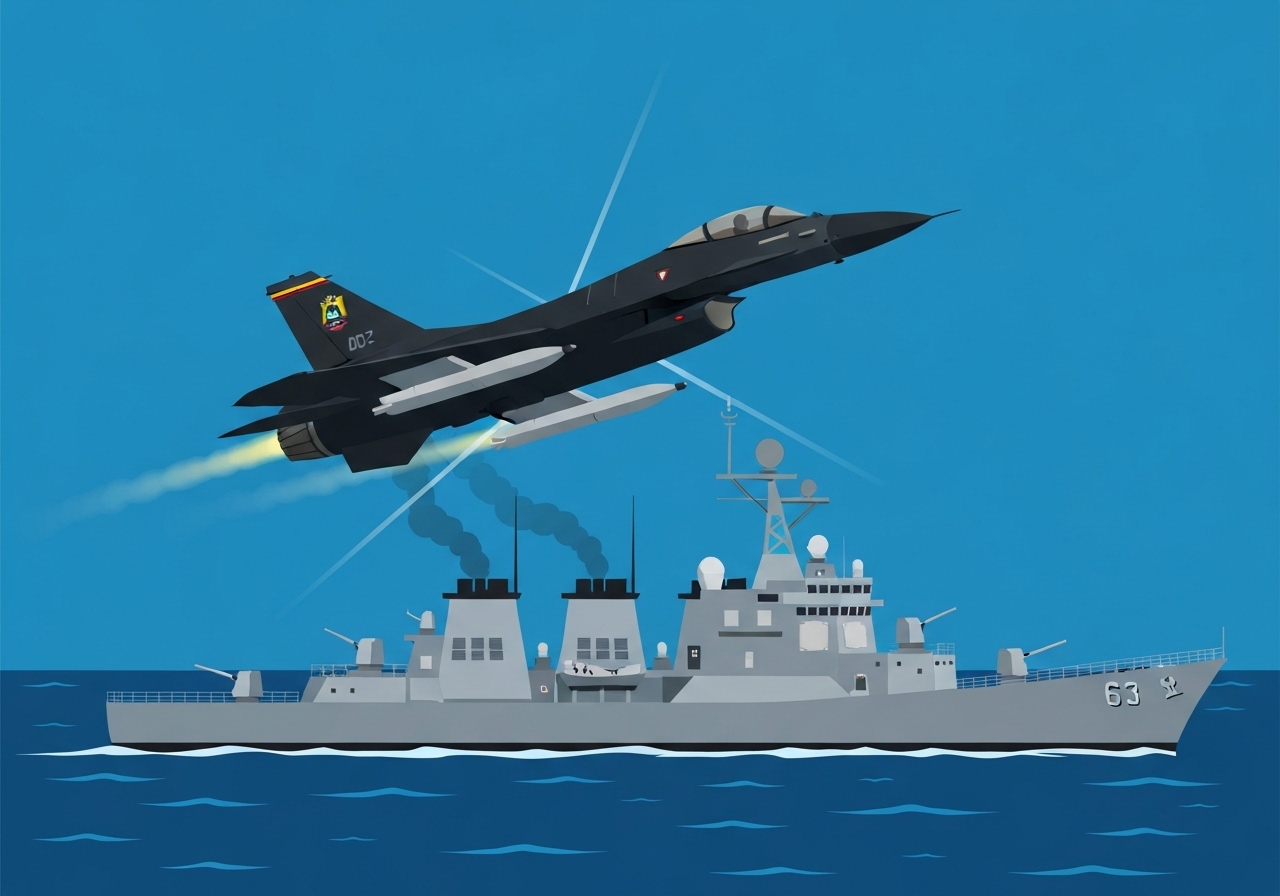
— Two armed Venezuelan F-16 fighter jets performed a low-altitude flyover of the U.S. guided-missile destroyer Jason Dunham in the southern Caribbean Sea, a Pentagon official said, in a move the United States called a provocative show of force; the ship did not return fire.
Key Takeaways
- The flyover occurred on Sept. 4, 2025, in the southern Caribbean Sea over the destroyer Jason Dunham.
- The Pentagon characterized the action as intended to interfere with counternarcotics and counterterrorism operations.
- The incident followed a U.S. strike two days earlier on a Venezuelan boat that U.S. officials said was carrying drugs.
- President Trump said 11 members of the Tren de Aragua gang were killed in the strike; reporting remains unclear on whether they had an opportunity to surrender.
- The Dunham is part of a broader U.S. deployment of ships and surveillance planes supporting a major counternarcotics operation in the region.
- The U.S. administration has issued a secret directive authorizing military force against some Latin American drug cartels labeled as terrorist organizations.
- Senior U.S. officials have publicly advocated forceful measures, drawing sharp criticism from Venezuela’s government.
Verified Facts
The U.S. guided-missile destroyer Jason Dunham was overflown by two armed Venezuelan F-16s on Sept. 4, 2025, while operating in the southern Caribbean Sea. Pentagon officials described the event as a deliberate display intended to obstruct U.S. counternarcotics activities. The warship did not engage the jets.
The flyover came two days after a U.S. military strike on a Venezuelan-flagged boat in the Caribbean that U.S. officials said was carrying illicit narcotics. The United States has linked the vessel to the Tren de Aragua criminal group. President Trump stated that 11 members of that gang were killed in the strike.
The Jason Dunham is operating as part of a concentrated U.S. presence in the region that includes surface ships and surveillance aircraft assigned to a large counternarcotics operation. U.S. officials say the deployments aim to disrupt drug flows and associated criminal networks that they consider a national security threat.
U.S. policy actions in recent weeks include a reportedly classified directive signed by the president authorizing the Pentagon to use military force against certain Latin American drug groups the administration has designated as terrorist organizations. Officials have cited this authority in explaining more aggressive interdiction operations.
Context & Impact
The flyover adds to growing tensions between Washington and Caracas, where the U.S. has escalated pressure on Venezuelan authorities and alleged criminal networks. Venezuela views such U.S. military activity near its maritime approaches as provocative and has publicly criticized the strikes.
For U.S. policymakers, the incident underscores operational risks when military assets carry out interdiction missions near foreign territorial waters and in contested regions. Aerial encounters raise the potential for miscalculation and diplomatic fallout, even when there is no exchange of fire.
- Operational risk: Close passes by armed fighters increase the chance of accidents or unintended escalation.
- Diplomatic pressure: Caracas may use the flyover to justify a hardened stance domestically and internationally.
- Counternarcotics effect: Aggressive interdiction can disrupt shipments but may also harden trafficking networks and provoke retaliatory actions.
Regional and Political Effects
Regionally, neighboring states and maritime traffic may face greater uncertainty as the U.S. expands military activity. Politically, hardline rhetoric from U.S. officials and retaliatory statements from Venezuelan leaders deepen polarization and complicate prospects for negotiation on cross-border security issues.
Official Statements
The Pentagon described the maneuver as a highly provocative move intended to interfere with U.S. counter-narco-terror operations and warned against further attempts to obstruct those efforts.
Pentagon statement
Secretary of State Marco Rubio said recent seizures had not deterred traffickers and argued for more forceful measures.
Secretary of State Marco Rubio
Unconfirmed
- Whether the 11 people killed in the U.S. strike were given a chance to surrender remains unclear.
- The precise orders or chain of command that directed the Venezuelan jets to conduct the flyover have not been publicly confirmed.
- Attribution of the motive for the flyover beyond a general show of force has not been independently verified.
Bottom Line
The low pass by Venezuelan F-16s over the Jason Dunham signals an uptick in the risk of direct military confrontation as the United States pursues aggressive counternarcotics operations in the Caribbean. Absent diplomatic de-escalation or clearer rules of engagement, similar encounters are likely to recur and could complicate regional security.