
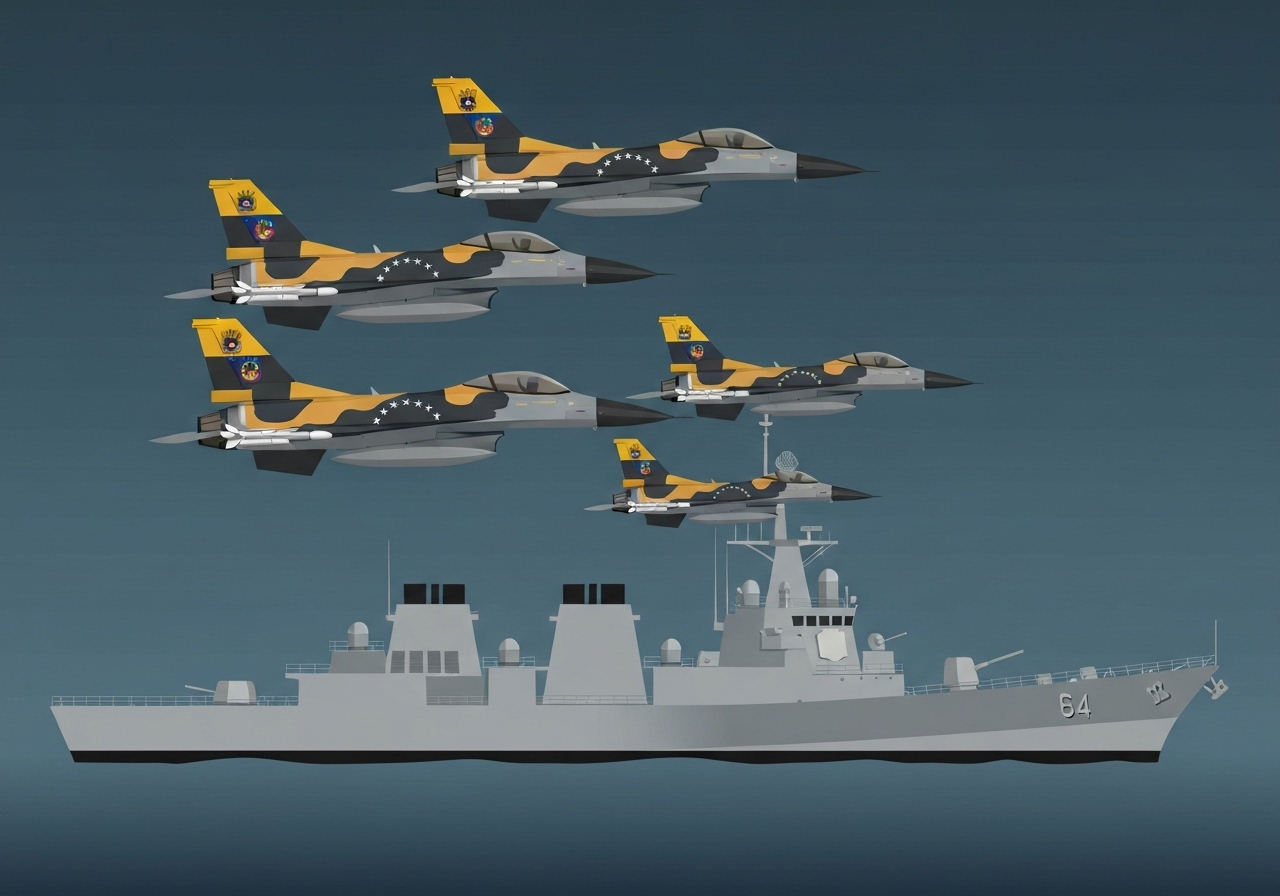
On Sept. 4, 2025, two Venezuelan F-16 fighter jets flew over the U.S. Navy destroyer USS Jason Dunham in international waters in the Caribbean, prompting a stern Pentagon warning and heightening tensions after a U.S. strike two days earlier killed 11 people aboard a Venezuelan vessel said to be carrying illegal narcotics.
Key Takeaways
- Two Venezuelan F-16s conducted an overflight of the USS Jason Dunham on Sept. 4, 2025.
- The Pentagon described the action as a “highly provocative move.”
- The incident occurred amid an expanded U.S. naval presence—at least seven warships and 4,500+ personnel—in the Caribbean.
- The episode follows a U.S. strike that killed 11 people on a Venezuelan vessel accused of drug trafficking.
- U.S. officials have linked Venezuela’s government to narco-trafficking networks; Caracas denies those claims.
- Legal and political debate is ongoing over U.S. authority to carry out lethal strikes at sea.
Verified Facts
U.S. officials identified the Venezuelan aircraft as two F-16 fighter jets and reported they overflew the USS Jason Dunham while the destroyer operated in international waters of the Caribbean Sea on Sept. 4, 2025. The Pentagon released a brief statement characterizing the action as “highly provocative.”
The overflight follows a separate U.S. operation on Sept. 2, 2025, in which U.S. forces struck a vessel that Washington says was transporting illegal narcotics; U.S. authorities reported 11 people were killed in that strike. President Donald Trump has publicly linked the hit to trafficking tied to the Tren de Aragua group, which Washington designated as a terrorist organization earlier this year.
The U.S. has deployed a naval tasking in the region that includes at least seven warships and more than 4,500 sailors and Marines. Elements of the 22nd Marine Expeditionary Unit are conducting amphibious training and flight operations from southern Puerto Rico as part of that buildup.
Context & Impact
The overflight intensifies an already fraught U.S.-Venezuela dynamic. Washington says it is carrying out counter-narcotics and counter-terror operations in the Caribbean; Pentagon officials warn Caracas not to obstruct those missions. Caracas has rejected U.S. allegations tying the Maduro government to organized-trafficking groups.
Domestically in the U.S., the strike that killed 11 people has prompted legal and political questions. Critics argue that using lethal force instead of interdiction and arrest raises constitutional and international law concerns. Supporters in the U.S. government frame the actions as necessary to disrupt networks they say are poisoning American communities.
Regionally, the presence of multiple U.S. warships and the reported aircraft overflight carry the risk of miscalculation. Military encounters at sea or in the air can escalate quickly, and both sides will likely monitor rules of engagement and flight patterns closely to avoid unintended clashes.
Official Statements
“Today, two Maduro regime military aircraft flew near a U.S. Navy vessel in international waters,” the Pentagon said, calling it a “highly provocative move.”
Pentagon statement
“The poisoning of the American people is over,” Defense Secretary Pete Hegseth said defending U.S. counter-narcotics actions.
Pete Hegseth, U.S. Defense Secretary
Unconfirmed
- Whether the Venezuelan jets intended to intimidate or merely transited routine patrol airspace is not independently verified.
- Claims that President Maduro personally runs Tren de Aragua remain disputed and are denied by Venezuelan authorities.
- Full legal assessments on the U.S. authority to conduct the Sept. 2 strike are under review and contested in public debate.
Bottom Line
The F-16 overflight of the USS Jason Dunham on Sept. 4, 2025, underscores rising tensions between the U.S. and Venezuela after lethal U.S. action against a suspected drug vessel. The episode adds diplomatic and legal pressure to an already polarized situation and increases the risk of further military encounters in the Caribbean.