
Lead
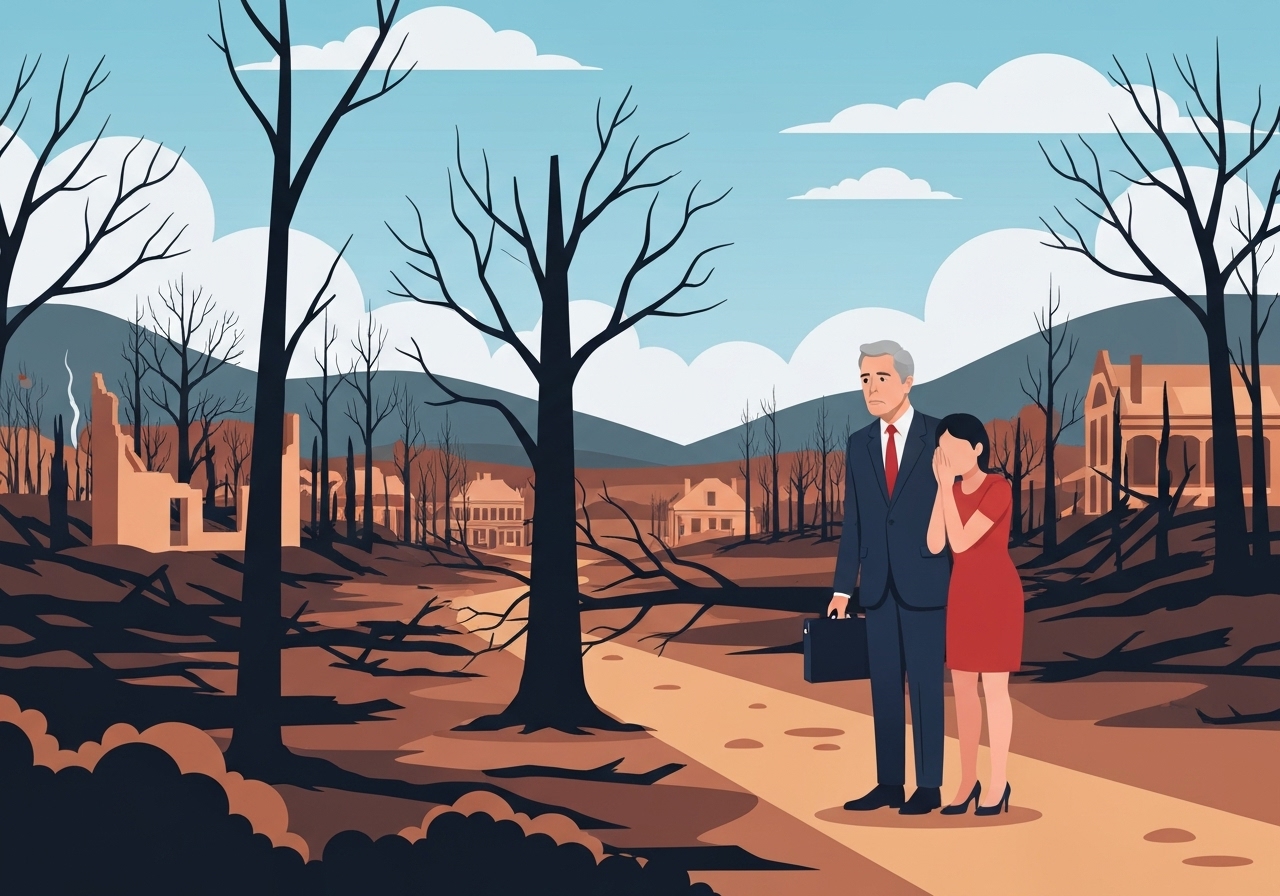
Australian authorities are assessing one of the nation’s worst recent heatwave-linked bushfire episodes after a blaze in Victoria left one person dead, forced whole towns to evacuate and destroyed more than 300 structures. Fires have consumed about 350,000 hectares across south-eastern Australia, with emergency crews warning blazes could burn for weeks. Prime Minister Anthony Albanese visited the hardest-hit communities and announced joint federal–state recovery funding as firefighters and emergency services continued containment and relief efforts.
Key Takeaways
- One fatality: human remains were located near a vehicle off Yarck Road at Gobur, about 100 metres from the scene, and the person is yet to be formally identified.
- Area burned: roughly 350,000 hectares of bushland have been scorched across Victoria’s south-east.
- Property losses: authorities estimate more than 300 structures destroyed, including about 80 homes.
- Local impacts: Longwood accounts for about 150 structures lost; Natimuk saw around 30 houses and 40 sheds destroyed; Ravenswood and Harcourt lost over 47 homes and three businesses combined; Mount Mercer lost one house and 12 sheds.
- Emergency status: a state of disaster remained in much of Victoria, with 11 emergency warnings active at 3:30pm on Sunday and 32 fires reported active across the state.
- Relief and safety: 13 relief centres opened; a statewide total fire ban and air quality advisories are in place; Harcourt residents were told not to drink tap water due to a burst main.
- Funding: the federal and state governments committed A$19.5 million in immediate disaster recovery assistance.
- Weather context: the Bureau of Meteorology recorded Australia’s fourth-warmest year in 2025 (average +1.23°C nationally); a brief cooldown followed three days of extreme heat, with significant rain not expected until later in the week.
Background
Heatwave conditions across south-eastern Australia—part of a broader pattern of extreme warmth tied to the nation’s ongoing climate trends—helped multiple fires ignite and spread quickly last week. The Walwa River Road fire began last Monday and expanded through the week amid dry fuels and gusty winds, joining blazes in the Otways, Longwood and near the New South Wales border.
Victoria has experienced repeated severe fire seasons in recent years, taxing firefighting resources and community resilience. Local authorities, emergency management agencies and volunteers coordinate response and recovery, while state and federal governments provide financial aid and logistical support. Agricultural communities are also vulnerable: active fires and road closures have complicated feed and water provision for livestock.
Main Event
On Sunday, police confirmed human remains were located in the Longwood bushfire zone; the discovery was made approximately 100 metres from a vehicle off Yarck Road at Gobur. Identification procedures are ongoing. Hundreds of residents were evacuated across multiple townships as emergency warnings urged people to “leave immediately” or “take shelter now” via the VicEmergency platform.
Firefighters and emergency personnel—numbering in the thousands across the state—continued direct suppression, asset protection and backburning where conditions permitted. Many areas remain too hazardous for detailed damage assessments because smouldering hotspots and unstable trees present ongoing safety risks.
Localised impact reports show concentrated destruction: Longwood lost about 150 structures, Natimuk around 30 houses and 40 sheds, and Ravenswood/Harcourt more than 47 homes plus three businesses. Mount Mercer reported the loss of one house and 12 sheds. Officials say the counts are preliminary and will change as access improves.
Prime Minister Anthony Albanese visited affected towns, offering federal support and pledging continuity of recovery aid. Premier Jacinta Allan described the situation as “another difficult day,” noting dozens of active fires and urging residents to obey evacuation orders. Emergency Management Commissioner Tim Wiebusch warned against spectators entering impacted zones because of the danger posed by damaged trees and lingering fire activity.
Analysis & Implications
The scale of area burned and property loss highlights how quickly extreme heat and dry vegetation can compound into widespread disaster, even outside the traditional peak of the fire season. At roughly 350,000 hectares, this event adds materially to recent multi-year trends of larger, more intense blazes in south-eastern Australia—patterns that climate science connects to warmer average temperatures and more frequent heat extremes.
Beyond immediate property loss, the social and economic repercussions will be felt for months. Displaced households need shelter, psychosocial support and rebuilding assistance; local businesses and farms face lost income, damaged infrastructure and interrupted supply chains. The A$19.5 million in initial recovery funding addresses urgent needs but is likely the first tranche in a longer reconstruction cycle.
Environmentally, large burns can cause short-term declines in air quality and water-system contamination, as seen in Harcourt’s “do not drink” advisory after a burst water main became inaccessible. Air quality readings reached “very poor” in several monitoring towns on Sunday, posing health risks for older adults, children, pregnant people and those with cardiac or respiratory conditions.
Operationally, resources will be stretched: crews must balance suppression with community protection and later with recovery tasks such as damage assessment and infrastructure repairs. Continued dry, windy weather could prolong containment efforts; while cooler conditions have arrived, significant rain is not expected statewide until later in the week, limiting rapid relief from fire behaviour.
Comparison & Data
| Metric | Reported Value |
|---|---|
| Area burned | ~350,000 hectares |
| Structures destroyed (total) | 300+ (≈150 at Longwood) |
| Homes lost (approx.) | ~80 |
| Active fires (statewide) | 32 |
| Emergency warnings (snapshot) | 11 (3:30pm Sunday) |
| Relief centres open | 13 |
| Immediate recovery funding | A$19.5 million |
The table aggregates official figures released by Victorian emergency agencies and on-the-ground reporting. Town-level totals vary and will be revised as inspectors gain safe access; many losses are currently recorded as preliminary. The area burned is an early estimate derived from incident mapping and satellite analysis shared by state agencies.
Reactions & Quotes
Officials and community figures responded with a mix of reassurance, warning and appeals for restraint from onlookers.
“We’ve got your back, not just during this crisis, but through the recovery as well.”
Anthony Albanese, Prime Minister (federal government)
Albanese pledged federal support during a visit to affected communities and framed the funding announcement as an immediate step toward rebuilding.
“We are not through the worst of this by a long way. If you are told to leave by the emergency services, do so.”
Jacinta Allan, Premier of Victoria (state government)
Premier Allan emphasised the ongoing risk and urged people to heed evacuation orders. Emergency Management Commissioner Tim Wiebusch urged the public not to visit fire-affected areas because of dangerous conditions, including falling limbs.
Unconfirmed
- Exact identity and cause of death associated with the remains found at Gobur remain unconfirmed pending formal identification and investigation.
- Detailed final tallies of destroyed structures and homes are provisional; many sites are still inaccessible and counts may rise as inspections continue.
- Attribution of any single ignition source for the larger conflagrations has not been publicly confirmed; investigations into origins are ongoing.
Bottom Line
This sequence of fires—in a state already shaped by recent extreme heat—has caused significant human, property and environmental harm in Victoria. Immediate priorities are containment, life-safety evacuations, support for displaced people and securing critical services such as water and power.
Looking ahead, recovery will require sustained funding, fast access for accurate damage assessment and coordinated support for agriculture and small businesses. The event also underscores the broader trend of more frequent and severe weather extremes linked to rising temperatures, and it points to the continued need for investment in preparedness, resilient infrastructure and community planning.
Sources
- The Guardian — (media report)
- VicEmergency — (official state emergency information)
- Bureau of Meteorology — (official meteorological data, climate summaries)
- Coliban Water — (regional water authority advisory)
- EPA Victoria — (environmental monitoring and air quality)