
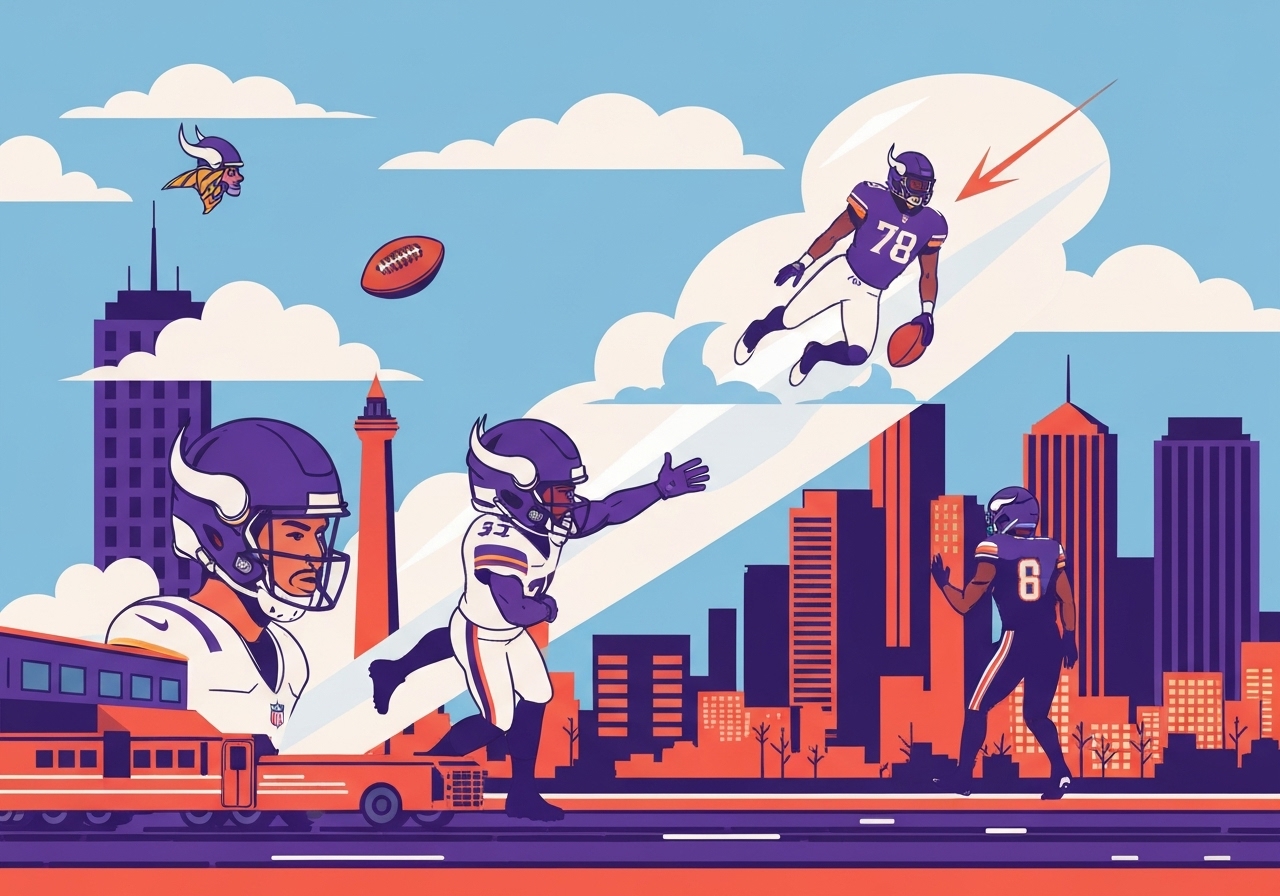
Lead: On Monday Night Football in Chicago on Sep. 8, 2025, the Minnesota Vikings rallied from an 11-point fourth-quarter deficit to beat the Bears 27-24, handing 22-year-old J.J. McCarthy a dramatic NFL debut. McCarthy, returning to his hometown, overcame a pick-six and early pressure to engineer three fourth-quarter touchdown drives and a two-point conversion. The victory improved Minnesota to 1-0 on the season, marked several franchise milestones in Chicago and produced modest upward movement in national power rankings.
Key Takeaways
- Minnesota defeated Chicago 27-24 on Sep. 8, 2025, completing a comeback after trailing by 11 points entering the fourth quarter.
- J.J. McCarthy, 22, recorded multiple passing TDs and a rushing score in his NFL debut while also throwing his first-career pick-six earlier in the game.
- NFL Research: McCarthy is the first starting QB since Steve Young (1985) to erase a 10+ point fourth-quarter deficit and win in his debut, and the only QB to do so on the road since 1950.
- McCarthy became the first player since Cam Newton in 2011 to post multiple passing TDs and a rushing TD in an NFL debut and the first in league history to score three fourth-quarter touchdowns in his debut.
- The Vikings’ season-opening win extended a franchise run in Chicago (six straight wins in the city) and moved Minnesota modestly upward in several national power rankings, with the largest single-source jump at two spots.
Background
The game carried weight beyond Week 1 scoreboard implications. Minnesota entered the season with a new-look quarterback room after transitioning from veteran starts (Kirk Cousins, Sam Darnold) to second-year J.J. McCarthy, the former Michigan starter whose last competitive game was 609 days earlier. Kevin O’Connell remains the offensive play-caller and is widely credited with building a QB-friendly scheme designed to accelerate younger signal-callers’ development. Defensively, Brian Flores’ unit had shown flashes during preseason but faced early pressure from the Bears’ front, testing Minnesota’s protection early.
The matchup also had divisional and historical context: the NFC North race is expected to be tight early, and Minnesota’s record in season openers (now 37-27-1) and unusual success in Chicago were both relevant narrative threads. Historically notable performances—like Fran Tarkenton’s 1961 debut and other mid-century comebacks—provide a template by which this result is being compared in team annals and national narratives.
Main Event
The contest began poorly for McCarthy: under heavy Chicago pressure he absorbed multiple sacks, completed a limited number of passes through three quarters and threw a pick-six that widened the Bears’ lead. Entering the fourth quarter Minnesota trailed 17-6 and faced growing doubts about the rookie’s readiness for a hostile road debut. A missed Bears field goal in the fourth denied Chicago a two-possession cushion and shifted momentum.
From that point McCarthy and the offense flipped the script. He orchestrated three touchdown drives in the fourth quarter—two passing scores and one rushing touchdown—then completed a two-point conversion toss to Adam Thielen to forge the final margin. The Vikings finished with a 27-24 victory after erasing the 11-point deficit, a rally that required complementary play from the defense and special teams.
Beyond the box score, McCarthy’s night set multiple records and team-firsts: he is the first Vikings starter with multiple passing TDs in a debut since Fran Tarkenton (1961), and league research attributes a number of rare debut feats to his performance. For Minnesota, the win also marked the franchise’s 40th comeback from deficits of 11+ points and continued a stretch of success in Chicago that now includes six straight wins in that city.
Analysis & Implications
Short-term, the game calms immediate concerns about the Vikings’ quarterback transition. McCarthy’s ability to rebound inside a single contest—overcoming a pick-six and early sacks to engineer late drives—signals mental resilience and poise under pressure. Still, one game is a small sample; long-term starter projection depends on consistency across multiple defensive schemes and away environments.
Kevin O’Connell’s play-calling drew broad praise for creating a pathway back into the game. The late-game script balance—calling effective passing plays alongside a decisive rushing touchdown—suggests the staff can both protect and expand McCarthy’s strengths. On the defensive side, Brian Flores’ unit improved pass-rush and coverage execution after halftime, a sign that halftime adjustments mattered and could be a recurring advantage.
In power-ranking terms the Vikings moved modestly upward in most national lists, with a largest single-source jump of two spots. Analysts’ incremental upgrades reflect a belief that Minnesota’s roster talent and coaching can mitigate rookie QB risk; however, the team’s true standing in the NFC and playoff projections will hinge on road performance, offensive line stability, and the health of key weapons over the next several weeks.
Comparison & Data
| Item | Value |
|---|---|
| Final score | Vikings 27, Bears 24 |
| Vikings season opener record | 37-27-1 |
| McCarthy age | 22 |
| Days since last competitive start (Michigan) | 609 |
| Franchise comeback wins from 11+ deficits | 40 (13 occurred after trailing 11+ in 4Q) |
The table summarizes key, verifiable figures from the game and historical context. Those numbers underpin why analysts adjusted rankings only slightly: the win is meaningful but not definitive for long-term forecasting.
Reactions & Quotes
National analysts and team insiders framed the result as a promising but early indicator for Minnesota’s season. Below are representative, brief remarks and their context.
“He flipped the switch in the fourth quarter and delivered when it mattered most.”
Eric Edholm, NFL.com (analysis)
Edholm’s comment (paraphrased) was offered as part of a broader evaluation that emphasized McCarthy’s turnaround from a poor start and credited coaching adjustments for putting the rookie in scoring positions late.
“The coaching staff allowed McCarthy to grow into the game and the offense finished strong.”
Brent Sobleski, Bleacher Report (analysis)
Sobleski’s assessment highlighted Kevin O’Connell’s role as an on-field instructor and the offense’s real-time development, a key reason several outlets nudged the Vikings upward in their Week 2 power rankings.
Unconfirmed
- Whether McCarthy’s fourth-quarter surge is a reliable predictor of season-long starter-level performance remains unconfirmed; more starts are needed to evaluate consistency.
- Any internal injury or minor ailment sustained by McCarthy or other starters during the game that might affect short-term availability was not publicly confirmed by team medical reports as of publication.
Bottom Line
The Vikings’ 27-24 win in Chicago is both a meaningful victory and an incomplete data point. It alleviates some immediate questions about the quarterback transition by showing McCarthy’s capacity to overcome early mistakes and finish games under pressure. Coaching and in-game adjustments were decisive; Kevin O’Connell’s play-calling and Brian Flores’ halftime defensive tweaks combined to produce a favorable late-game swing.
However, caution is warranted. Rankings movement was modest across national outlets because a single comeback—while historically notable—does not eliminate concerns about offensive line durability, consistency on third downs, or road-game poise over an entire season. The next several weeks will be critical: sustained offensive balance and continued defensive responsiveness will determine whether Minnesota’s early optimism should translate into a sustained run in the NFC.