
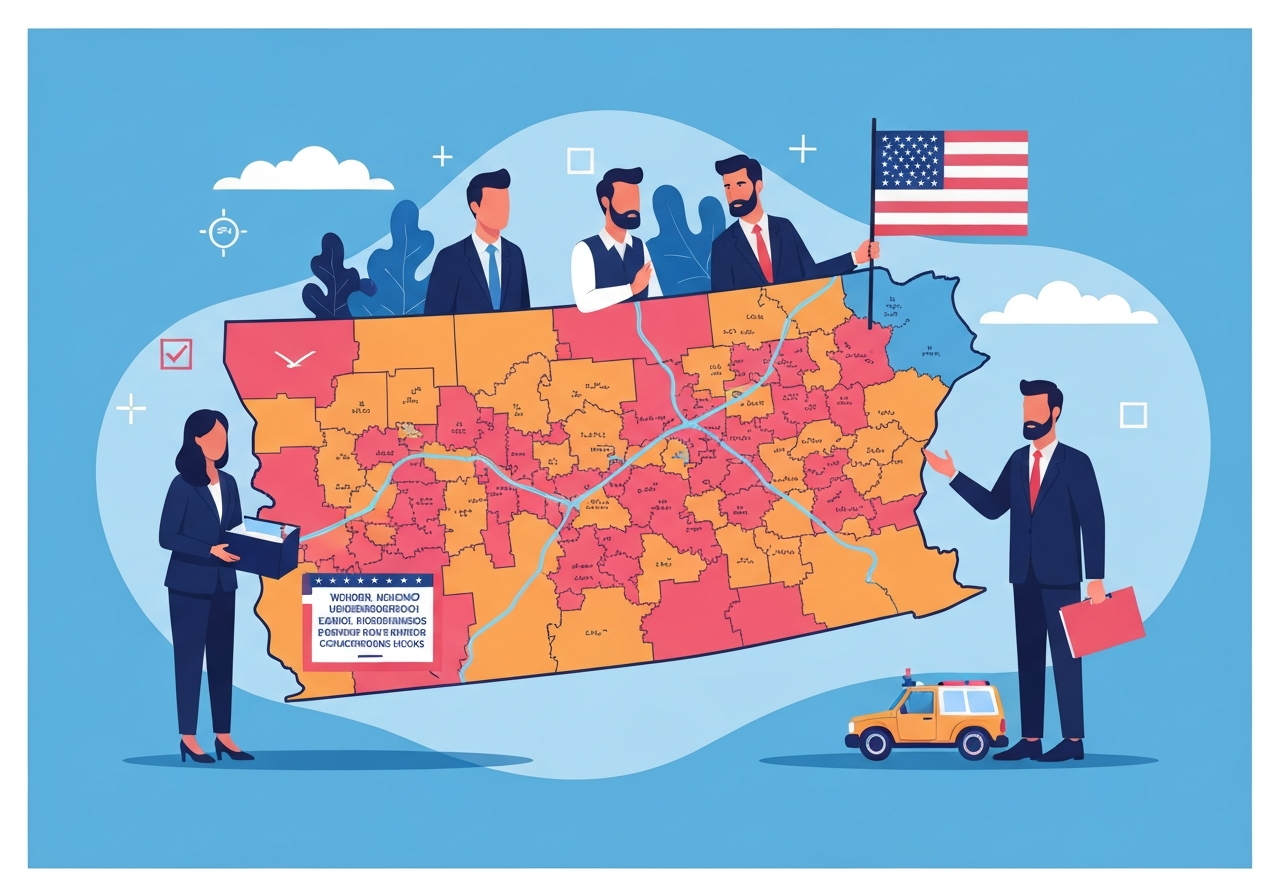
Virginia Democrats on Feb. 5 proposed a new congressional map designed to shift the state’s representation sharply toward their party ahead of the 2026 midterms. The plan would redraw districts so that eight are safely Democratic, two are Democratic-leaning competitive districts, and one is safely Republican, based on presidential vote splits from the most recent election. If enacted and upheld, the map could produce a 10–1 Democratic congressional delegation from Virginia, up from the current 6–5 split. The proposal comes while a state judge has blocked the legislature from advancing a constitutional amendment to permit midterm redistricting, and that ruling is under appeal to the Virginia Supreme Court.
Key Takeaways
- The map proposed Feb. 5, 2026 would create eight safe Democratic districts, two Democratic-leaning competitive districts, and one safe Republican district based on the latest presidential vote patterns.
- Under the proposed lines, Virginia’s delegation could shift from six Democrats and five Republicans today to as many as 10 Democrats and one Republican in 2026.
- A Virginia state judge last month barred the legislature from advancing a constitutional amendment to allow midterm redistricting; Democrats have appealed and the case is pending before the Virginia Supreme Court.
- If the appeal succeeds, Virginia plans an April referendum asking voters whether lawmakers may take up redrawing congressional districts ahead of the midterms.
- Internal disagreement has surfaced within the Democratic Party during the map-drafting process, though party leaders currently signal broad, not unanimous, support for the proposal.
- The move is part of a wider cycle of partisan redistricting efforts across roughly a dozen states over the past year.
Background
Virginia shifted from a battleground state to a reliably Democratic-leaning state over the last decade, reflected in statewide results and congressional outcomes. Historically, redistricting has been a contested, highly political process in the Commonwealth; previous cycles produced litigation and court-drawn maps. The recent proposal builds on that history but departs from past practice by seeking midcycle change ahead of a federal election year. Key stakeholders include Democratic leaders in the General Assembly who backed the amendment drive, Republican legislators who oppose midterm redistricting, and advocacy groups on both sides that view map lines as determinant of political power for years.
The specific mechanics at issue are procedural as well as partisan: under Virginia law, a constitutional amendment must clear certain legislative steps before appearing on a public ballot, and courts can block processes they find inconsistent with constitutional rules. The state judge’s recent order prevents the legislature from proceeding with the amendment for the 2026 cycle, prompting an expedited appeal. If the Supreme Court allows the amendment to proceed, the next step would be a voter referendum in April; only with voter approval could lawmakers legally redraw districts in time for the midterms.
Main Event
On Feb. 5, Democrats released the proposed congressional plan after weeks of private discussions among state and national party operatives. The map was presented using presidential vote splits from the most recent election to classify district partisan lean, producing the configuration of eight safe Democratic districts, two Democratic-leaning competitive districts, and one safe Republican district. Party strategists frame the plan as aligning district lines with contemporary population centers and voting patterns, though critics call it an overtly partisan gerrymander.
Implementation of the map depends on the outcome of the pending legal appeal. Last month’s state court ruling halted the legislature from advancing a constitutional amendment that would explicitly permit lawmakers to redraw congressional boundaries for 2026, and Democrats have appealed that ruling to the Virginia Supreme Court. Should the state Supreme Court overturn or narrow the lower court’s order, the amendment could proceed to a statewide referendum in April, where voters would decide whether to permit midterm redistricting.
Internal dynamics within the Democratic Party have been notable: some rank-and-file members and outside groups raised concerns over specific lines and potential political trade-offs, while leadership argued for expediency to capitalize on favorable midterm conditions. Republican officials denounced the proposal as partisan manipulation and signaled immediate legal and political opposition. Observers in Richmond and Washington are treating the proposal as a bellwether for similar efforts in other states.
Analysis & Implications
Politically, if the proposed map survives legal and electoral hurdles, it would dramatically reshape Virginia’s congressional delegation and strengthen Democratic influence at the federal level. A 10–1 delegation would not only increase Democratic votes in the U.S. House but also alter committee assignments and legislative bargaining power tied to delegation size and seniority. For Virginia voters, the shift could mean reduced competitive districts and longer-lasting partisan advantages depending on population changes and future redistricting cycles.
Legally, the case illustrates ongoing tension between judicial oversight of mapmaking and legislative prerogative. Courts have increasingly become the venue where redistricting disputes are resolved; the Virginia appeal and any subsequent rulings will contribute to emerging jurisprudence about midcycle redistricting and the limits of legislative authority. The state Supreme Court’s timetable and reasoning will be pivotal for both the April referendum’s viability and the calendar for implementing any new lines before filing deadlines for the midterms.
Nationally, Virginia’s effort is a high-profile example of a broader partisan redistricting struggle unfolding in about a dozen states. The concentration of resources and strategic focus on mapmaking signals that parties view district lines as central to near-term electoral advantages. This dynamic may intensify reactive strategies—court challenges, voter referendums, and federal litigation—that could prolong uncertainty into the 2026 campaign season and beyond.
Comparison & Data
| Metric | Current (Before Proposal) | Proposed Map |
|---|---|---|
| U.S. House seats (D–R) | 6 D – 5 R | 10 D – 1 R (potential) |
| Safely Democratic districts | — | 8 |
| Democratic-leaning competitive districts | — | 2 |
| Safely Republican districts | — | 1 |
The table summarizes the current delegation and the proposed allocation of district types based on recent presidential vote splits. Exact vote percentages per district were not published with the map summary; classification into safe or leaning categories reflects the party-tilt analysis provided by the map drafters rather than independent precinct-level tabulation.
Reactions & Quotes
Party officials and outside commentators offered contrasting framings in the hours after the proposal became public.
This proposal is intended to reflect how Virginians voted in the most recent presidential contest and to ensure representation for growing communities, party officials said in a statement summarizing the map rationale.
Virginia Democratic leadership (statement)
Democrats framed the plan as aligning districts with current electoral reality, stressing demographic and geographic shifts that, they argue, justify new lines. They emphasize a procedural pathway—appeal, potential referendum—rather than immediate implementation.
Republican leaders described the plan as an overt partisan maneuver that would blunt competitive races and prompt legal resistance.
Virginia Republican Party (spokesperson)
Republicans highlighted legal channels and public messaging to challenge the map if it advances, arguing the proposed configuration diminishes voter choice. They have signaled intent to pursue both courtroom options and public campaigning ahead of any referendum.
Legal analysts noted that the swift timeline and pending court questions make the outcome uncertain, and that precedent around midcycle redistricting is still evolving.
Election law scholar (academic analysis)
Neutral experts pointed to the uncertain legal terrain and noted possible ripple effects in other states where parties consider midterm map changes. They underscored that procedural rulings could matter as much as map geometry.
Unconfirmed
- Whether the Virginia Supreme Court will permit the constitutional amendment to proceed to an April referendum remains unresolved.
- The precise voting percentage thresholds used to classify each district as safe or leaning have not been independently verified in public data released with the map summary.
- The level of continued dissent within the Democratic caucus over final line-drawing is not fully public and could affect final legislative support.
Bottom Line
The proposal represents a calculated effort by Virginia Democrats to redraw congressional lines in a way that could deliver a substantial short-term partisan advantage in the U.S. House. Its immediate fate hinges on a pending appeal to the Virginia Supreme Court and, if allowed to proceed, an April referendum that would place the question directly before voters.
Even if courts or voters block the plan, the episode underscores how redistricting has become a frontline political strategy with national implications. Observers should watch the state Supreme Court’s schedule, the content and timing of any referendum, and ongoing intra-party negotiations in Richmond—each will determine whether the proposed map changes the balance of power in Washington come 2026.
Sources
- The New York Times — news media report summarizing the proposal and legal context