
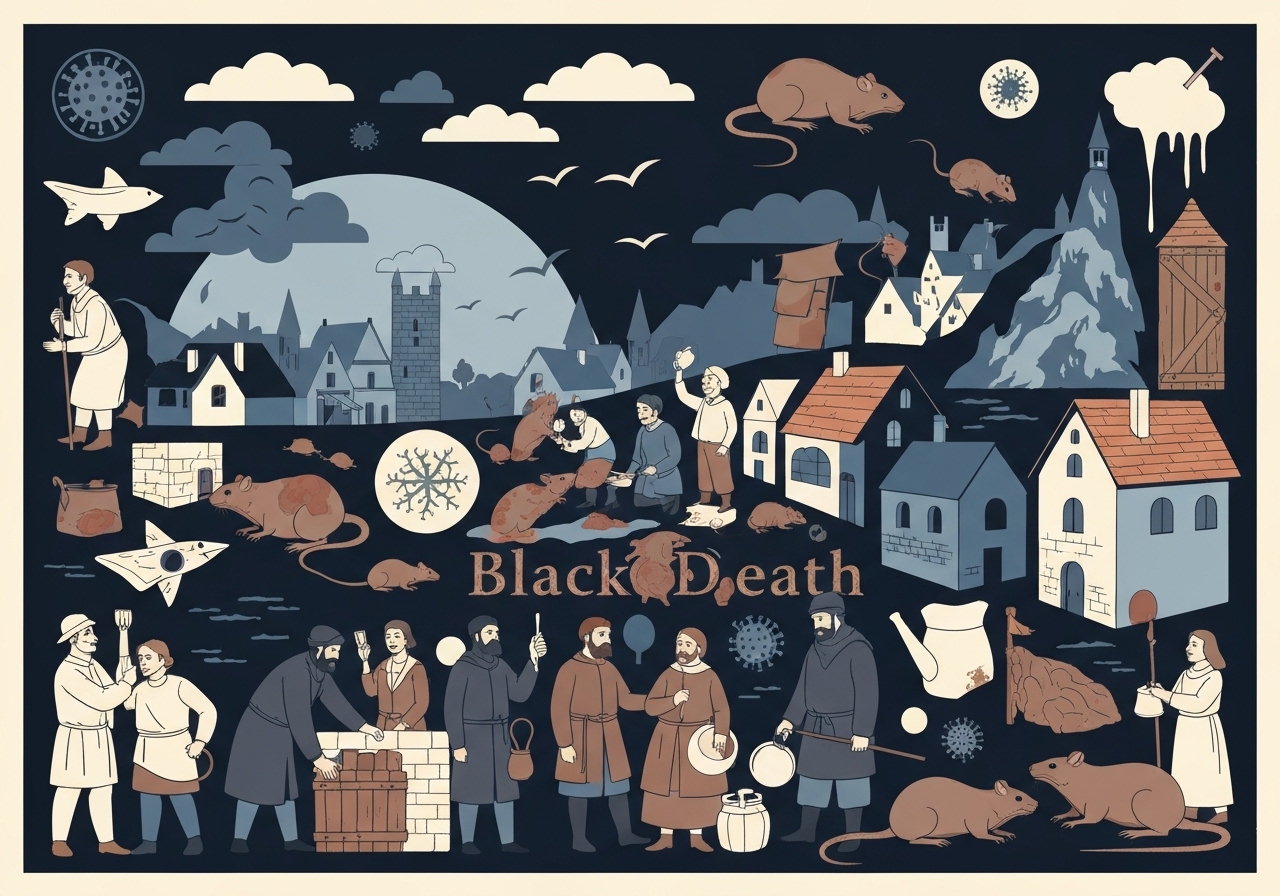
The new study links major volcanic activity in the mid-1340s to a cascade of climatic, ecological and socioeconomic disruptions that helped carry Yersinia pestis into the Mediterranean and then into Europe. Tree-ring evidence and contemporaneous chronicles point to unusually cool, cloudy summers from 1345–47, years that also saw sharp cereal price rises and emergency grain controls. Those shortages, the authors argue, reconfigured trade flows—bringing Black Sea grain into Italian ports—and created conditions that facilitated the 1346–49 pandemic that killed roughly one-third of Western Europe. The paper appears in Communications Earth & Environment (2025) and ties paleoclimate, ice-core chemistry and archival records into a single causal sequence.
Key Takeaways
- New interdisciplinary study links volcanic sulphur injections around 1345 to three consecutive cool/wet summers (1345–47) detected in European tree rings.
- The pathogen Yersinia pestis is traced to a distinct 14th-century strain originating in the Tien Shan region; spread reached the Lower Volga/Black Sea by 1346.
- Crop failures and famine followed the climatic downturn, most severely affecting parts of Spain, southern France, Egypt and northern/central Italy.
- Price spikes and emergency grain regulations are recorded in 1346, consistent with large-scale trans-Mediterranean grain movements from the Black Sea region.
- Authors argue these combined factors—climate shock, disrupted food markets and trade links—created a ‘‘perfect storm’’ enabling the pandemic’s rapid spread into port cities such as Genoa, Venice, Florence and Siena.
- Historical comparisons note recurrent second-pandemic outbreaks through the 17th century; the Black Death’s demographic impact reached about one-third population loss in Western Europe.
- The study’s DOI: 10.1038/s43247-025-02964-0; authors call for interdisciplinary frameworks to assess future zoonotic risks under climate change.
Background
Plague in medieval Eurasia is best understood as a sequence of pandemics rather than a single event. The first major wave, the Justinian Plague, began around 541 CE and recurred episodically for centuries; the so-called second pandemic began in the mid-14th century with the Black Death. By the 1340s a genetically distinct Yersinia pestis lineage that molecular studies link to the Tien Shan mountains was moving west along established trade corridors toward the Black Sea coast.
Medieval markets and urban centers depended on complex grain networks, especially in smaller Italian cities that could not be fully self-sufficient. When weather or harvest shocks occurred, elites and administrators increasingly intervened with price caps, trade restrictions and import programs; such interventions are well attested in archival letters and fiscal records from the 1340s. These commercial ties to the Black Sea and the Golden Horde provide the geopolitical backdrop for understanding how a pathogen traveling in rodent or flea hosts could cross from Eurasia into Mediterranean ports.
Main Event
The authors assembled new summer-temperature reconstructions from eight European tree-ring sites, including samples with so-called “blue rings” that signal unusually cold/wet growth seasons in 1345–47. Parallel ice-core sulfur records indicate a significant atmospheric injection of sulphur compounds consistent with one or more large volcanic eruptions near that interval. Contemporary chronicles—from chronicles to poetic references—describe darkened skies, dimmed eclipses and extended cloudiness across Eurasia, corroborating the proxy signals.
That sustained climatic downturn precipitated localized crop failures. Administrative and market records show cereal price surges in 1346 and the introduction of emergency measures to secure grain supplies. The authors document how those measures increased reliance on grain shipped across the Black Sea trade routes controlled in part by the Golden Horde and landed in Italian ports such as Genoa and Venice, cities that also had established maritime links to the Near East and the Black Sea littoral.
Once maritime grain fleets and the crews servicing them became vectors of human and rodent movement, the paper argues, Y. pestis could move from endemic foci on the steppe into Mediterranean trading hubs. From those ports the disease spread inland along trade and pilgrimage pathways, producing the catastrophic pandemic outbreak from 1346 into the late 1340s that decimated populations in Europe and the Mediterranean basin.
Analysis & Implications
The study emphasizes conjunctures: a climatic shock from volcanic forcing, ecological vulnerability in rodent reservoirs, and socioeconomic responses that altered trade and food distribution. Individually these factors are familiar to historians and paleoclimatologists; their value here lies in the temporal overlap the authors demonstrate across independent datasets. That overlap strengthens a causal reading in which the eruption(s) were not the single cause but the initial trigger in a chain that amplified pathogen mobility.
By linking ice-core sulphur spikes and tree-ring anomalies to price records and administrative correspondence, the analysis foregrounds how non-medical systems—markets, supply chains, and governance—mediate disease risk. The authors caution that transport of contaminated goods or commensal rodents along commercial routes is distinct from proven direct transmission via grain, but they show the re-routing of staple supplies plausibly increased contact rates between infected carriers and dense human populations in port cities.
Policy implications are twofold: first, climate shocks can cascade into public-health crises when they disturb food systems and mobility; second, interdisciplinary surveillance that combines climate proxies, pathogen genomics and trade network data can improve detection of compound risks. The paper explicitly draws a parallel to contemporary globalization and warns that zoonotic spillovers under rapid environmental change may be more likely in an interconnected world.
Comparison & Data
| Year / Period | Region | Noted Impact |
|---|---|---|
| 541 CE | Byzantine Mediterranean | Justinian Plague — early second pandemic wave |
| 1345–47 | Europe / Mediterranean | Volcanic sulfate spike, cool summers, crop failures |
| 1346–49 | Western Europe | Black Death — ~1/3 population loss |
| 1665 | London | Plague outbreak — ~60,000 deaths (~1 in 10 residents) |
The table summarizes key episodes used in the authors’ comparison: a millennia-scale perspective anchored by the Justinian pandemic, the mid-14th-century climatic perturbation, and later second-pandemic recurrences. The tree-ring “blue ring” signal and ice-core sulphur tally provide the physical-climate evidence, while price and administrative records supply the socioeconomic metrics used to infer market disruptions and grain flows in 1346.
Reactions & Quotes
Authors presented their interpretation as a synthesis aimed at explaining timing and transmission pathways rather than claiming a single proximate cause. Independent scholars contacted for comment emphasized the study’s methodological breadth while noting inherent limits in archival coverage for some regions.
“This is something I’ve wanted to understand for a long time.”
Ulf Büntgen, study co-author (University of Cambridge)
That reflection, offered by a lead author, frames the paper’s motivation: to ask why the pandemic broke out where and when it did by combining climate proxies and documentary evidence. The team argues the convergence of signals across independent archives increases confidence in the proposed sequence of events.
“Although the coincidence of factors that contributed to the Black Death seems rare, the probability of zoonotic diseases emerging under climate change and translating into pandemics is likely to increase in a globalized world.”
Ulf Büntgen, study co-author (University of Cambridge)
This second quotation underscores the authors’ contemporary framing: they draw lessons from the past about how climate shocks, ecological change and global trade can interact to heighten pandemic risk. Commentators have noted that while the historical conditions are unique, the general mechanism—compound stresses amplifying disease spread—has modern analogues.
Unconfirmed
- The precise volcanic source or geographic location of the sulphur injections around 1345 remains unresolved; ice-core chemistry indicates an event but not an exact eruption site.
- Direct archaeological or biomolecular evidence that traded grain itself carried Y. pestis into Mediterranean ports has not been found; the study infers increased contact via trade networks rather than proving grain-borne transmission.
- The relative contribution of human travel versus rodent/flea movement in initial Mediterranean introductions cannot be fully disentangled from current sources.
Bottom Line
The paper presents a coherent, evidence-based argument that one or more volcanic eruptions in the mid-1340s precipitated climatic anomalies that, by undermining harvests and shifting grain flows, helped open pathways for a Tien Shan–derived Y. pestis lineage to enter Mediterranean trade hubs and spread through Europe. The contribution is not a single-cause claim but a reconstruction of intersecting environmental and social mechanisms that together increased transmission opportunities during a narrow historical window.
For modern readers the study is a reminder that climate shocks can cascade through food systems and transport networks to affect public health in indirect but profound ways. The authors recommend combining paleoclimate, genomic and commercial network data to assess compound risks—an interdisciplinary template that may be valuable for anticipating zoonotic threats in an era of rapid environmental change.
Sources
- Ars Technica (news) — journalist summary and interview with study authors.
- Communications Earth & Environment (peer-reviewed study) — original research article and DOI (2025).