
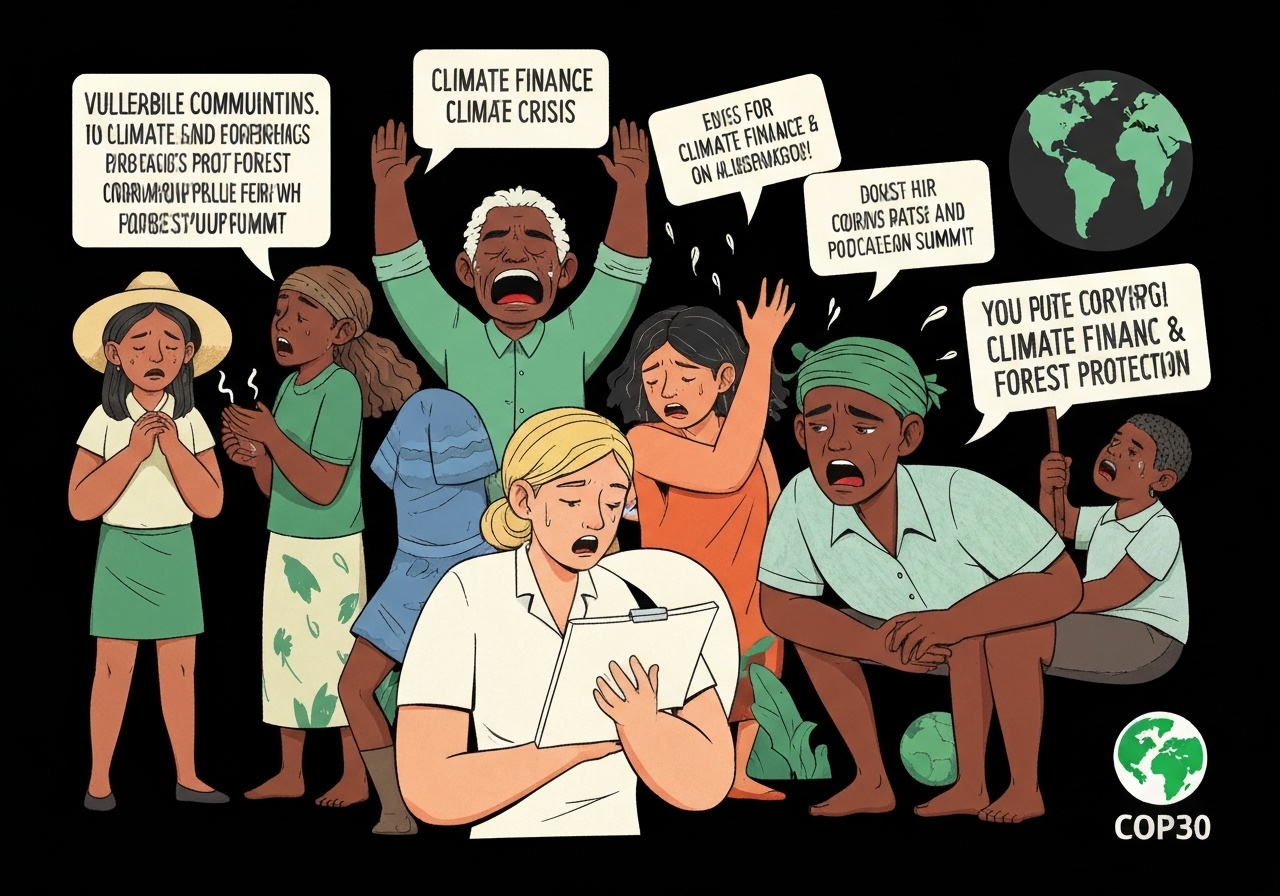
Lead: At COP30 in Belém, Brazil on Nov. 7, 2025, delegates from countries hit hardest by extreme weather delivered urgent reports of destruction and loss, pressing wealthier emitters for more help. Speakers from Haiti, the Marshall Islands and Kenya described recent hurricanes, sea‑level impacts and deadly landslides as evidence that climate harms are escalating now. Officials at the talks also advanced proposals to protect forests and begin unifying global carbon markets, while questions persisted about delivery of promised finance. The summit mixed immediate pleas from frontline states with diplomatic efforts to fund forest protection and standardize emissions trading.
Key Takeaways
- More than 3,000 Indigenous delegates are expected at COP30 in Belém, compared with roughly 170 who attended last year’s summit in Azerbaijan.
- Developed countries pledged $300 billion last year to help vulnerable states adapt, but a significant share of that finance has not been disbursed.
- Brazil’s proposed rainforest fund attracted $5.5 billion in initial pledges on day one and aims to leverage investments up to $125 billion over time.
- Officials warned it is increasingly difficult to keep global warming below the Paris 1.5°C threshold; scientists report 2024 was the warmest year on record.
- A new coalition led by Brazil, the EU and China seeks to align national emissions trading systems into a shared global carbon market.
- Hurricane Melissa and severe rains in the Caribbean and East Africa have produced immediate humanitarian needs and renewed urgency for resilience financing.
- Several major leaders, including the U.S. president and China’s and India’s heads of state, were absent, sending deputies and ministers instead.
Background
United Nations climate conferences bring governments, scientists and civil society together to negotiate emissions cuts, finance and adaptation. COP30 is being held on the fringe of the Amazon in Belém, chosen in part to spotlight rainforest protection amid mounting deforestation pressures and competing development priorities. Vulnerable countries and small island states have long argued that they bear the brunt of a problem they did not cause, calling for stronger adaptation funding, loss-and-damage mechanisms and recognition of disproportionate impacts.
Climate negotiators arrive amid a grim scientific backdrop: global average temperatures remain above preindustrial levels and experts say every fraction of a degree of additional warming increases the frequency and severity of extreme events. Financial pledges made at prior COPs, including a $300 billion commitment by wealthier countries announced last year, have not been fully delivered, producing mistrust among lower-income states. At the same time, initiatives such as carbon markets and forest finance are being promoted as tools to both reduce emissions and channel funds to protecting critical ecosystems.
Main Event
On Nov. 7, delegates heard firsthand accounts from countries grappling with recent disasters. Haiti’s diplomat described devastation after Hurricane Melissa and urged high-emitting countries to support storm preparedness and recovery. Kenya’s vice president recounted ongoing search-and-rescue operations after a landslide triggered by torrential rains and warned that cycles of drought and flood are now regular occurrences across parts of Africa.
The Marshall Islands’ foreign minister portrayed rising seas, coral die-off and shifting fish stocks as immediate threats to food security and livelihoods. Caribbean representatives and resilience experts highlighted Hurricane Melissa as a recent catastrophe that exposed gaps in emergency response and long-term adaptation funding. Civil-society leaders stressed that these on-the-ground impacts should drive negotiators toward concrete, timebound commitments.
Parallel to those testimonies, heads of state and senior ministers pushed two central initiatives: a Brazil‑backed rainforest fund and a coalition to harmonize emissions trading systems. The rainforest fund secured $5.5 billion in early pledges and aims to scale to roughly $125 billion by leveraging public and private investments. Brazil, the EU and China announced a joint effort to begin aligning carbon markets, a complex task meant to create incentives for emission reductions across jurisdictions.
Indigenous participation was a visible feature of the summit. Brazil’s government—now home to a newly created Indigenous Peoples’ Ministry—invited thousands of Indigenous delegates and activists to engage in panels and negotiations, even as protests highlighted tensions over recent approvals for oil development at the Amazon’s mouth and plans for infrastructure that tribal leaders say would cut through their territories.
Analysis & Implications
The testimonies from frontline countries underscore a widening gap between climate science and climate politics. With last year recorded as the warmest on record and the 1.5°C Paris benchmark increasingly out of reach, negotiators face pressure to accelerate mitigation while expanding finance for adaptation and loss-and-damage. Failure to translate pledges into disbursed funds would deepen mistrust and weaken cooperation on other agenda items such as carbon markets.
The forest fund’s early pledges indicate appetite among some donor governments to pay for forest conservation as a climate mitigation and biodiversity strategy. If the fund achieves scale, it could redirect capital flows toward avoided deforestation and provide income streams for countries that protect standing forests. However, translating initial commitments into sustained, verifiable results will require clear monitoring rules, anti-corruption safeguards and meaningful involvement of Indigenous and local communities.
Efforts to link emissions trading systems could lower the cost of decarbonization for some countries and companies, but the effort is technically and politically fraught. Harmonizing price signals, baselines and verification protocols across jurisdictions with different industrial mixes and regulatory capacities is a multi-year endeavor. Moreover, a global carbon market could widen inequities unless it includes robust safeguards to ensure that poorer countries and communities benefit rather than lose out.
Geopolitically, the absence of several top leaders complicated the summit’s optics but did not halt diplomacy. Deputies and ministers from large emitters used the platform to reaffirm national transitions to renewables, signaling that progress on energy transition and multilateral arrangements can proceed even when heads of state don’t attend. Still, the disconnect between rhetoric and rapid delivery of finance remains the summit’s most destabilizing fault line.
Comparison & Data
| Item | Figure | Context |
|---|---|---|
| Adaptation finance pledged (prior COP) | $300 billion | Commitment by developed countries; substantial disbursement gaps reported |
| Rainforest fund—initial pledges | $5.5 billion | Day-one commitments toward a $125 billion leverage target |
| Indigenous delegates expected at COP30 | >3,000 | Compared with ~170 at the previous summit in Azerbaijan |
The table above highlights the disparity between headline pledges and early financing flows. While the rainforest fund’s $5.5 billion is a tangible first step, it sits well below the $125 billion scale target and the broader adaptation finance gap. Greater Indigenous representation at COP30 contrasts sharply with past summits and may influence negotiation dynamics, particularly on forest and land-use issues.
Reactions & Quotes
Frontline representatives characterized recent storms and floods as existential and immediate threats that demand faster funding and adaptation support.
Haiti delegation / Frontline diplomat (paraphrased)
Officials from several developing regions urged richer nations to turn pledges into cash, framing the demand as a matter of climate justice rather than charity.
African Union Commission chair / Mahmoud Ali Youssouf (paraphrased)
Brazil, China and EU ministers emphasized cooperation on a shared carbon market as a mechanism to lower emissions costs and incentivize reductions across borders.
Delegation statements from Brazil, China, EU (paraphrased)
Unconfirmed
- The precise timeline and tranche schedule for disbursing the previously pledged $300 billion is not publicly confirmed and remains subject to bilateral and multilateral negotiation.
- Details on how the rainforest fund will verify avoided deforestation and allocate funds to Indigenous communities are still being finalized and lack full public documentation.
Bottom Line
COP30 exposed a stark divide between the lived reality of vulnerable countries and the pace at which finance and policy mechanisms are being put in place. Personal accounts from Haiti, the Marshall Islands and Kenya gave urgency to technical discussions about carbon markets and forest funding, underlining that negotiations have immediate human consequences.
Progress on a rainforest fund and nascent steps toward an aligned global carbon market are meaningful, but their impact will depend on transparent rules, predictable financing and inclusion of Indigenous and local stakeholders. Observers should watch whether pledged sums are converted into rapid, verifiable support for adaptation and loss-and-damage; failure to do so risks deepening mistrust and undermining broader climate cooperation.