
Lead
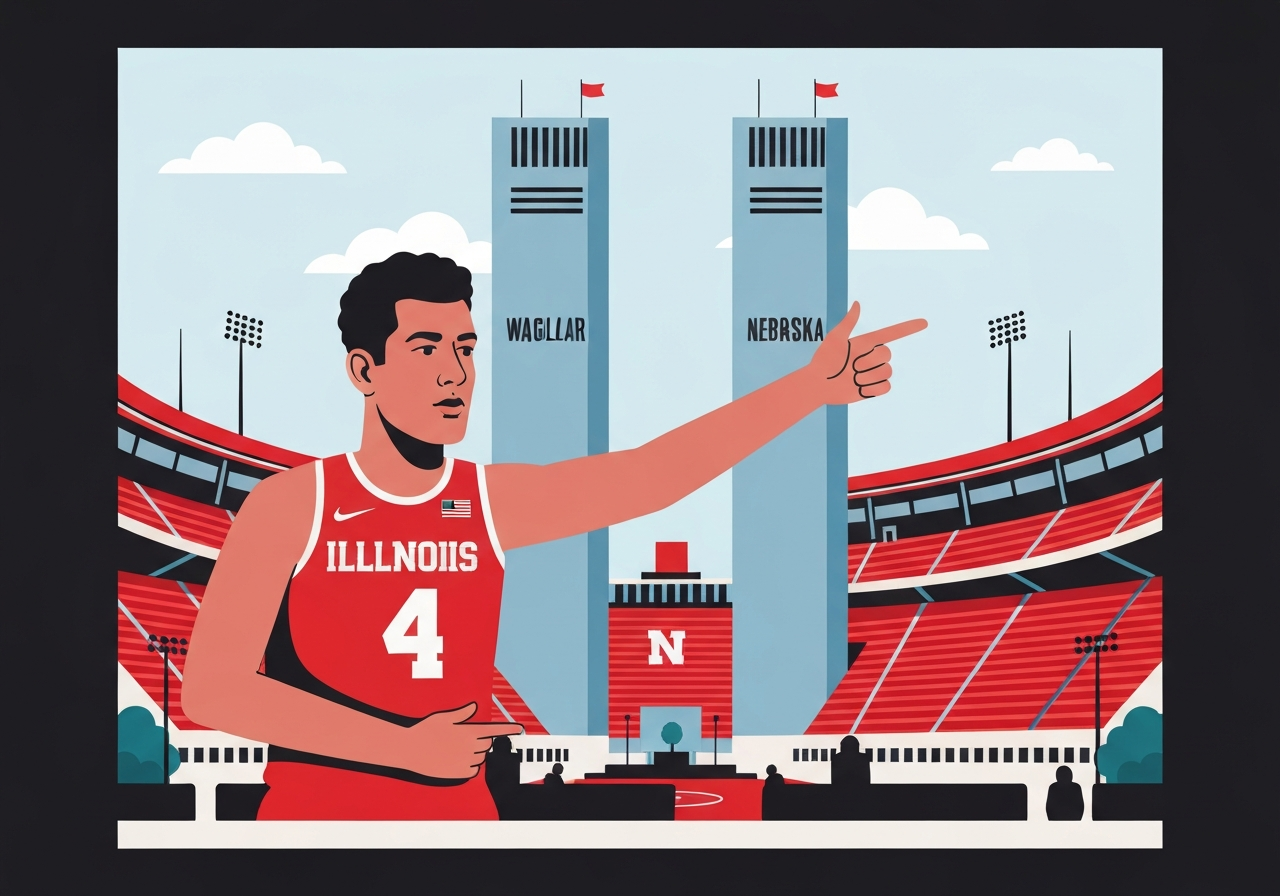
LINCOLN, Neb. — On Sunday Illinois delivered a decisive response to its Dec. 13 setback at Nebraska, beating No. 5 Nebraska 78-69 in Lincoln. Freshman guard Keaton Wagler poured in a game-high 28 points, with 24 coming in the second half, while Illinois controlled the paint and the boards. The victory was Illinois’s 11th straight since that December loss and improved the Illini to 19-3 overall, 10-1 in Big Ten play. Nebraska, now 20-2 and 9-2 in the conference, saw a strong first-half perimeter outburst fade as Illinois imposed its frontcourt size in the second half.
Key Takeaways
- Final score: Illinois 78, Nebraska 69 in Lincoln on Sunday, snapping Nebraska’s 20-0 start earlier in the season.
- Keaton Wagler scored a game-high 28 points, including 24 in the second half, and added five rebounds and five assists.
- Nebraska connected on 15 three-pointers overall, hitting 11 in the first half but just 4 of 15 in the second half.
- Illinois dominated inside, outscoring Nebraska 28-18 in the paint and outrebounding them 40-27.
- Free throws were decisive: Illinois led the line 21-4 and converted 10 of Wagler’s 12 attempts after he drew 12 fouls.
- Illinois has won 11 straight games since the Dec. 13 loss to Nebraska and is 6-0 on the road in Big Ten play this season.
- The Ivisic twins combined for 19 points on 8-for-10 shooting, 15 rebounds and three blocks, bolstering Illinois’s interior advantage.
Background
Illinois entered the game having lost to Nebraska on Dec. 13, a result that has since become the program’s only defeat in a streak of wins that has reshaped the Illini’s season. The two programs carry Big Ten title implications into this stretch, with Illinois ascending into the top 10 and Nebraska rising to a top-5 national ranking after a 20-0 run earlier in the year. Both teams feature contrasting strengths: Nebraska’s perimeter shooting and offensive spacing versus Illinois’s length and interior depth.
Personnel developments affected lineups for both teams. Nebraska’s Braden Frager returned from an ankle absence and provided an immediate scoring boost off the bench, while Illinois leaned on a frontcourt rotation that includes the Ivisic twins and David Mirkovic. Those matchups framed a game that began as a three-point barrage from Nebraska and evolved into an inside battle where Illinois could leverage size and rebounding to reverse momentum.
Main Event
Nebraska jumped to an early 9-4 edge after two three-pointers by Payton Sandfort, but Illinois answered with an 11-3 run to lead 15-12. The Illini then briefly used a Twin Towers look featuring Tomislav and Zvonimir Ivisic and at one point fielded five players taller than 6-foot-7, sparking a 10-2 stretch that made it 25-20. Nebraska closed the half with a barrage, hitting six of its next seven triples from four different players to take a 39-33 lead into halftime.
The turning point came after halftime, when Illinois opened with a 13-5 run and then a critical 10-0 spurt late in the second half. Keaton Wagler and Jake Davis hit threes during that run, and Wagler’s second-half scoring surge carried Illinois to a 66-55 lead with 6:45 remaining. Nebraska never cut the margin below seven in the closing minutes as Illinois protected the lead with free throws and interior defense.
On the stat sheet, Illinois owned the paint 28-18 and the glass 40-27, while converting opportunities at the foul line 21-4. Tomislav Ivisic paced the frontcourt with 12 points, eight rebounds and three assists, while Zvonimir chipped in seven points, six rebounds and two blocks off the bench. David Mirkovic added 10 points and eight rebounds to round out the Illini’s interior production.
For Nebraska, Braden Frager led the team with 20 points off the bench, going 6 of 12 from three. Payton Sandfort finished with 14 points but managed only two in the second half. Sam Hoiberg posted a 13-6-6 line and Jamarques Lawrence scored 10, while center Rienk Mast struggled to 2-for-10 shooting and five points after missing the prior two games with injury.
Analysis & Implications
This win has immediate and broader implications for Illinois. In the short term it cements Illinois as a major contender in the Big Ten race, placing the Illini alongside Michigan and others at the top of the standings. The victory over a top-5 opponent on the road strengthens Illinois’s quadrant 1 resume, now counting as a fifth Quad 1A win, which matters heavily for NCAA selection and seeding discussions.
Scheme-wise, Illinois illustrated a viable blueprint against high-volume perimeter teams: clog the paint with size, win the rebound battles, and force opponents into lower-value possessions. Nebraska’s first-half three-point success was countered by the Illini’s interior control and free-throw dominance in the second half, a combination that swung efficiency margins decisively.
Keaton Wagler’s emergence as a two-way go-to option shifts Illinois’s ceiling upward. His ability to score off the ball and create after halftime runs gives Illinois a second-half offensive engine, while the frontcourt’s ability to alter shots and secure defensive rebounds allows the backcourt freedom to operate. If Illinois sustains both the Wagler scoring bursts and reliable frontcourt defense, their national and conference outlooks improve considerably.
Comparison & Data
| Category | Illinois | Nebraska |
|---|---|---|
| Final Score | 78 | 69 |
| Three-Pointers | N/A | 15-35 (11 in 1H) |
| Points in Paint | 28 | 18 |
| Rebounds | 40 | 27 |
| Free Throws | 21 | 4 |
| Blocks | 6 | N/A |
| Fastbreak Points | 3 | 8 |
The table highlights where the game was decided: Illinois’s advantage on the offensive glass and at the foul line offset Nebraska’s perimeter volume. Nebraska’s 11 first-half threes created a halftime lead, but the Cornhuskers were unable to sustain that efficiency after the break and made just four second-half threes. Illinois’s ability to convert trips to the foul line and limit Nebraska on the offensive glass in the second half widened the margin enough to secure the road win.
Reactions & Quotes
Postgame remarks from both teams emphasized adjustments and momentum. Illinois staff and players credited halftime corrections and frontcourt effort for the second-half reversal, while Nebraska reflected on an inability to maintain first-half shooting and on fatigue against Illinois’s size.
We were able to clean up the paint and get to the line, which changed the game in the second half.
Illinois coach postgame (paraphrased)
Observers noted Wagler’s late-game control and the Ivisic twins’ matchup advantage as decisive factors. Nebraska sources pointed to the hot first half from distance and the difficulty of sustaining that level against a physical interior team.
Keaton took over in the second half and our frontcourt answered when it mattered most.
Illini player reaction (paraphrased)
Unconfirmed
- Long-term award projections, such as Wagler being the clear frontrunner for Big Ten Player of the Year, remain speculative and depend on performance across the rest of the season.
- The exact number of fouls drawn attributed solely to Wagler was reported as 12; confirmation from official play-by-play and box score should be consulted for a play-by-play foul breakdown.
- Any notion that this single win guarantees a top seed is not certain; future conference results and NCAA evaluation metrics will be decisive.
Bottom Line
Illinois’s 78-69 victory in Lincoln is more than a marquee win on the resume; it is proof that the Illini can overcome elite three-point shooting by enforcing an interior identity. Wagler’s second-half scoring and the Ivisic twins’ physical presence created a clear blueprint Illinois can use against perimeter-oriented opponents.
For Nebraska, the result exposes the risk of relying on superlative perimeter efficiency without an interior counterbalance. For Illinois, maintaining the combination of Wagler’s playmaking and steady frontcourt production will determine whether this team remains a legitimate Final Four contender and a serious Big Ten title threat.