
Lead
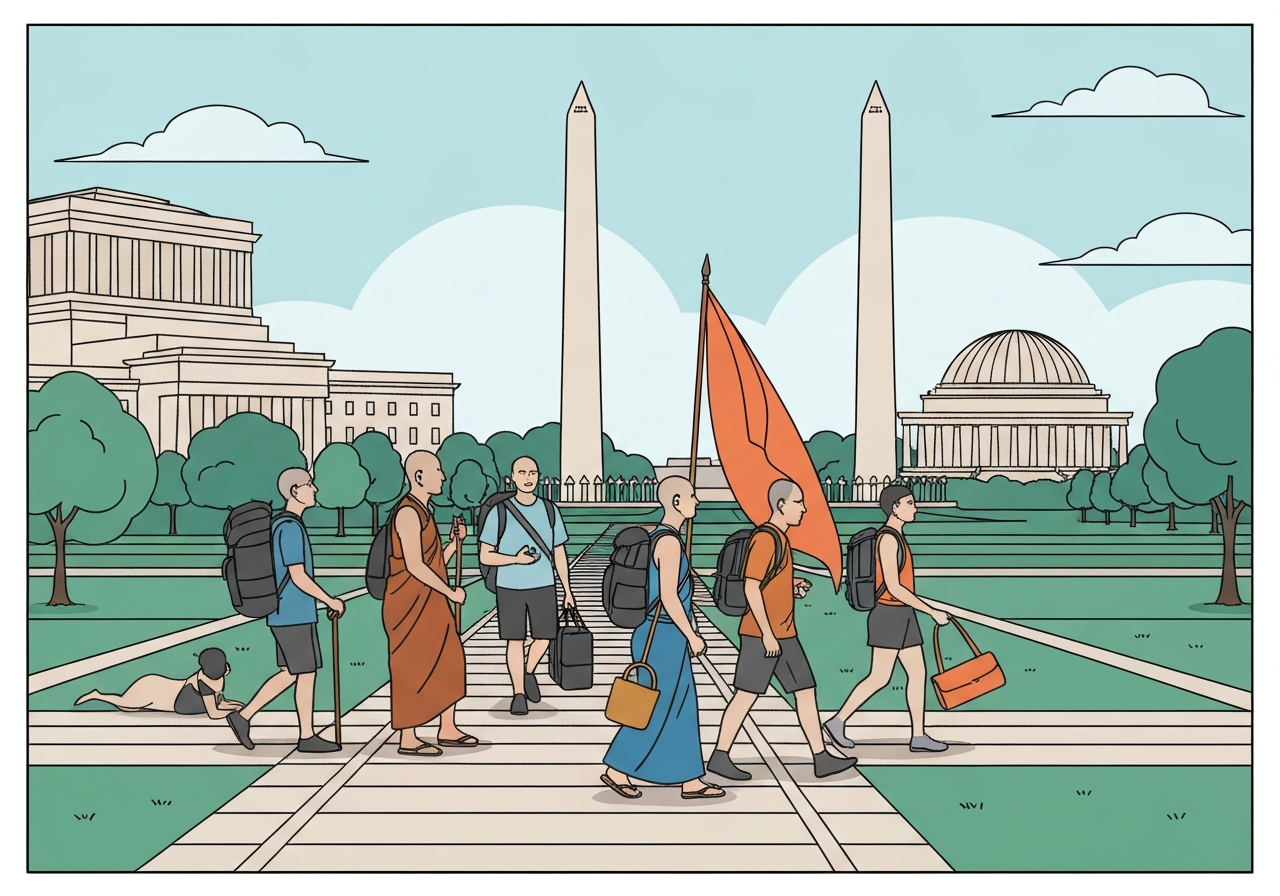
A group of Theravada Buddhist monks arrived in Washington, D.C., on Tuesday, completing a 15-week, roughly 2,300-mile (3,700-kilometer) “Walk for Peace” that began in Fort Worth, Texas. They crossed the Potomac via Chain Bridge shortly after 8 a.m., drawing large, often silent crowds along city streets. The saffron-robed procession — accompanied by a rescue dog named Aloka — sought to promote a simple message of peace amid political polarization. The visit will include stops at American University, the Washington National Cathedral and the Lincoln Memorial.
Key Takeaways
- The walk began Oct. 26, 2025, at the Huong Dao Vipassana Bhavana Center in Fort Worth and covered about 2,300 miles over roughly 15 weeks.
- Organizers said the public portion in Washington included nearly 3,500 people at American University’s Bender Arena and large crowds along the route.
- Two monks were hurt in a November highway crash near Houston; Venerable Maha Dam Phommasan had a leg amputated and later rejoined the group in a wheelchair.
- The trek lasted 108 days of walking, a number held sacred in several South Asian religions and cited by organizers as spiritually significant.
- Authorities provided rolling road closures and police escorts to protect participants and spectators during the group’s Washington appearances.
- Leaders said the walk is a spiritual offering rather than a political campaign, though they plan to submit a request to lawmakers to recognize Vesak, the Buddha’s birthday.
Background
Peace walks are a longstanding practice in Theravada Buddhism, intended as a public expression of nonviolence and mindfulness. The current walk was organized by the Huong Dao Vipassana Bhavana Center in Fort Worth and included monks from multiple monasteries; its leader, Venerable Bhikkhu Pannakara, served as the visible organizer and spokesperson. Social media amplified the procession, with millions reported to have followed updates online and local crowds greeting the group from Alabama through Virginia. The walk’s nonpartisan framing — emphasizing personal cultivation of peace over policy advocacy — has been a repeated theme from organizers.
Earlier long-distance journeys by Pannakara inspired aspects of this trek: he met Aloka, the rescue dog, during a 112-day walk across India in 2022. That precedent shaped the group’s approach to public engagement — quiet, solemn processions punctuated by short addresses and interfaith moments. The walk’s route threaded small towns and major cities, producing varied local responses and logistical challenges such as winter weather and highway safety. Organizers relied on escorts, volunteers and local hosts to manage crowds and ensure the monks’ safety.
Main Event
On Tuesday morning the monks marched single file across Chain Bridge into the District of Columbia, escorted by police on bicycles and in vehicles. After a night in Arlington, Virginia, the group entered American University’s Bender Arena, where volunteers had laid out a blanket for Aloka and nearly 3,500 people filed in to watch in respectful silence. Pannakara addressed the gathering, stressing the personal and collective importance of walking for peace and asking how many were willing to take action to cultivate harmony.
The trek has not been without hardship. In November, while walking near Houston, the monks’ escort vehicle was struck by a truck; two monks were injured and Venerable Maha Dam Phommasan later required amputation of a leg. Organizers and the community assisted with recovery logistics, and Phommasan rejoined the procession near Washington, entering the arena in a wheelchair — a moment many in the crowd described as deeply moving.
In Washington the group visited the National Cathedral and prepared to appear at the Lincoln Memorial, with interfaith leaders joining Pannakara on steps and at a reception hosted in part by Washington Episcopal Bishop Mariann Budde. Police issued rolling road closures along the route to protect the monks and spectators, and local volunteers helped wheelchair users and others navigate icy sidewalks. Officials and organizers emphasized safety while accommodating large, often silent crowds who came to witness the procession.
Analysis & Implications
The Walk for Peace combines religious practice with public visibility, and its broad reception illustrates how ritualized nonviolent action can resonate across ideological divides. In a polarized civic environment, the visual of saffron robes and silent marchers offered many Americans a momentary respite from partisan contention, which can bolster civic cohesion in localized ways. Organizers’ deliberate refusal to frame the walk as a political movement has likely broadened appeal, though it does not eliminate the potential for political interpretation.
Requests to recognize Vesak as a national holiday demonstrate how spiritual initiatives can evolve into civic propositions; organizers say such recognition is not the primary aim, but the proposal will nonetheless test lawmakers’ receptivity to religious observances entering public policy debates. If legislators give it formal consideration, conversations will likely pivot to questions of precedent, pluralism and the limits of state recognition for faith-based holidays. The episode could also prompt other faith groups to seek comparable observances.
From a security and logistics perspective, the successful management of rolling closures and large, silent crowds suggests a model for coordinating open-air religious processions with municipal authorities. The public-health and accessibility aspects — notably aiding participants with mobility needs — were visible in Washington and could influence how future long-distance pilgrimages plan medical and transport contingencies. Finally, the walk’s media footprint, amplified by social platforms and human-interest coverage, underscores the continuing role of narrative imagery in shaping public attention.
Comparison & Data
| Metric | Reported Value |
|---|---|
| Start date | Oct. 26, 2025 |
| Distance | ~2,300 miles (3,700 km) |
| Duration | ~15 weeks / 108 days of walking |
| Public attendance (Bender Arena) | ~3,500 people |
| Serious injuries | Two monks injured; one (Maha Dam Phommasan) had leg amputated |
The table above highlights the event’s scale and some concrete measurements reported by organizers and news outlets. Compared with many faith-based pilgrimages, the Walk for Peace combined long-distance endurance with frequent public stops and modern media outreach, which amplified its reach beyond the communities physically encountered along the route. The 108-day figure carries symbolic weight in several religious traditions, and organizers repeatedly invoked that symbolism in remarks and programming. The final legs in the Washington area drew the largest documented single gatherings and required heightened logistical coordination.
Reactions & Quotes
Officials, participants and observers offered a mix of gratitude, reflection and cautious admiration for the monks’ message and endurance. In Washington, thousands responded with silence and applause as a mark of respect when the monks entered the arena.
“This walk is very meaningful. This walk could change our life. How many of us are willing to walk to bring world peace?”
Venerable Bhikkhu Pannakara (group leader)
Pannakara framed the journey as a spiritual practice intended to ripple outward into society. His remarks at the cathedral and arena emphasized humility, interfaith solidarity and daily-minded compassion rather than political demands.
“It’s a spiritual offering, an invitation to live peace through everyday actions, mindful steps and open hearts.”
Long Si Dong (temple spokesperson)
Temple spokespeople repeatedly underlined that the walk was not intended as a legislative campaign, even as organizers planned to petition for recognition of Vesak. Responses from attendees reflected personal impact rather than political alignment.
“To see people gathering peacefully and setting an example, I think, is a wonderful thing.”
Jackson Vaughn (attendee, 33)
Vaughn, who has used a wheelchair since 2024, said the procession and the help of fellow travelers reinforced a sense of connection and independent movement that mattered to him personally.
Unconfirmed
- The precise size of the online audience is reported in the millions but has not been independently verified by a third-party analytics source.
- The outcome and legislative timetable for any formal request to declare Vesak a U.S. national holiday remain uncertain and depend on future congressional action.
- Details about medical follow-up and long-term recovery plans for the monks injured in the November crash are not fully documented in published reports.
Bottom Line
The Walk for Peace concluded in Washington as a high-profile act of religiously grounded civic presence: a long-distance spiritual practice that briefly united thousands of onlookers across multiple states. Its public reception — quiet, attentive and at times emotional — highlights how nonpolitical forms of protest and ritual can create shared civic experiences in a fractious moment. Organizers’ stated intent was to model inner peace as a social good rather than to pursue a defined political agenda.
Looking ahead, the walk may prompt conversations about how faith communities engage publicly, how municipalities support long-distance processions, and whether symbolic religious initiatives translate into concrete policy proposals such as holiday recognition. Regardless of any legislative outcome, the visual and human stories from this trek — including the recovery of injured monks and the presence of Aloka, the rescue dog — are likely to shape public memory of the event.