
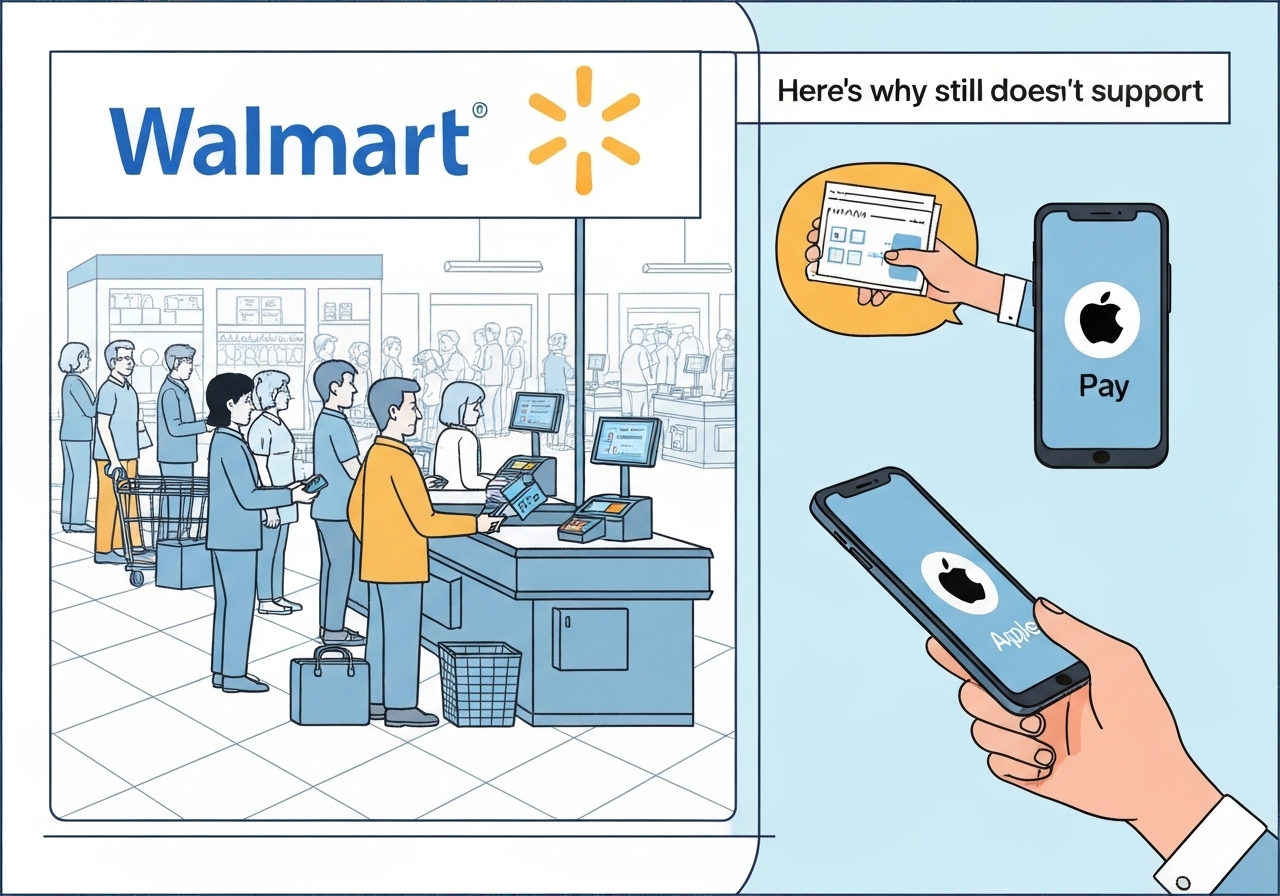
Lead: In 2026, Walmart continues to block NFC-based payments at stores across the United States, including Apple Pay, Google Pay and tap-to-pay cards. Instead the company steers customers toward QR-based Walmart Pay and a Scan & Go workflow for Walmart+ and Sam’s Club members. The stance has sparked renewed social-media frustration and debate about convenience versus retailer data collection. Walmart says its systems provide a touchless experience; critics say the choice is driven by control over shopper data.
Key takeaways
- Walmart does not accept NFC/contactless payments at U.S. stores in 2026; that includes Apple Pay, Google Pay and contactless cards.
- Walmart Pay, launched in 2016, uses QR codes linked to a customer’s Walmart account rather than NFC tap-to-pay.
- Scan & Go is available to Walmart+ and Sam’s Club members and bypasses traditional checkout, but also ties purchases to a Walmart account.
- Apple charges no extra merchant fee for Apple Pay; standard card processing fees still apply to retailers.
- Walmart has updated terminals in many locations to NFC-capable hardware but reportedly disables the NFC functions.
- Retailers such as Kroger, Home Depot and H-E-B eventually accepted Apple Pay; Walmart has not signaled a similar reversal.
- Walmart’s QR-first approach makes it easier for the company to associate transactions with customer profiles compared with tokenized NFC payments.
Background
Walmart introduced Walmart Pay in 2016 as a mobile checkout option that relies on the Walmart app and a QR-code scan at the register. The system was pitched as a way to offer contactless payments across a large store footprint while keeping transactions linked to Walmart customer accounts. Over the past decade many large U.S. retailers moved to support Apple Pay and other NFC systems to deliver faster tap-to-pay checkouts.
Where other chains have shifted—for example Kroger, Home Depot and H-E-B adopted Apple Pay after initially resisting—Walmart has kept its QR-first approach in the U.S. It is important to note that acceptance varies by country: many Walmart stores outside the United States, including much of Canada, already accept Apple Pay and other contactless methods.
Main event
In early 2026 the absence of Apple Pay at Walmart U.S. locations again drew viral attention on social platforms as shoppers posted videos and threads showing disabled NFC terminals. The practical effect for a customer is clear: to pay with a phone in a Walmart store you must either use the Walmart app’s QR workflow or Scan & Go if you’re a member of Walmart+ or Sam’s Club. Those options require signing into and linking payment methods to a Walmart account.
Technically, modern payment terminals in many Walmart stores are capable of NFC contactless transactions but are reportedly set to ignore NFC taps. That keeps the checkout flow on Walmart’s controlled pathways (Walmart Pay/Scan & Go) and prevents tap-to-pay alternatives from completing purchases at the terminal.
Walmart has repeatedly defended its approach as delivering a consistent, touchless checkout experience through its in-house tools. Company comments to the press emphasize convenience and investments in technologies designed to reduce friction at scale. Still, customers and some payments experts say the inconvenience of scanning a QR or opening an app sits at odds with the simplicity of two-second NFC taps.
Analysis & implications
At the center of the debate is data and control. QR-based checkouts that require a logged-in Walmart account make it straightforward for the retailer to tie every purchase to a customer profile. That data has commercial value for personalized promotions, inventory planning and advertising. By contrast, Apple Pay’s tokenization and privacy protections limit the granularity of data a merchant receives about the cardholder’s identity.
From a merchant-cost perspective the common claim that Apple charges retailers for Apple Pay acceptance is inaccurate: Apple’s widely reported fees are typically arrangements with card issuers, not an extra point-of-sale surcharge merchants pay per Apple Pay transaction. The financial barrier to enabling NFC is therefore lower than some commentators assume; the remaining question is strategic rather than purely technical.
Customer experience also matters. Many shoppers now expect tap-to-pay as standard; restaurants, convenience stores and many big-box retailers have offered it for years. Refusing NFC risks friction, longer queues and customer dissatisfaction—especially among frequent mobile-pay users. Over time this could nudge some shoppers to competitors that accept their preferred payment method.
Regulatory and antitrust scrutiny of platform control and data use is rising globally. If retailers are seen to disable a broadly available payment standard to preserve a proprietary data funnel, that practice could draw attention from consumer protection or competition regulators—though no formal investigations of Walmart on this matter were publicly announced as of January 2026.
Comparison & data
| Feature | Walmart (U.S.) | Apple Pay / NFC |
|---|---|---|
| Tap-to-pay (NFC) | Disabled at registers | Native support on most terminals |
| Mobile workflow | Walmart Pay (QR), Scan & Go | Tap via Wallet app |
| Data linked to account | High (Walmart account tied) | Lower (tokenized, limited data) |
| Merchant fees | Standard card-processing fees | Standard card-processing fees |
The table above summarizes the practical differences shoppers encounter. Walmart’s approach trades the speed and privacy benefits of NFC for tighter integration with its loyalty and marketing systems—an intentional trade-off with quantifiable impacts on data flow but less clear cost advantages.
Reactions & quotes
Walmart’s public position emphasizes in-house solutions that it says provide a touchless experience. A company spokesperson told press outlets that the retailer has implemented systems designed to let customers pay without touching shared surfaces and that it invested in Scan & Go and Walmart Pay to that end.
“We do not enable NFC and instead provide Walmart Pay and Scan & Go to deliver touchless payments and checkout experiences.”
Walmart (company statement to press)
Apple’s published guidance highlights the privacy mechanics of Apple Pay and the way tokenization limits card-data exposure to merchants.
“Apple Pay is designed so that your actual card numbers are not shared with merchants and are not stored on Apple servers—only a device-specific token is used.”
Apple (support documentation)
Technology press coverage and shopper posts stress the convenience trade-off. Reporters and users have described the lack of NFC at Walmart as a recurring friction point that reappears in public conversations whenever new battery-of-checkout videos circulate.
“Customers keep pointing out that scan-based checkouts feel slower and less convenient than tap-to-pay, and that frustration keeps resurfacing online.”
Technology press coverage and social posts
Unconfirmed
- Whether Walmart’s decision to disable NFC is driven solely by data-monetization objectives is not independently verified; Walmart frames it as a convenience and consistency choice.
- The exact internal economics—how much incremental ad or marketing revenue Walmart derives from QR-linked purchase data—has not been publicly disclosed.
- Any pending regulatory inquiries specifically targeting Walmart’s NFC policy had not been announced publicly as of January 18, 2026.
Bottom line
Walmart’s refusal to enable Apple Pay in U.S. stores in 2026 is a deliberate policy choice that prioritizes account-linked, QR-based payment flows over platform-level privacy protections. That approach secures richer customer-level data for Walmart but sacrifices some speed and convenience valued by many shoppers.
For consumers the practical takeaway is simple: if you want to use a phone to pay at a Walmart in the U.S., expect to use Walmart Pay or Scan & Go; bringing a contactless card or Apple Pay will not work at most registers. For policymakers and rivals, the situation highlights tensions between convenience, privacy and merchant control that will continue to shape payments policy and retail competition.