
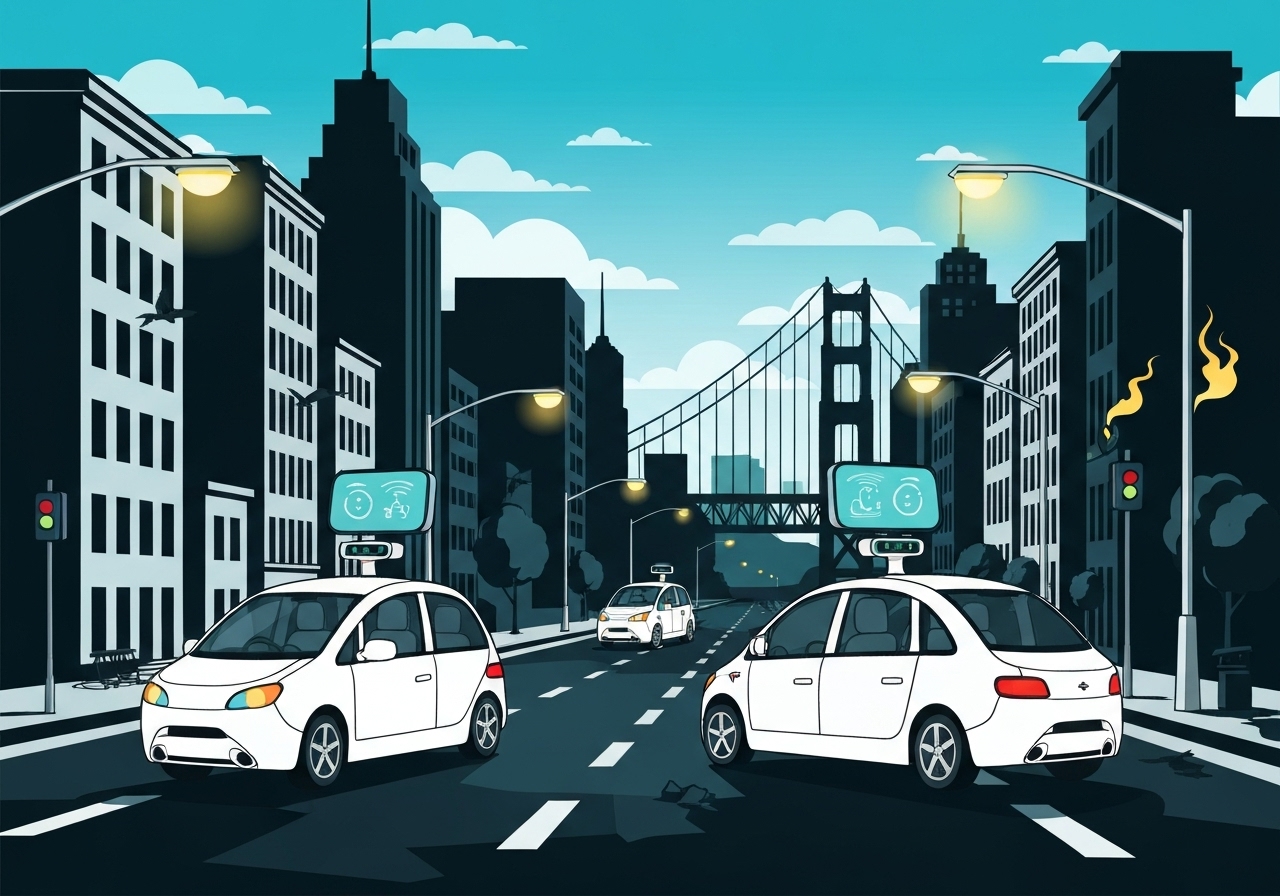
Lead: Waymo resumed its autonomous ride-hailing operations in San Francisco on Sunday, Dec. 21, 2025, after a sweeping power outage disrupted traffic signals across large portions of the city. The outage, partly traced to a fire at a Pacific Gas & Electric substation near Eighth and Mission Streets on Saturday, left roughly 130,000 homes and businesses affected and halted some driverless vehicles at intersections. Waymo paused service Saturday evening as emergency crews and city officials worked to manage intersections and transit disruptions. By early Sunday most power had been restored, though more than 20,000 customers remained without electricity.
Key Takeaways
- About 130,000 San Francisco accounts—roughly one-third of the city’s PG&E customers—were affected at the peak of the outage on Saturday, Dec. 20, 2025.
- More than 20,000 customers still lacked power early Sunday, Dec. 21, as crews continued restoration and investigations.
- Waymo proactively suspended ride-hailing service Saturday evening and said it resumed operations the following day after coordinating with city officials.
- Waymo vehicles are programmed to treat non-functioning traffic signals as four-way stops, but the company acknowledged the outage produced unusual traffic conditions.
- A fire inside a PG&E substation near Eighth and Mission Streets was identified as a key cause; the utility said the full failure is under investigation.
- City agencies deployed police, transit workers and emergency crews to manage intersections; BART and Muni services bypassed or suspended some downtown stops during the disruption.
- Tech rivals and observers used the incident to spotlight differences in autonomous-system training and emergency performance.
Background
San Francisco has been an important testing ground and commercial market for autonomous vehicles, with companies such as Waymo operating driverless ride-hailing services in densely trafficked neighborhoods. Those services depend on a stable combination of digital mapping, on-board sensors and predictable infrastructure such as powered traffic signals. When that infrastructure fails at scale, it creates atypical traffic patterns—dark intersections, pedestrians and manually directed traffic—that strain the logic built into autonomous navigation systems.
PG&E serves the city’s electricity needs through a distributed network of substations and feeders; when a major substation experiences an incident, outages can cascade across neighborhoods. Local government agencies, transit operators and emergency services plan for partial outages, but the confluence of a busy holiday weekend and a broad utility failure increased the operational complexity for public agencies and private mobility providers alike.
Main Event
The outage began Saturday morning and intensified through the afternoon, affecting neighborhoods including the Richmond, Sunset, Presidio, Golden Gate Park and parts of downtown. Social media and on-scene reports showed Waymo vehicles stopped at intersections with hazard lights on as traffic signals went dark or began flashing red. City officials urged residents to avoid nonessential travel while crews worked to manage intersections manually.
Waymo said most active trips were completed before the company paused service Saturday evening and directed vehicles either back to depots or to pull over safely. A Waymo spokesperson described close coordination with city officials as crews and police were dispatched to direct traffic in several high-traffic corridors. Transit operators reported that several BART and Muni downtown stations were bypassed or experienced suspended service.
PG&E identified a fire inside a substation near Eighth and Mission Streets as a key factor in the outage, but the utility emphasized that investigators were still determining the full scope of the failure. By early Sunday, crews had restored power to a majority of affected customers, though restoration work and follow-up repairs continued for tens of thousands still without service.
Analysis & Implications
The incident highlights a core vulnerability of autonomous fleets: dependence on functioning public infrastructure. When traffic signals fail across multiple neighborhoods, AV control systems encounter scenarios they may not routinely face in testing datasets, increasing reliance on fallback rules like four-way-stop behavior and human escalation pathways. That mismatch raises operational and safety questions for regulators and operators alike.
Operationally, the outage tested fleet-management decisions—whether to continue trips, pull vehicles to safe locations, or return to depots—as well as interagency coordination during a citywide emergency. Waymo’s choice to pause service was conservative from a safety-management perspective, but it also underlines how AV uptime is inextricably linked to external systems beyond the vehicle’s sensors and models.
Policy implications could follow. Regulators may press for clearer contingency requirements, reporting standards for incidents tied to infrastructure failures and joint emergency plans between utilities, cities and mobility firms. Insurance and liability frameworks could also evolve if agencies determine a need for special operational certifications when driving under widespread infrastructure outages.
Comparison & Data
| Measure | Value |
|---|---|
| Accounts affected at peak | ~130,000 |
| Customers still without power (early Sunday) | >20,000 |
| Geographic impact (noted neighborhoods) | Richmond, Sunset, Presidio, Golden Gate Park, parts of downtown |
| Waymo service status | Paused Saturday evening, resumed Sunday |
The table above summarizes the concrete, reported figures tied to the outage and Waymo’s operational response. Those numbers frame the magnitude of the utility failure and give a baseline for comparing future incidents or for measuring improvements in grid and mobility resilience.
Reactions & Quotes
Waymo emphasized rapid coordination with city officials and a commitment to incorporate lessons from the outage into future operations. The company framed its pause and restart as part of a safety-first approach to large-scale disruptions.
“We are resuming ride-hailing service in the San Francisco Bay Area.”
Waymo spokesperson Suzanne Philion
City leadership described emergency deployments and noted the multi-agency response to manage intersections and transit interruptions. Officials underscored the importance of public-safety teams in preventing chaos at key junctions.
“Waymo has also paused service,”
Mayor Daniel Lurie
Competitors and industry observers used the moment to contrast approaches to training and real-world exposure. One rival highlighted its own dataset and training claims while critics urged sober analysis rather than marketing opportunism.
“Trained on billions of real-world miles, including power outages.”
Tesla (public statement / social post)
Unconfirmed
- The investigation into the substation fire is ongoing; whether the fire was the sole cause of the cascading failures has not been publicly confirmed.
- Claims that any specific autonomous system is fully immune to large-scale infrastructure outages remain unverified and rely on vendor-provided performance descriptions.
- The precise number of Waymo vehicles stalled in intersections during the outage has not been published by either the company or city agencies.
Bottom Line
The December outage and its ripple effects on Waymo’s service underscore how autonomous mobility depends on resilient public infrastructure and clear emergency coordination. While Waymo’s safety protocols—like treating dead signals as four-way stops—are designed for these contingencies, citywide failures create rare edge cases that are hard to simulate exhaustively.
Expect renewed scrutiny from regulators, more detailed emergency-playbook coordination between utilities, cities and mobility providers, and potential policy discussions on minimum contingency standards for commercial autonomous services. For riders and city residents, the episode is a reminder that technological advances bring new interdependencies that must be managed collectively.
Sources
- San Francisco Chronicle — local news report (media)
- Waymo — company / official statements and service pages (official)
- Pacific Gas & Electric (PG&E) — utility / outage and incident information (official)
- City and County of San Francisco — municipal updates and emergency notices (official)