
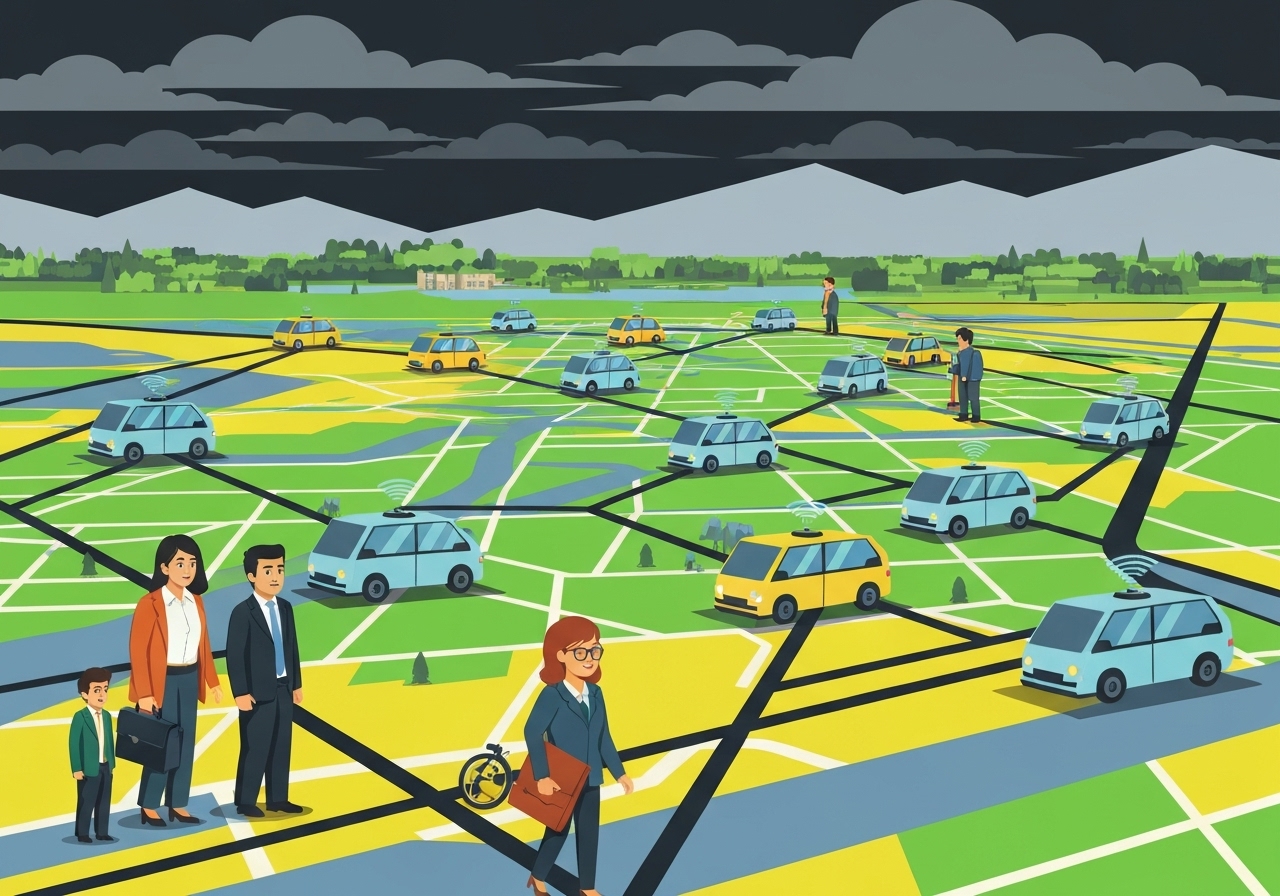
Lead: On Saturday a multi-hour power outage in San Francisco knocked out traffic signals across parts of the city and caused dozens of Waymo autonomous vehicles to stop at darkened intersections. The stoppages produced localized gridlock but no reported accidents or injuries, and tow truck operators removed some vehicles overnight. Following intervention from the mayor’s office, Waymo temporarily suspended its ride-hailing service in the Bay Area; the company said service was expected to resume shortly after 3:30 p.m. San Francisco time. Nearly 19,000 electricity customers still lacked power on Sunday afternoon, according to PowerOutage.com, while Pacific Gas & Electric said it expected full restoration by 2 p.m. Monday.
Key Takeaways
- An hourslong power outage in San Francisco on Saturday left traffic lights dark and caused Waymo vehicles to stop at intersections, creating congestion but no injuries.
- Waymo temporarily suspended its Bay Area ride-hailing service after the city raised concerns about the fleet’s role in gridlock; the company planned to resume service shortly after 3:30 p.m. San Francisco time.
- Nearly 19,000 electricity customers in San Francisco remained without power on Sunday afternoon per PowerOutage.com; PG&E stated on social media it expected full restoration by 2 p.m. Monday.
- Waymo operates roughly 1,000 vehicles in San Francisco, a fleet that has grown since the company entered the market in 2023 and that is regularly visible across city neighborhoods.
- Tow-truck operators reported towing Waymo vehicles overnight, and social media circulated multiple videos showing stalled cars with hazard lights blinking at intersections.
- City officials, Waymo representatives and PG&E coordinated in the immediate response; no formal safety incident or injuries were reported by authorities.
Background
Waymo expanded into San Francisco in 2023 and now runs a fleet of about 1,000 driverless vehicles in the city. The company’s cars have become a common presence on urban streets and a visible test case for how autonomous systems interact with existing road infrastructure. Autonomous vehicles depend on multiple inputs — cameras, lidar, GPS and traffic signal recognition — and darkened intersections remove one element of normal operating cues.
San Francisco’s electrical outage over the weekend affected tens of thousands of customers across the region and temporarily disabled traffic-control devices in multiple neighborhoods. Pacific Gas & Electric posted that it anticipated full restoration by 2 p.m. Monday, while independent outage trackers recorded nearly 19,000 customers without power on Sunday afternoon. Urban transportation systems are susceptible to cascading effects when power controls fail, as signal outages quickly elevate congestion and complicate both human and automated driving.
Main Event
Late Saturday, a broad outage caused many traffic signals to lose power; Waymo vehicles approaching dark intersections stopped because their perception systems could not detect active traffic lights. Operators and drivers of conventional cars reported backups as autonomous vehicles remained stationary with hazard lights illuminated. Tow trucks worked through the night to move some stalled Waymos off key junctions, according to tow operators who spoke with reporters and posted updates on social platforms.
A representative from the San Francisco mayor’s office contacted Waymo about the gridlock the cars were contributing to, and the company’s spokesperson said the decision to suspend service followed that outreach. The suspension covered Waymo’s ride-hailing operations in the Bay Area into Sunday afternoon. Waymo emailed statements to media outlets describing the pause and the company’s coordination with city officials while crews and utility workers addressed the outage.
Throughout the outage social media platforms filled with short videos and photos showing driverless cars stopped in travel lanes. City traffic-management teams worked to clear intersections and, where feasible, deploy personnel to direct traffic manually. Officials emphasized that there were no reported collisions or injuries linked to the stalled autonomous vehicles during the event.
Analysis & Implications
The incident highlights a known operational limitation of many autonomous systems: dependency on external infrastructure and visible signals. When traffic lights fail, AVs that rely on signal recognition and conservative fallback strategies — such as stopping when a signal is unreadable — can exacerbate congestion rather than resolve it. That conservatism prioritizes safety but can conflict with efficient traffic flow in dense urban settings.
For cities evaluating larger deployments of autonomous fleets, the episode raises questions about coordination protocols between fleet operators and municipal authorities. The mayor’s office intervention demonstrates one practical route: rapid communication that can trigger a temporary suspension to reduce immediate harm to the broader traffic network. Regulators may now examine whether mandatory contingency procedures or city-managed override mechanisms should be required for commercial AV operations during infrastructure failures.
Economically, suspended service affects riders who depend on Waymo for errands, school runs and perceived safety advantages; the company’s market acceptance in parts of the city may hinge on reliably navigating outages and other edge cases. For Waymo and similar operators, the event will probably prompt technical and operational reviews — from software behavior at unlit intersections to dispatch rules that avoid high-risk zones during outages.
Comparison & Data
| Metric | Reported Value |
|---|---|
| Waymo vehicles in San Francisco | ~1,000 |
| Customers without power (Sunday afternoon) | Nearly 19,000 |
| Reported injuries from incident | 0 |
The table above places the fleet size alongside the number of customers affected by the outage and the reported safety outcome. While the fleet number explains why multiple intersections were affected, the absence of injuries underscores that the vehicles’ conservative responses did not create measurable harm in this instance. Still, the operational trade-offs between safety-first behavior and traffic flow efficiency are now more visible to both regulators and the public.
Reactions & Quotes
City officials said they flagged the operational disruption to Waymo to limit congestion while infrastructure repairs proceeded. The following selected statements were shared publicly.
“The decision to suspend services occurred after the mayor’s team contacted the company about the significant gridlock its cars were contributing to.”
San Francisco mayor’s office (representative)
This characterization indicates direct municipal engagement; the mayor’s office intervened as a tactical step to reduce downtown bottlenecks while traffic signals remained inoperative.
“The service was expected to resume shortly after 3:30 p.m. San Francisco time.”
Waymo spokesperson
Waymo framed the pause as temporary and said its teams were coordinating with city and utility personnel to restore normal operations once the grid and traffic controls were back online.
“[We] expected to have all power restored by 2 p.m. Monday.”
Pacific Gas & Electric (social media post)
PG&E’s public timeline set a target for full restoration, providing a schedule around which city agencies and fleet operators could plan resumption of normal services.
Unconfirmed
- Whether Waymo’s onboard sensors or a specific software component directly misinterpreted the darkened signals; company technical logs have not been released publicly.
- Whether a different fallback configuration (for example, carefully proceeding through intersections when safe) would have reduced gridlock without increasing collision risk; this trade-off remains under evaluation.
- Any immediate regulatory changes or fines from the city tied to this specific incident; municipal responses beyond the operational request to suspend service were not announced.
Bottom Line
The San Francisco outage underlined a structural vulnerability for autonomous fleets: when urban infrastructure fails, conservative AV behavior can compound traffic disruption even as it maintains safety. In this case, the trade-off favored zero injuries but produced notable congestion and public criticism, prompting temporary suspension of services after municipal intervention.
Going forward, expect both policy and technical responses: cities may seek clearer contingency protocols for commercial AVs, while operators like Waymo will likely revisit fallback strategies, geo-fencing rules and real-time coordination mechanisms with municipal agencies and utilities. For riders and residents, the episode is a reminder that autonomous systems operate within—and depend upon—the broader reliability of public infrastructure.
Sources
- The New York Times (news)
- PowerOutage.us (independent outage tracker)
- Pacific Gas & Electric (utility — public statement/outage communications)
- City & County of San Francisco (municipal communications)
- Waymo (Alphabet) (company statements/press)