
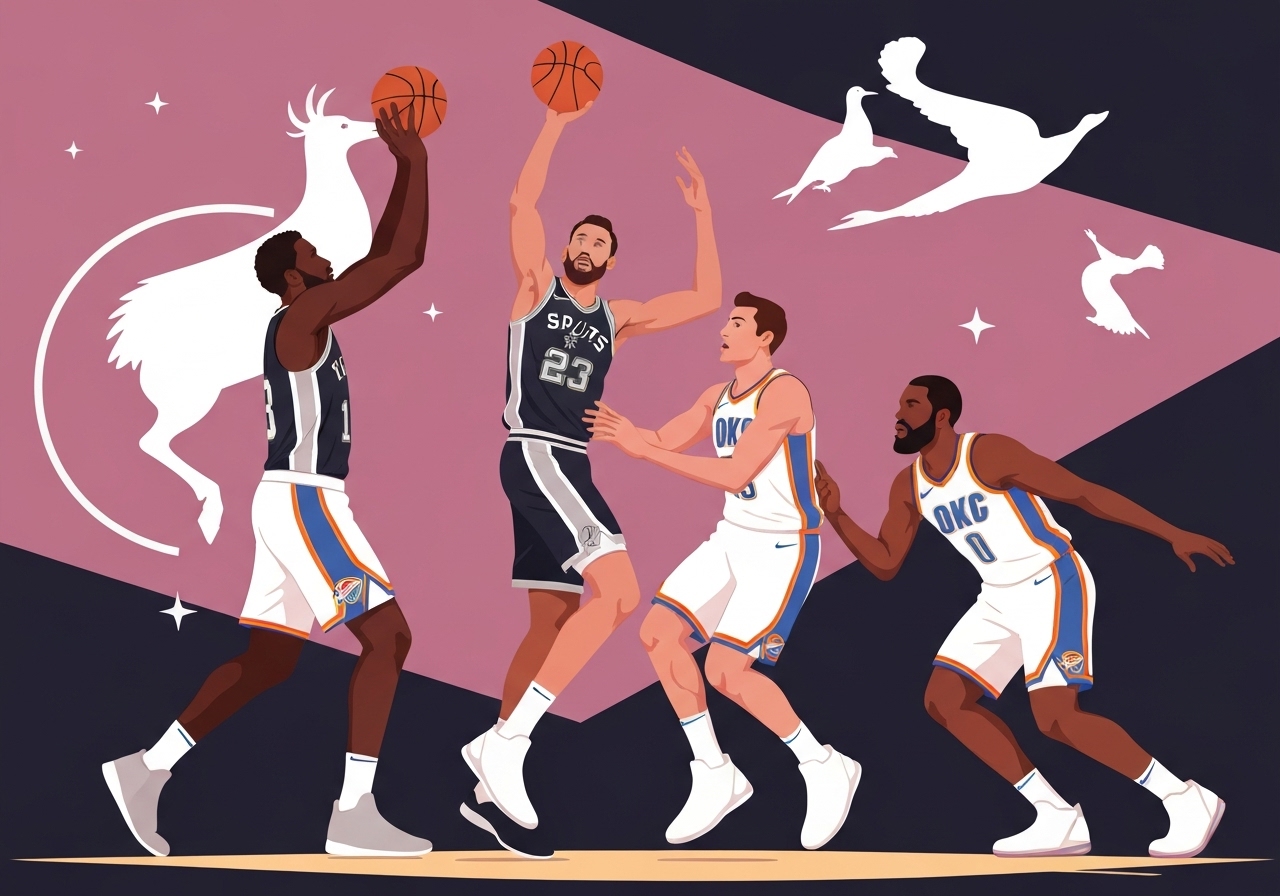
Victor Wembanyama returned from a 12-game absence on Dec. 14, 2025, in Las Vegas and provided an immediate lift as the San Antonio Spurs edged the Oklahoma City Thunder 111-109 to reach the NBA Cup final. Wembanyama finished with 22 points and nine rebounds in a limited 21-minute stint while the Spurs’ balanced attack overcame a Thunder club that entered 24-2. San Antonio will meet the New York Knicks in Tuesday night’s championship game. The defeat halted Oklahoma City’s 16-game winning run and was only the Thunder’s second loss of the season.
Key Takeaways
- Victor Wembanyama returned from a strained left calf after a 12-game absence and posted 22 points and nine rebounds in 21 minutes, finishing +21 on the night.
- The Spurs defeated the Thunder 111-109 in Las Vegas on Dec. 14, 2025, advancing to the NBA Cup final against the New York Knicks.
- Oklahoma City entered the game 24-2 and on a 16-game winning streak; their only other loss came Nov. 5 at Portland.
- San Antonio received a scoring lift from Devin Vassell (23 points); De’Aaron Fox and Stephon Castle each contributed 22 points.
- Shai Gilgeous-Alexander led the Thunder with 29 points; Chet Holmgren and Jalen Williams added 17 points apiece.
- The Spurs went 9-3 during Wembanyama’s absence this season; his minutes were restricted but his impact was immediate and efficient.
- Oklahoma City’s start (24-2) is the second-best since the 2015-16 Golden State Warriors began 25-1, underscoring the significance of the upset.
Background
The NBA Cup has become a high-stakes midseason showcase, and both San Antonio and Oklahoma City entered Las Vegas with clear objectives: the Spurs to prove readiness when fully healthy, the Thunder to continue an early-season dominance. Oklahoma City’s 24-2 record represented one of the league’s most explosive openings since the 2015-16 Golden State Warriors, and the Thunder arrived riding a 16-game winning streak. San Antonio, by contrast, had been managing life without Victor Wembanyama while compiling a 9-3 ledger in his absence, a stretch that tested its depth and rotation.
Wembanyama missed 12 games with a strained left calf before being cleared to play in the Cup semifinal under a minutes restriction. The decision to return him for a controlled role reflected both medical caution and the Spurs’ need for a defensive and offensive presence inside. For Oklahoma City, last year’s Cup final loss to Milwaukee (97-81) and the Thunder’s broader title ambitions have placed extra attention on any test that could expose limits in their depth or defense.
Main Event
Wembanyama’s entry into the semifinal injected energy immediately; he removed his warmup pants before the second quarter and drew loud “M-V-P” chants from the Spurs crowd. Playing under a strict minutes cap, he still turned in a +21 plus-minus in 21 minutes and gave San Antonio a presence on both ends that altered Oklahoma City’s interior plans. The Spurs trailed at halftime by three after a first half in which Wembanyama was +20 in roughly seven minutes of action, but they trimmed the margin late in the half with a 13-point run to narrow the deficit.
San Antonio seized momentum in the third quarter with a 10-0 spurt that put the Spurs ahead 62-56 and set up a tense, tightly contested fourth. Devin Vassell paced the Spurs with 23 points while De’Aaron Fox and Stephon Castle each added 22, sharing scoring responsibilities that prevented the Thunder from keying solely on Wembanyama. Oklahoma City relied on Shai Gilgeous-Alexander’s 29 points and supporting 17-point efforts from Chet Holmgren and Jalen Williams, but late-game stops and turnovers swung the game San Antonio’s way.
The final minutes featured back-and-forth possessions, free-throw sequences and clutch stops; at the final buzzer the scoreboard read 111-109 in favor of the Spurs. San Antonio’s rotation decisions and Wembanyama’s efficient minutes were decisive in a game where small margins and bench contributions determined the outcome.
Analysis & Implications
Wembanyama’s return, even on a minutes restriction, changed the Spurs’ profile instantly. His presence altered Oklahoma City’s shot selection and rebounding matchups, producing a defensive ripple that teammates exploited. That plus-minus of +21 in 21 minutes is a quantitative marker of impact, but the qualitative effect — crowd momentum, opponent adjustments and lineup flexibility — is equally important for San Antonio’s trajectory heading into the final.
For the Thunder, the loss raises questions about resilience in high-pressure tournament settings despite an otherwise exceptional start. Oklahoma City’s 24-2 record and 16-game streak reflected a team operating at an elite level, but single-elimination games magnify small rotations and late-game execution issues. The Thunder’s depth will be scrutinized: can secondary options produce consistent late-game outcomes when SGA is contained or fatigued?
The upcoming final against the New York Knicks tests San Antonio in different ways: the Spurs will need to manage Wembanyama’s minutes across a shorter preparation window while preserving his effectiveness. If the Spurs can replicate efficient production from Wembanyama alongside balanced scoring from Vassell, Fox and Castle, they have a plausible path to the Cup. Conversely, if the minutes cap limits rim protection or offensive continuity, the Knicks’ frontcourt and halfcourt sets could exploit friction points.
Comparison & Data
| Team/Season | Start (record) | Notable metric |
|---|---|---|
| Oklahoma City Thunder (2025-26) | 24-2 | 16-game winning streak entering semifinal |
| Golden State Warriors (2015-16) | 25-1 | Best start in modern era referenced |
| San Antonio Spurs (without Wembanyama) | 9-3 | Spurs record during Wembanyama’s absence |
The table places Oklahoma City’s hot start in historical context — the Thunder’s 24-2 opening is rare and sits just behind the 2015-16 Warriors’ 25-1. San Antonio’s 9-3 stretch without Wembanyama showed internal resilience, and his return in the Cup adds a new variable. These numbers frame Tuesday’s final as both a test of the Spurs’ load management and Oklahoma City’s ability to rebound from an unexpected loss.
Reactions & Quotes
“M-V-P” chants rang out when Wembanyama removed his warmups, manifesting the crowd’s enthusiasm for his return.
Spurs fans, arena observation
Wembanyama’s box score — 22 points, nine rebounds and +21 in 21 minutes — was widely noted as the decisive efficiency in a close game.
Game box score (ESPN)
The upset immediately sparked commentary about the Thunder’s late-game execution and San Antonio’s rotation strategy heading into the final.
League analysts (media coverage)
Unconfirmed
- Any longer-term effect of Wembanyama’s strained left calf on his availability beyond the NBA Cup final has not been disclosed by the Spurs’ medical staff.
- The exact minute allocation Wembanyama will receive in Tuesday’s final and whether it will change based on in-game conditions remains undecided by coaching staff.
- Internal adjustments the Thunder will make to rotation and late-game strategy have not been formally released and were still being evaluated by Oklahoma City coaches.
Bottom Line
Victor Wembanyama’s return in a limited role catalyzed a narrow Spurs upset that stopped Oklahoma City’s 16-game streak and advanced San Antonio to the NBA Cup final. The game underscored how a single elite player’s efficient minutes can shift outcomes in single-elimination settings. San Antonio now faces the New York Knicks with a key question: can they preserve Wembanyama’s health while extracting enough impact to win the Cup?
For the Thunder, the loss is a reminder that a dominant regular-season start does not guarantee invulnerability in a tournament environment; roster depth and late-game execution will be focal points moving forward. The Cup final will test both teams’ ability to adapt strategy quickly and manage star minutes under pressure.