
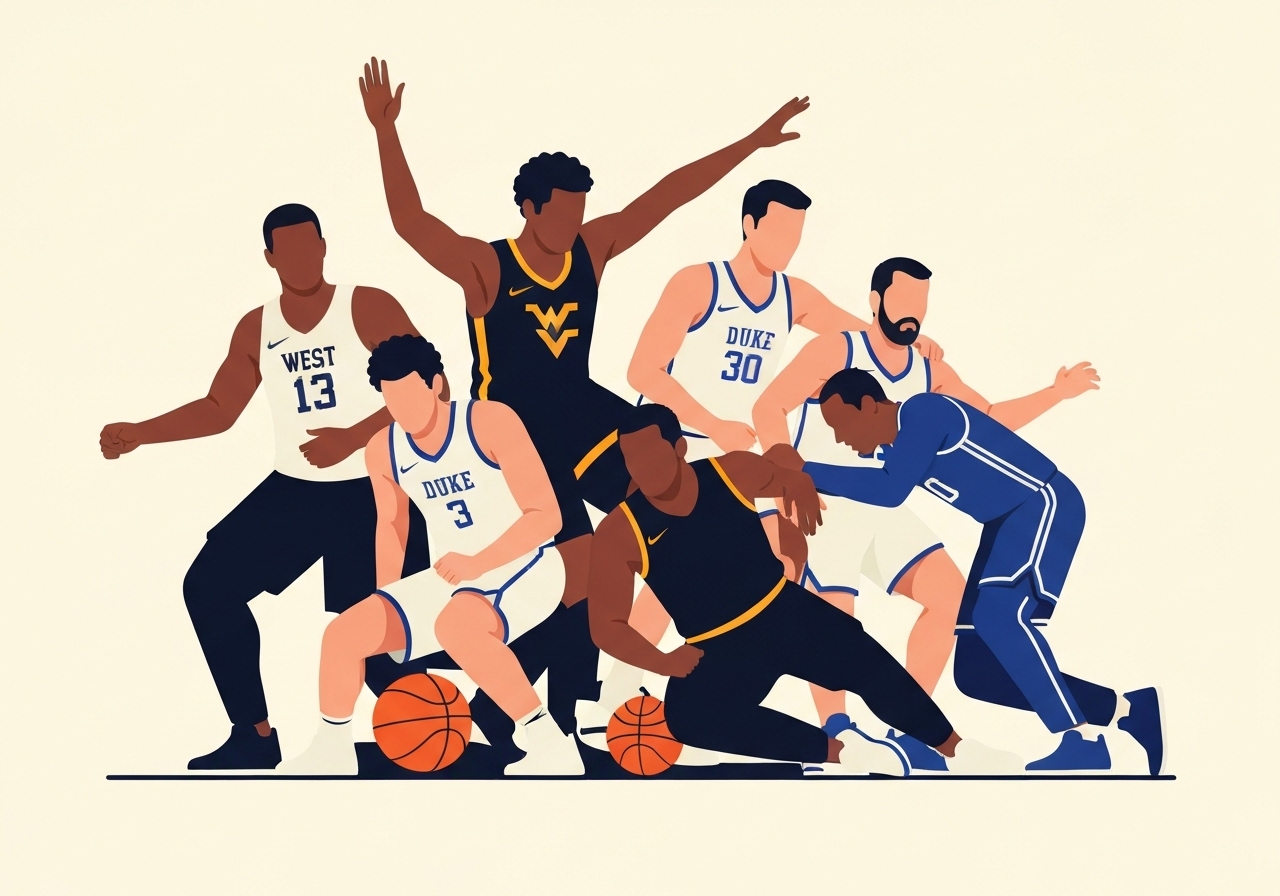
Lead: On Friday night, November 15, 2025, at The Greenbrier Tip-Off, West Virginia defeated No. 15 Duke 57-49 after a bench-clearing melee at the end of the first half resulted in seven total ejections. Officials ruled that six Mountaineers were among those tossed — including multiple starters — leaving WVU with only five players to begin the second half. Despite the numbers disadvantage, West Virginia rallied behind a 24-9 third-quarter surge and held on for the victory. Coach Mark Kellogg called the sequence “the craziest game” of his career but praised his team’s resolve after the win.
Key Takeaways
- Seven players were ejected at halftime following a skirmish; game officials identified six West Virginia players among those ejected and two Duke players were also removed.
- Four WVU starters were reported as among the players who left the bench during the incident, a rule violation that carries automatic ejection under game enforcement.
- The game ended West Virginia 57, Duke 49; the Mountaineers improved to 4-0 while Duke fell to 2-2 in the early season.
- Backup guard Célia Rivière scored 12 points in a season-high 22 minutes, stepping into an expanded role after the ejections.
- West Virginia turned the contest with a 24-9 third-quarter run after trailing 23-20 at halftime when the fracas began.
Background
The contest was part of The Greenbrier Tip-Off, an early-season neutral-site event that has drawn top programs seeking competitive tune-ups. Both programs entered the weekend with heightened stakes: West Virginia trying to establish a fast start and Duke seeking consistency against ranked opponents. Bench discipline and roster depth are recurring themes in early nonconference play, where teams test rotations and personnel limits ahead of conference schedules.
College basketball rules on on-court altercations are strict; leaving the bench during an altercation typically triggers automatic ejection and can prompt further review by conference offices. That context matters here because when multiple players depart the bench, it not only alters immediate rotations but also can trigger institutional reviews and possible suspensions that affect coming games.
Main Event
The incident began at the end of the first half when Duke’s Jordan Wood blocked a 3-point try by West Virginia’s Jordan Harrison, preserving a 23-20 halftime advantage for Duke. Video and reports show Wood and Harrison exchanging words and physical contact after the block; Harrison shoved Wood, and a Duke teammate intervened, escalating a brief cluster of players near the baseline.
Referees intervened within seconds and prevented the altercation from widening on court, but several West Virginia players left the bench area during the exchange. Game officials rule that leaving the bench during an on-court incident warrants immediate ejection, and that standard produced a flurry of removals before the teams returned for the second half.
ESPN reporting named multiple Mountaineers who left the bench during the skirmish; among those identified were Gia Cooke, Jordan Thomas, Madison Parrish, Kierra Wheeler and Carter McCray. The official ejection tally listed six West Virginia players as ejected overall; two Duke players — Jordan Wood and Jordan Harrison — were also assessed ejections by the crew.
With West Virginia reduced to five available players at the start of the second half, reserve senior Célia Rivière stepped up, logging a season-high 22 minutes and scoring 12 points. WVU used a decisive 24-9 third-quarter run to build separation and preserve the margin through the fourth quarter.
Analysis & Implications
The immediate competitive implication was stark: West Virginia faced the prospect of finishing a game with minimal rotation flexibility, yet the team’s cohesion and a standout performance from a reserve preserved the win. That outcome highlights how momentum swings and tactical adjustments can offset numerical disadvantages in short stretches of a game.
Disciplinarily, the incident raises questions about short-term availability for upcoming games and longer-term program responses. Conference or institutional review could result in additional suspensions or penalties; teams typically issue statements or forward reports to league offices after such incidents, and those reviews can affect midweek scheduling or early conference play.
For Duke, the episode is a setback both in record (now 2-2) and in optics: the program will likely face scrutiny over the altercation’s trigger and whether in-game leadership could have prevented escalation. For West Virginia, while the win bolsters an unbeaten start, the coaches and athletic department will need to address the conduct that led to multiple ejections.
Comparison & Data
| Period | Score Detail |
|---|---|
| Halftime | Duke led 23-20 |
| Third quarter | West Virginia went on a 24-9 run |
| Final | West Virginia 57, Duke 49 |
The scoreboard reflects how a single dominant third quarter can reverse a halftime deficit: WVU’s 24-point surge for nine allowed points in the period created the separation that carried into the endgame. The numerical ejections changed substitution patterns and forced longer minutes for reserves, underscoring the operational risk when bench discipline breaks down.
Reactions & Quotes
Coach Mark Kellogg addressed the incident and the win in postgame remarks, framing both the disruption and the team response.
I think that’s the craziest game I’ve ever been a part of in my coaching career, without question.
Mark Kellogg, West Virginia head coach
Kellogg later balanced criticism with praise for his players’ response on the court.
I couldn’t be more proud of the resiliency, the guts, the grit, all of the things that I think our team is.
Mark Kellogg, West Virginia head coach
Unconfirmed
- One named West Virginia player list in reports omits the identity of a sixth Mountaineer ejected; official game reports may clarify the full roster of ejections when posted.
- No public conference or institutional discipline beyond in-game ejections had been announced immediately after the contest; any additional suspensions or sanctions remain pending review.
- Details about whether Duke will face further penalties or appeals related to the two ejections are not confirmed at the time of reporting.
Bottom Line
The game was defined as much by the halftime confrontation and its roster consequences as by the on-court performance that followed. West Virginia’s ability to regroup and execute a dominant third quarter turned a potentially crippling situation into a signature early-season victory.
Moving forward, both programs face questions about discipline and depth. WVU must balance celebrating a 4-0 start with addressing the behavior that cost multiple players game time, while Duke will want to correct course after a 2-2 stretch and ensure similar incidents do not undermine its season objectives. Conference reviews and any subsequent sanctions will shape availability in coming games.