
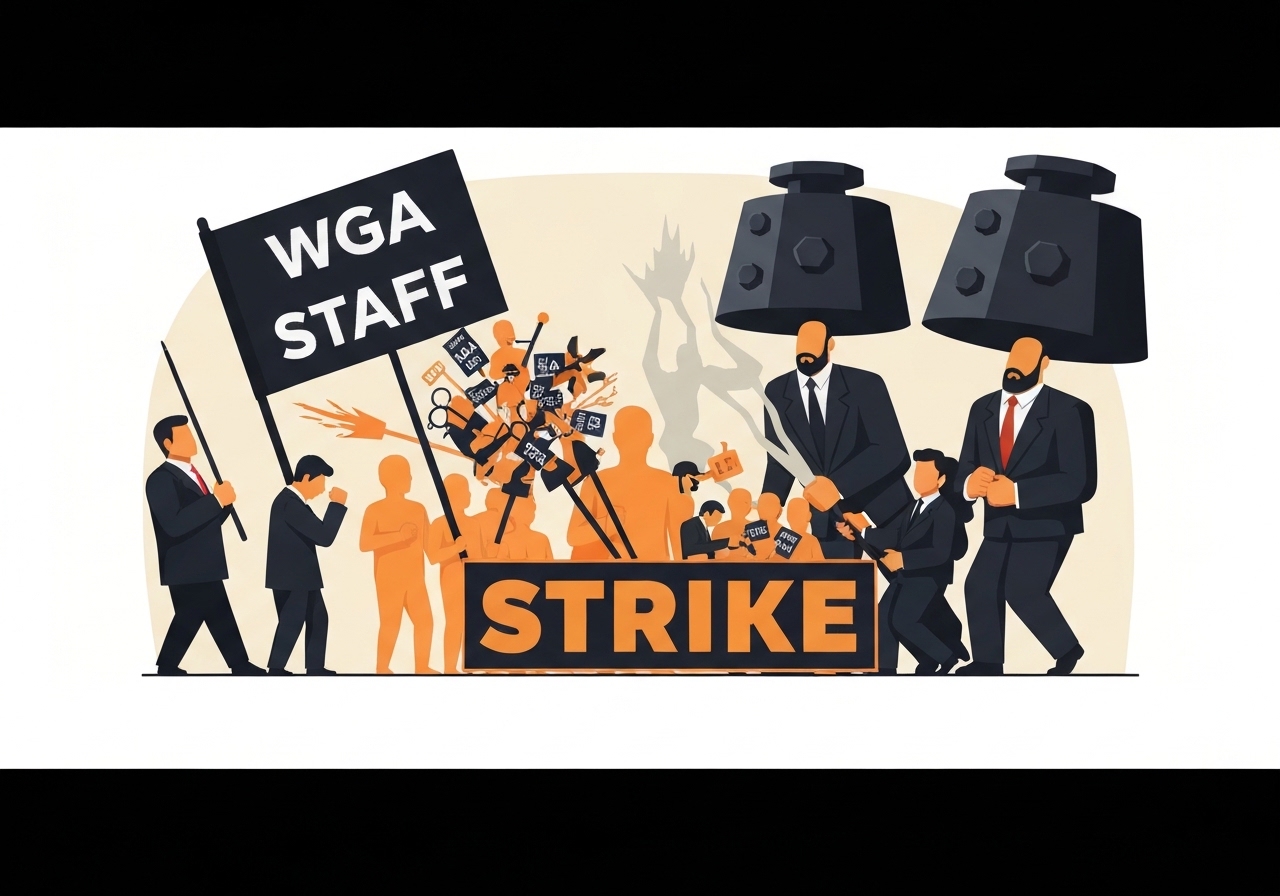
Lead: The Writers Guild of America West (WGAW) staff voted to authorize a strike, citing unfair labor practices and accusing guild management of bargaining in bad faith. The authorization — supported by 82 of 100 eligible staffers — comes as the WGA prepares to return to negotiations with major studios on March 16. Staff say grievances include alleged “surface bargaining,” unilateral changes to working conditions, unlawful surveillance and retaliation. WGAW management denies the accusations and says it has proposed comprehensive compensation and benefits improvements.
Key Takeaways
- 82 of 100 WGAW staffers voted to authorize a strike over unfair labor practices, according to the staff union.
- The staff union alleges surface bargaining, unilateral changes, unlawful surveillance and retaliation as core complaints.
- Negotiations between staff representatives and WGAW management have been ongoing intermittently since September, with the most recent session on Jan. 17.
- Management publicly offered a minimum annual salary of $55,000; staff seek a $59,737 floor and broader protections.
- Staffers pressed for strict generative-AI safeguards; management says it currently has no intention to use AI and would provide paid training if it did.
- WGSU filed an unfair labor practices complaint in August alleging the unlawful firing of an organizing committee member; WGAW denied that claim.
- 64% of WGA staff union members report earning less than $84,850, cited as the Los Angeles County single-person low-income threshold.
Background
The staff union at WGA West organized last spring amid a broader period of labor activity across the entertainment industry. Staffers formalized demands for a first contract that would set wages, job protections and grievance procedures for roles including attorneys, research analysts, residuals representatives and software engineers. Negotiations between the Pacific Northwest Staff Union (PNWSU) representing those employees and WGAW management began in September and have proceeded in fits and starts; the parties last met on Jan. 17. The staff union says persistent disagreements over bargaining practices and specific contract language prompted members to pursue stronger remedies and the option of a strike authorization.
The context includes the guild-wide 2023 strike, during which WGAW staff played key support roles in organizing and sustaining picket lines. That history sharpened tensions: staffers emphasize both the financial precarity many face and the institutional memory of extended labor action. Management, for its part, stresses continuity of core operations and notes that certain executive and managerial personnel who work with the negotiating committee are not in the PNWSU bargaining unit. Both sides frame their positions as protecting the membership’s longer-term interests.
Main Event
During a break in talks, the staff staged a picket outside WGAW headquarters demanding “just cause” discipline language and a “fair deal.” The union reported on Instagram that, because management would not bargain in good faith, staff would take collective action. No strike start date was announced after the authorization vote; the authorization legally permits, but does not require, a walkout.
The WGSU (Writers Guild Staff Union) has outlined a suite of proposals: just-cause and grievance procedures, AI workplace protections, formalized work-from-home terms, staffing and workload standards, climate-impact language, professional development, living-wage pay increases and a union wage scale that rewards longevity. The union also highlighted that 64% of its members fall below the $84,850 threshold for a single-person household in Los Angeles County, framing pay demands around cost-of-living pressures.
Management circulated a four-page comparison of proposals and counterproposals the same day the authorization was announced. That document shows management’s offered minimum salary at $55,000 versus the staff’s $59,737 request. On AI, management confirmed no current plan to deploy generative tools in staff evaluations and offered paid training if AI were introduced; staff worry broad AI restrictions could limit managerial use of productivity tools and assessment technologies.
Analysis & Implications
Operationally, a staff strike at WGAW could complicate the union’s ability to support writers during critical contract talks with the Alliance of Motion Picture and Television Producers (AMPTP). WGAW told members it prefers staff not strike during the AMPTP talks, which resume March 16 and lead into the May 1 contract expiration, but acknowledged that work to secure funding for writer health and pension plans must continue. If staff are absent, management says other non‑bargaining-unit personnel will cover core functions to limit disruption.
Politically, the dispute raises questions about labor governance: when staff who administer and implement bargaining efforts organize separately, tensions can emerge between protecting institutional priorities (funding, benefits) and ensuring fair workplace standards for employees. The staff framing emphasizes everyday workplace fairness and AI protections, while guild leadership highlights fiduciary duties to members and the solvency of negotiated funds. That divergence can make compromise more complex and prolong bargaining timelines.
Economically, the salary floor difference ($55,000 vs. $59,737) is significant for lower-paid staff and may influence retention and recruitment in a high-cost market like Los Angeles. The salary gap, combined with the statistic that roughly two-thirds of staff earn below the county’s low‑income threshold, gives bargaining leverage to the union on cost-of-living and equity grounds. Conversely, management will point to fiscal constraints and the need to safeguard writers’ pension and health funds established after the 2023 strike.
Looking ahead, a strike authorization ahead of studio negotiations raises leverage dynamics: staff pressure could increase public and member scrutiny of WGAW leadership choices, while an actual staff walkout could disrupt the guild’s bargaining logistics and media relations. Alternatively, rapid movement to a first contract could neutralize that risk if both sides prioritize an expeditious resolution before the industry‑wide deadline.
Comparison & Data
| Item | Management Offer | Staff Proposal |
|---|---|---|
| Minimum annual salary | $55,000 | $59,737 |
| Members under LA single-person low-income | 64% below $84,850 | |
These figures show a concrete salary gap and a notable concentration of staff below the county low‑income threshold. While the dollar difference may appear modest at a glance, it compounds across benefits, raises and long-term pension accrual. Management emphasizes broader compensation packages and benefit improvements it says are already on the table; staff stress immediate wage floors and enforceable language on AI and disciplinary protections.
Reactions & Quotes
The staff union publicized the authorization and framed it as a necessary escalation after what it describes as inadequate bargaining.
“If management won’t bargain in good faith with us at the table, we will see them on the picket line.”
WGSU (staff union Instagram)
WGAW management responded with a denial of the unfair labor practice allegations and an emphasis on continued negotiations.
“The WGAW has been bargaining in good faith and has offered comprehensive proposals with improvements to compensation and benefits.”
WGAW spokesperson (organizational statement)
Guild leadership expressed support for staff rights while warning about timing during studio negotiations and the need to protect funds negotiated by writers in 2023.
“We respect the staff’s right to collective activity and hope to reach a first-contract agreement soon.”
WGA leadership (member communication)
Unconfirmed
- Allegations of “unlawful surveillance” have been asserted by staff but have not been independently substantiated in public filings.
- The claim that an organizing committee member was unlawfully fired led to an unfair labor practices complaint in August; the guild has denied the allegation and the claim’s outcome is not confirmed here.
- Management’s future use of generative AI is a point of dispute: management says it currently has no plans to deploy AI, but long‑term intentions remain unspecified and unconfirmed.
Bottom Line
The staff authorization highlights a widening fault line within the WGA ecosystem: employees charged with supporting writers now press their own bargaining demands while the larger guild prepares for high‑stakes talks with studios. The immediate practical effect is an added layer of risk to operations and optics as AMPTP negotiations resume March 16 ahead of the May 1 contract expiration.
Resolution will depend on whether management and staff can bridge the salary floor, disciplinary safeguards and AI language gaps without disrupting the guild’s bargaining capacity. Even if no walkout occurs, the authorization increases staff leverage and raises the political cost of protracted impasse for WGAW leadership.