
Lead
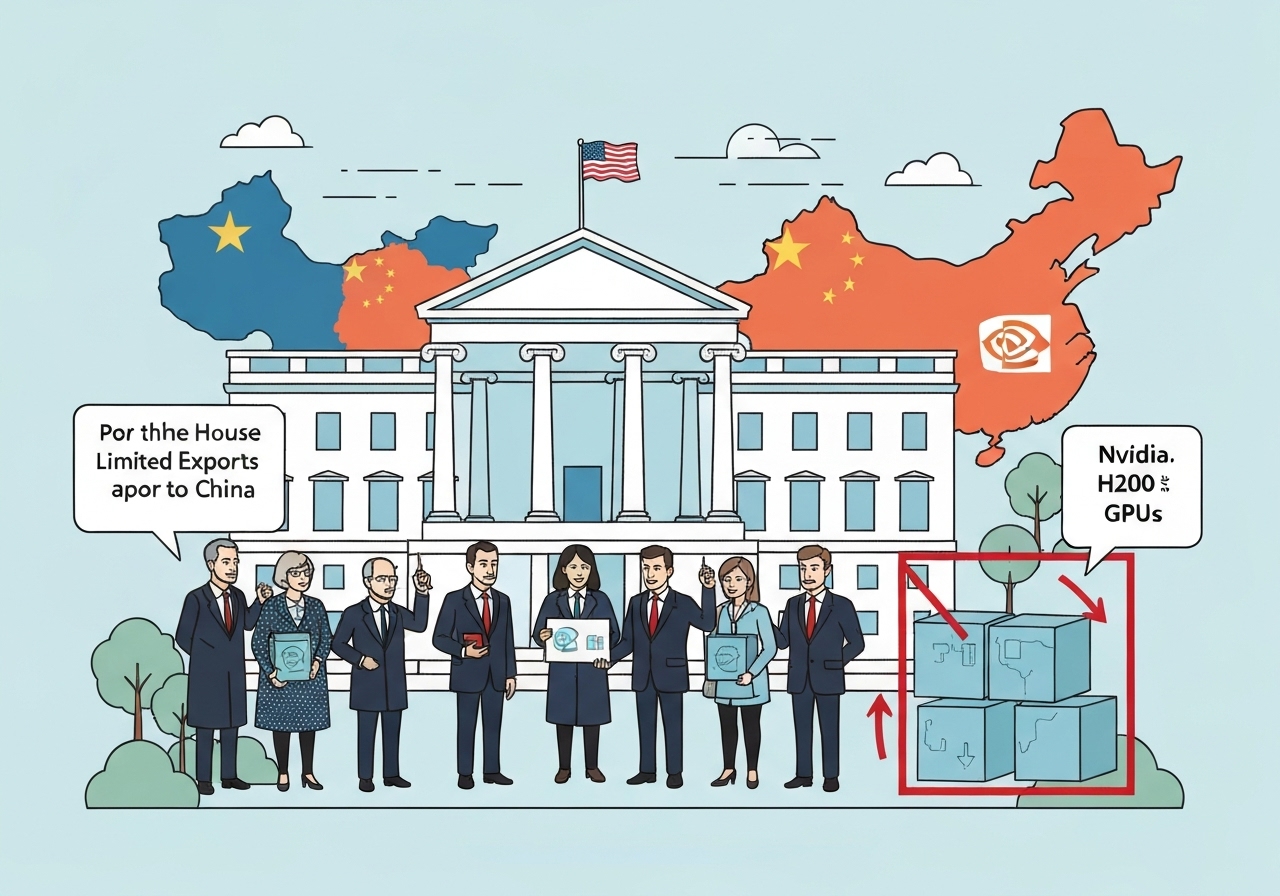
The White House is planning to direct the U.S. Department of Commerce to permit exports of Nvidia’s H200 graphics-processing units to China, according to a person with knowledge of the plan reported on Dec. 8, 2025. The proposal would allow GPUs that are roughly 18 months behind Nvidia’s most advanced chips to be sold to Chinese customers as a compromise between strict export curbs and unrestricted commercial access. Administration officials hope the move will undercut arguments that bans only hand market share to Chinese competitors while placating Beijing, which has blocked imports of some less powerful models. If approved, H200 exports could expand Nvidia’s addressable market in China while keeping key advanced capabilities restricted.
Key Takeaways
- The White House plans to instruct the Commerce Department to permit exports of Nvidia H200 GPUs to China, per a person with knowledge of the plan reported Dec. 8, 2025.
- The H200 is described as roughly 18 months behind Nvidia’s cutting-edge GPUs; the administration frames this as a controlled relaxation, not a full rollback of export controls.
- Officials see the proposal as a middle ground between a complete ban on advanced AI chips and unrestricted trade that could boost Chinese competitors.
- The move follows public comments that the decision rests with President Trump and that Commerce Secretary Howard Lutnick is supportive, according to sources.
- Supporters of prior restrictions argue those measures slowed China’s progress, while critics say Chinese firms like DeepSeek and Alibaba have continued to advance AI despite the curbs.
- Commerce and Nvidia spokespeople did not immediately respond to requests for comment when the reporting was published.
- The proposal comes amid broader supply-chain concerns: the U.S. still seeks to reduce reliance on TSMC and grapples with Chinese leverage over minerals and other inputs.
Background
Since 2022–2023, U.S. administrations have tightened export rules aimed at preventing China from acquiring the most capable AI chips and semiconductor manufacturing tools. The Biden administration implemented a suite of restrictions intended to slow Beijing’s hardware-driven AI acceleration and to preserve a U.S. competitive lead during a sensitive technological transition. Proponents argued those measures bought time for U.S. firms to scale and for allies to coordinate limits.
Opponents of strict export controls countered that bans risked ceding commercial opportunities to non-U.S. suppliers and accelerating domestic substitution inside China. Chinese firms and state-backed programs have invested heavily to close capability gaps, and public reporting shows major Chinese cloud providers and chip designers pressing ahead even under sanctions. Separately, the global semiconductor supply chain remains concentrated: Taiwan Semiconductor Manufacturing Company (TSMC) still dominates advanced logic production, while China controls important commodity supplies such as some rare earths and battery minerals.
Main Event
According to the reporting, White House officials want the Commerce Department to authorize exports of Nvidia’s H200 cards to China on the basis that the H200 trails the company’s top-tier models by about 18 months. The idea is to permit a class of high-performance GPUs that stop short of the absolute latest generation, creating a policy “sweet spot” between national-security concerns and commercial openness. The proposal reportedly reflects internal White House debate between security hawks who favor stringent curbs and economic advisers wary of ceding markets.
Commerce Secretary Howard Lutnick publicly said the ultimate choice belongs to President Trump, and people familiar with internal discussions described Lutnick as supportive of a calibrated opening. A Commerce spokesman declined to comment to reporters, and spokespeople for Nvidia and the White House did not immediately respond to requests for comment. The person who briefed the reporter stressed the plan had not been finalized and that legal and licensing details would follow any presidential directive.
If enacted, the H200 export policy would require careful licensing conditions and technical definitions to prevent the transfer of features deemed sensitive. Enforcement mechanisms, end-user checks and carve-outs for military or dual-use entities would likely be central to any implementation. Administration officials and industry lawyers would also need to coordinate with allies and commercial partners to limit circumvention risks and secondary market flows.
Analysis & Implications
Strategically, permitting H200 exports aims to balance two competing risks: undercutting U.S. firms’ market share versus accelerating Chinese military or dual-use AI capabilities. Supporters argue that selectively lifting controls for chips that lag the cutting edge preserves a commercial presence for U.S. vendors while maintaining a technical edge at the frontier. Critics counter that even chips described as “18 months behind” can materially advance AI applications and could be repurposed in unexpected ways.
Economically, opening China to H200 sales could materially expand Nvidia’s addressable market in the near term and bolster revenue for U.S. supply-chain partners. Market access could temper the incentive for Chinese buyers to favor domestically produced alternatives or non-U.S. suppliers, potentially slowing the growth of rival ecosystems. Still, analysts caution that long-term competitive dynamics depend on Chinese investment in native hardware design and manufacturing, which has continued despite previous curbs.
On the diplomatic front, the proposal appears aimed at reducing Sino–U.S. tensions over tech trade by offering Beijing a visible concession. Beijing’s prior blocking of imports for some models complicates the picture: Chinese regulators may still restrict certain imports for economic or strategic reasons, and any U.S. move would be judged against China’s wider industrial policy objectives. Internationally, allies tracking U.S. export controls may press for coordinated frameworks to avoid simple rerouting of components through third countries.
Comparison & Data
| Policy or Item | Status Before | Proposed Change |
|---|---|---|
| Export restrictions on advanced GPUs | Broad curbs on latest-generation chips under prior rules | Allow H200-class GPUs (~18 months behind latest) to be exported with licensing |
| Chinese import stance | Beijing has blocked some less powerful models (e.g., H20) | U.S. seeks a concession Beijing would accept; outcome uncertain |
| Supply-chain concentration | High dependence on TSMC for advanced nodes | Policy change does not immediately alter foundry dependence |
The table above clarifies the narrow, technical nature of the proposed shift: it would modify which device classes are permitted, not reverse controls on manufacturing tools or the most advanced chips. Any economic benefit to U.S. vendors will depend on licensing regimes, enforcement robustness and whether Chinese customers can integrate the H200 into higher-scale systems without additional restricted inputs.
Reactions & Quotes
“The decision is in the hands of President Trump.”
Howard Lutnick, Commerce Secretary (public comment)
“Lutnick is supportive of the strategy,”
Person familiar with internal discussions (anonymous)
“Restrictions previously slowed some pathways but did not fully stop Chinese progress,”
Restriction proponents (public/private statements summarized)
Each quoted remark requires context: Lutnick’s line emphasizes executive discretion; the anonymous source signals internal alignment at Commerce; and supporters’ summaries reflect the policy debate about efficacy versus commercial cost. Reporters seeking official confirmation found that Commerce and Nvidia spokespeople did not immediately respond to inquiries.
Unconfirmed
- Whether President Trump has signed or will sign a formal directive to implement the H200 export change is unconfirmed and was not reported at the time of the article.
- It is not yet verified which specific technical features or performance thresholds will define the H200-class devices for licensing purposes.
- The degree to which the Chinese government would permit broader imports of H200 units or continue to block certain models is not confirmed.
Bottom Line
The White House proposal to allow Nvidia H200 exports to China represents a calibrated policy pivot intended to preserve U.S. commercial interests while maintaining a technical edge at the very frontier of AI chips. It acknowledges limits of blanket bans by attempting to channel sales into a less-sensitive product tier, but success depends on precise technical definitions, licensing safeguards and enforcement to prevent diversion to sensitive end users.
Policymakers will need to weigh near-term economic benefits for U.S. firms against long-term strategic risks, and the move will be watched closely by allies, industry competitors and Chinese regulators. For readers, the essential takeaway is that this is a potential, targeted relaxation — not a wholesale reversal — and many critical details remain unresolved.