
Lead
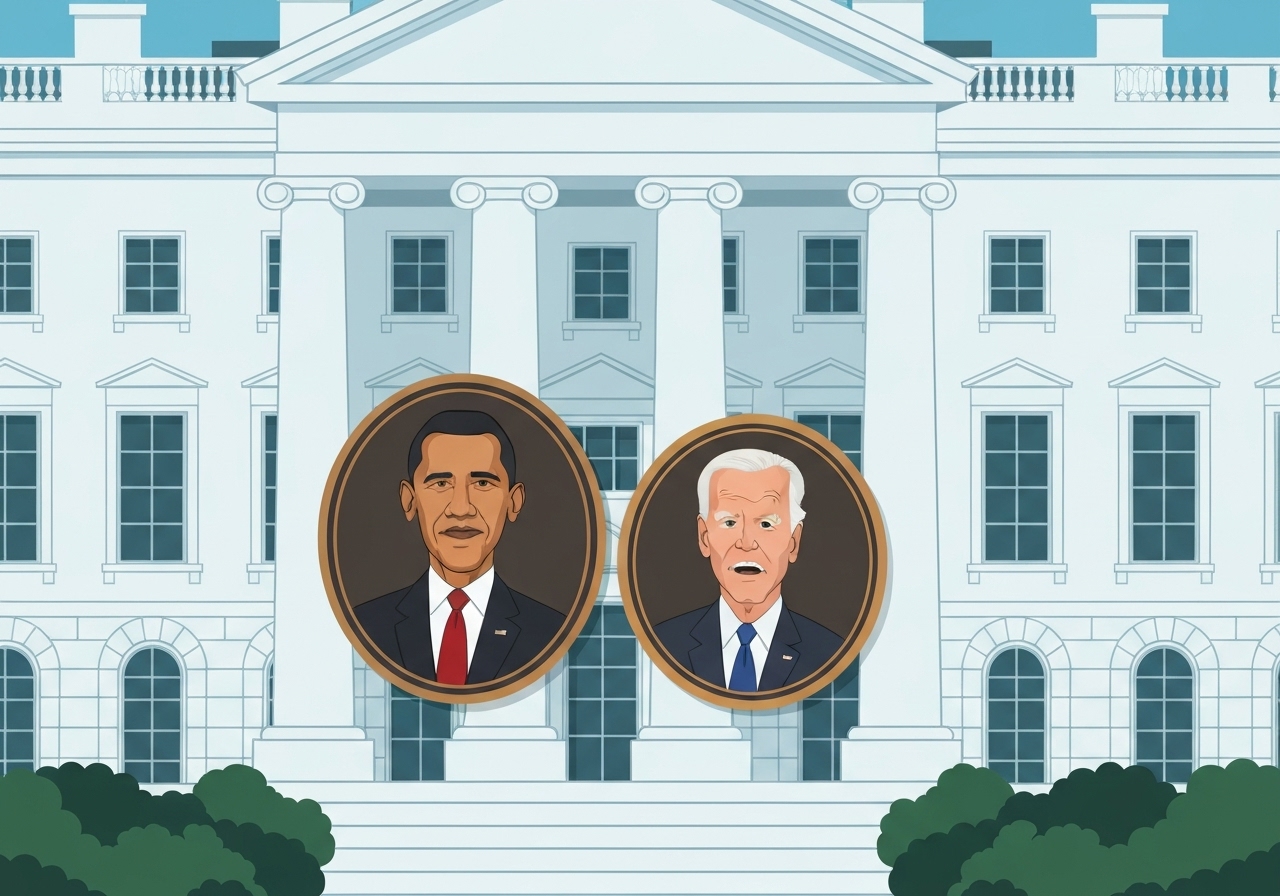
The White House in December 2024 added new commemorative plaques that sharply criticize former presidents Barack Obama and Joe Biden, displaying language that repeats disputed and partisan claims. The plaques accuse Mr. Biden of taking office after “the most corrupt Election ever seen” and of overseeing economic and foreign-policy failures; they also use derisive language about Mr. Obama and highlight grievances from the Trump administration. Officials for the current White House did not provide immediate comment on who funded or authorized the installations. The displays have prompted mixed responses from Republican lawmakers and renewed debate about presidential legacy and public space at the executive residence.
Key Takeaways
- The plaques were installed at the White House in December 2024 and include caustic descriptions of Presidents Biden and Obama, repeating several false or contested claims about the 2020 election and other events.
- One plaque asserts Biden took office “as a result of the most corrupt Election ever seen in the United States,” a claim tied to efforts by Donald Trump to overturn the 2020 results.
- The Biden plaque cites inflation during his term, attacks the Inflation Reduction Act as the “Green New Scam,” and labels the 2021 Afghanistan withdrawal a “disaster,” noting 13 U.S. service members died during that withdrawal.
- Obama’s plaque uses the full name “Barack Hussein Obama” and accuses him of divisive policies, criticizing Obamacare, the Iran nuclear deal, and the Paris climate agreement.
- The plaques praising Donald Trump describe substantive policy achievements attributed to his administration and include boastful projected second-term measures.
- The White House has not confirmed whether taxpayer funds or federal staff were used to produce or install the plaques.
- Sen. Lisa Murkowski publicly criticized the displays as inappropriate for former presidents; Sen. Lindsey Graham treated them as amusing and downplayed their significance.
Background
Commemorative plaques and portraits at the White House and other federal buildings have long reflected institutional norms about presidential legacy: most past installations emphasize service and the office rather than partisan judgment. The Trump administration’s decision to affix overtly political and critical plaques departs from that custom, embedding contemporary partisan narratives in a site historically treated as nonpartisan public property. Similar controversies have arisen before when presidential libraries, monuments or displays appeared to rewrite or aggressively frame historical records to favor one administration.
The language on the new plaques echoes widely circulated claims from former President Trump and his allies, including assertions about the 2020 election and critiques of policy agreements rescinded or altered during his term. Those claims intersect with broader debates over presidential accountability, public memory, and how state spaces should present contested events. Key stakeholders include White House staff, Republican officials who support or tolerate the displays, critics who view them as a politicization of a national site, and historians and preservationists concerned about precedent.
Main Event
The new plaques installed in December 2024 single out Mr. Biden and Mr. Obama with unusually charged language. The plaque about Mr. Biden claims he assumed office “as a result of the most corrupt Election ever seen in the United States,” lambastes his handling of inflation, derides the Inflation Reduction Act as the “Green New Scam,” and blames his administration’s immigration policies for crises at the border. It also repeats the characterization of the 2021 Afghanistan withdrawal as “among the most humiliating events in American History” and notes the 13 U.S. service members killed during that operation.
Obama’s plaque lists grievances framed by the Trump administration: it uses his full middle name in a way the plaque’s designer intended as derisive, criticizes the Affordable Care Act as “Unaffordable,” blames him for a stagnant economy, and singles out the Iran nuclear deal and the Paris climate accord as policy failures later reversed by President Trump. The plaque also repeats allegations that Mr. Obama spied on the 2016 Trump campaign and claims he presided over the “Russia, Russia, Russia Hoax.”
By contrast, the plaques summarizing Mr. Trump’s presidency cast his time in office in glowing terms, celebrating tax cuts, regulatory rollbacks, trade and immigration policies, the Abraham Accords, and other achievements. One plaque even predicts future projects and titles, including a “Trump Presidential Ballroom” said to be built at the White House.
The White House declined to immediately answer questions about who paid for the plaques, whether federal funds or employees were involved, or whether this installation followed standard preservation or approval processes. The placement and tone have already prompted public commentary from lawmakers: Sen. Lisa Murkowski criticized the move as inappropriate, while Sen. Lindsey Graham treated the displays as less consequential and pivoted to electoral strategy.
Analysis & Implications
The plaques’ arrival marks a significant institutional shift: embedding partisan historical claims into White House grounds blurs the line between a sitting administration’s policy messaging and the nonpartisan stewardship of presidential history. If accepted as precedent, future administrations could use the White House’s physical space to enshrine partisan narratives, complicating historians’ work and frustrating bipartisan norms that have generally governed ceremonial displays.
Politically, the plaques serve immediate messaging goals for former President Trump and his supporters by consolidating a particular version of recent history that reinforces grievances about the 2020 election, immigration, and foreign policy. That messaging may energize base voters ahead of 2026 midterms and future presidential contests, but it also risks alienating swing voters and moderate Republicans who view the displays as disrespectful to former officeholders.
Legally and administratively, unanswered questions about funding and authorization are consequential. If federal resources were used, congressional oversight and inspector-general inquiries could follow. If privately financed and privately installed, the choice raises questions about access, curation standards, and whether private actors should be enabled to shape narratives within public executive spaces.
Internationally, the plaques may alter perceptions of U.S. institutional norms. Allies and rivals watch how the American presidency frames its own history; explicit politicization of White House displays could be seized upon by foreign actors as evidence of domestic instability or diminished institutional restraint, potentially affecting diplomatic optics during ongoing crises like the war in Ukraine.
Comparison & Data
| President | Tone on Plaque | Main Claims Highlighted |
|---|---|---|
| Barack Obama | Critical | Obamacare, Iran deal, Paris accords, alleged 2016 spying |
| Joe Biden | Accusatory | 2020 election fraud claim, inflation, Afghanistan withdrawal, immigration |
| Donald Trump | Laudatory | Tax cuts, economy, Abraham Accords, regulatory rollbacks |
The table above summarizes the plaques’ relative tone and principal claims. While official federal memorialization typically uses neutral descriptions, these documents emphasize partisan interpretation. The immediate context—an outgoing or successor administration overriding earlier norms—mirrors disputes over presidential libraries and federal exhibits where interpretation often becomes contested.
Reactions & Quotes
Republican reactions on Capitol Hill were mixed, illustrating a split between party institutionarians and loyalists. Senator Lisa Murkowski, who often departs from party orthodoxy, criticized the displays as inappropriate given the officeholders’ roles.
“These are individuals who served who were elected by people around this country… Let’s not have President Trump trying to redefine the contributions or lack of contributions of each. That’s inappropriate.”
Sen. Lisa Murkowski (R-Alaska)
Senator Lindsey Graham, a Trump ally, downplayed concern and shifted focus to electoral strategy, suggesting the plaques were not a major policy issue for him.
“I don’t think that’s going to move the ball for us. There may be some amusement there,”
Sen. Lindsey Graham (R-South Carolina)
Officials for Mr. Biden and Mr. Obama did not provide immediate public responses to the plaque text, according to reporting. The absence of a formal White House comment about funding and authorization has added to calls for transparency.
Unconfirmed
- The plaques claim President Biden “was forced to withdraw from his campaign for re-election in disgrace” after a June 2024 debate; there is no verified public evidence that he withdrew as a result of that debate.
- Text on the plaques repeats that the 2020 election was “the most corrupt Election ever seen,” an assertion that has been widely litigated and rejected by courts and election officials; it remains unsupported as a factual finding.
- The plaques assert that President Obama “spied” on the 2016 Trump campaign and created the “Russia, Russia, Russia Hoax”; those are disputed allegations without corroborating official determinations.
Bottom Line
The installation of partisan plaques inside the White House is an uncommon and consequential move that reconfigures how the executive residence presents recent history. Beyond immediate partisan signaling, the episode raises institutional questions about who controls narrative at national sites and whether future administrations will follow similar practices.
Key unresolved issues—who paid for the plaques, whether federal employees installed them, and whether there will be corrective steps—will determine if this becomes an isolated controversy or a lasting precedent. For lawmakers, preservationists and voters, the stakes include trust in nonpartisan stewardship of national symbols and the integrity of public spaces meant to represent the country as a whole.