
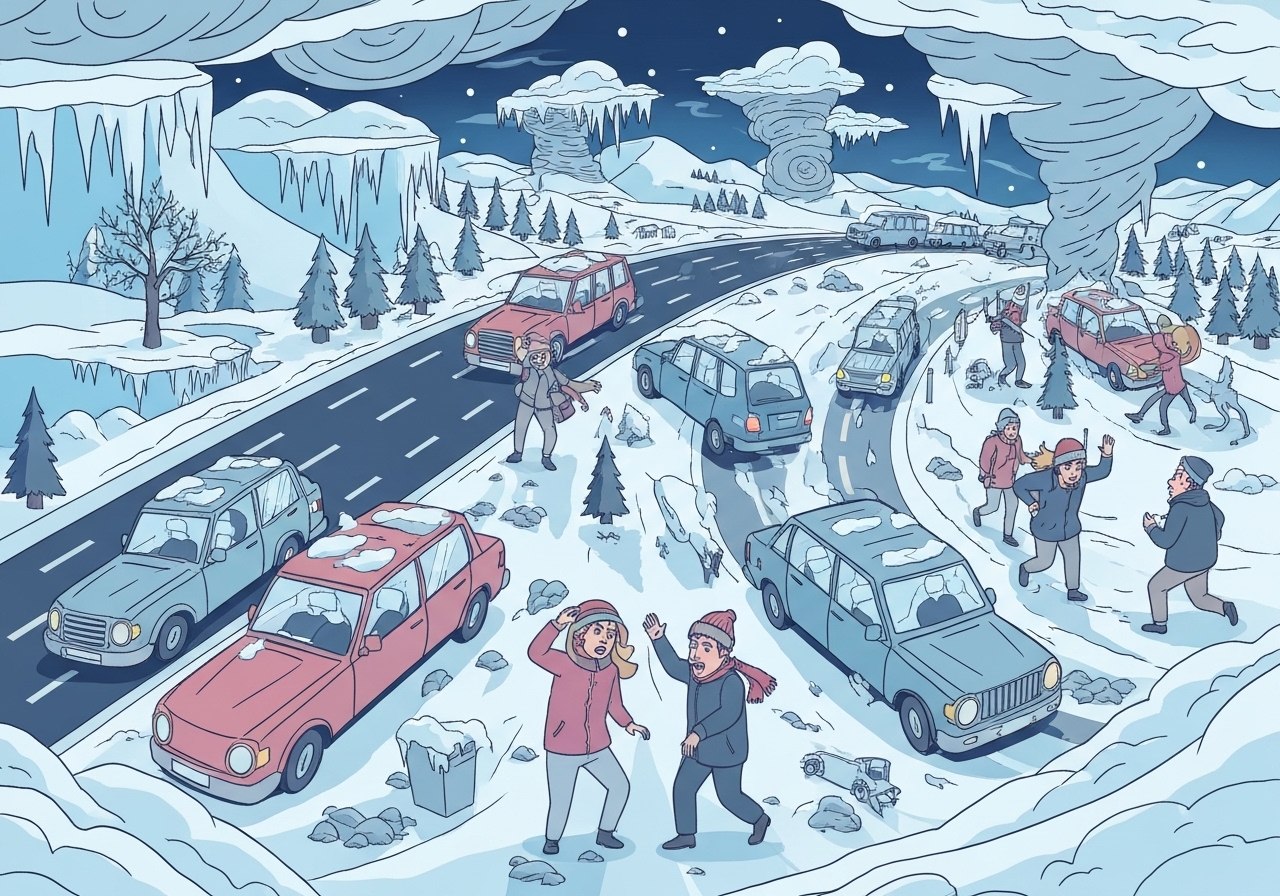
Between Friday night and early Saturday during the busy travel window between Christmas and New Year’s, a fast-moving winter storm dumped snow across the U.S. Northeast and Great Lakes, disrupting roads and air travel. New York City recorded about 4 inches (10.2 cm) of snow, while central eastern Long Island and parts of the Catskills saw higher totals up to 6 inches (15 cm) and 10 inches (25 cm), respectively. Flight-tracking service FlightAware reported at least 1,500 cancellations beginning Friday night, and state officials in New York and New Jersey declared emergencies as crews worked to clear streets and reopen airports. By Saturday morning many roads and runways were improving, though forecasters warned of lingering hazardous conditions and the risk of power outages.
Key Takeaways
- More than 1,500 flights were canceled beginning Friday night, according to FlightAware, affecting major hubs including JFK, LaGuardia and Newark.
- New York City measured about 4 inches (10.2 cm) of snow, with pockets of 6 inches (15 cm) on eastern Long Island and up to 10 inches (25 cm) in the Catskills.
- The National Weather Service warned of hazardous travel from the Great Lakes through the northern mid-Atlantic and southern New England, including tree damage and possible power outages.
- New York Gov. Kathy Hochul declared a state of emergency covering more than half of New York State; Acting New Jersey Gov. Tahesha Way issued a state of emergency for New Jersey.
- City crews in places like Times Square used shovels and snowblowers to clear sidewalks and streets as visitors described a mix of disruption and holiday spectacle.
- On the West Coast, heavy storms earlier in the week left at least four dead in California, with 10–18 inches (25–45 cm) of rain in some mountain areas and significant flood and mudslide damage in towns such as Wrightwood.
- Santa Ana winds with gusts over 60 mph (96 kph) were forecast in parts of Southern California, raising the risk of additional tree failures and outages in saturated areas.
Background
The disruption arrived during one of the busiest travel stretches of the year, when millions move between cities and families. Forecast models had flagged the potential for snow across a broad swath of the northern mid-Atlantic, New England and the Great Lakes, and regional agencies mobilized pre-emptive road treatments and airport alerts. Northeastern transit operators and airport authorities routinely brace for winter storms at this time of year; nonetheless, timing during the holiday surge increases the number of affected passengers and vehicles. FlightAware’s cancellation totals encompass delays and full cancellations reported beginning Friday night and reflect knock-on effects at connecting hubs nationwide.
Historically, storms that coincide with holiday travel tend to produce outsized disruption because of tight connections, limited alternate flights and higher road volumes. State-level emergency declarations—such as those made by New York and New Jersey officials—are designed to free resources and prioritize plowing and salt operations on major corridors. At the same time, localized microclimates in coastal Long Island and inland high terrain like the Catskills can produce sharp differences in accumulation over short distances, complicating response plans. Emergency managers also watch for ancillary hazards, including fallen limbs, isolated power outages and secondary crashes on salted but still slick roadways.
Main Event
The storm moved from northwest to southeast, laying down most snow late Friday into the pre-dawn hours on Saturday. In New York City, municipal crews worked through the night to plow routes and treat sidewalks; footage from Times Square showed workers clearing a mix of slush and powder with snowblowers and shovels. John F. Kennedy, LaGuardia and Newark airports posted snow advisories on social platforms and warned passengers that conditions could affect their itineraries. Though some flights were able to depart after deicing and runway clearing, the concentrated cancellations beginning Friday night left backlogs that persisted into the weekend.
In parts of Long Island and the Catskills, localized heavier bands pushed accumulations above forecasted amounts, with some communities recording up to 10 inches (25 cm) of snow. The National Weather Service forecaster Bob Oravec described the event as “winding down” by Saturday morning, noting only flurries remained in many places. Road crews reported isolated areas of poor visibility and slick bridges, prompting travel advisories and brief closures on secondary routes. Authorities emphasized that while major arteries saw rapid recovery, residential streets and some rural roads remained challenging for early-morning travelers.
Meanwhile, airports and airlines worked to rebook passengers and reposition crews; baggage delays and missed connections were reported at multiple hubs. Ground transportation agencies urged motorists to delay nonessential trips until crews could complete primary plowing and anti-icing. Social media posts from travelers showed scenes ranging from serene, snow-coated cityscapes to long security lines and crowded customer-service areas as people adjusted plans. By midday Saturday the combination of clearing operations and lighter precipitation allowed many flights and roads to resume normal operations.
Analysis & Implications
Although total snowfall amounts were uneven, the storm’s timing amid peak holiday movements amplified its impact. Flight cancellations tallying at least 1,500 are significant for a regional event and can cascade across airline networks: grounded aircraft and crews at one hub limit capacity across many others. For travelers, this raises the likelihood of longer rebooking waits and increased demand for rental cars and alternate routes, stressing ground systems that are already busy during the holidays.
From an infrastructure perspective, this episode highlights persistent vulnerabilities: aging distribution lines and trees with saturated root zones are more likely to fail during winter storms and heavy rains. While the NWS warned of potential power outages and tree damage, the actual footprint of outages depends on wind intensity and saturated soils. In urban centers, rapid plowing and deicing reduce closure times on primary corridors, but suburban and rural areas typically see slower recovery, disproportionately affecting essential workers and residents without flexible travel options.
Economically, even short-term travel disruptions have measurable effects on retail, hospitality and airline revenues during the holidays. Airlines incur costs from cancellations, accommodations and crew repositioning, while cities and states face overtime and equipment expenses for snow removal. Conversely, some local businesses—cafés, restaurants and lodging near airports—may see increased demand from stranded travelers seeking shelter or food, creating short-lived economic shifts within impacted corridors.
Comparison & Data
| Region | Reported Peak Snow/Rain | Flight Cancellations | Fatalities |
|---|---|---|---|
| New York City area | About 4 in (10.2 cm); pockets to 6 in (15 cm) | At least 1,500 (regional total) | — |
| Catskills / Long Island | Up to 10 in (25 cm) in Catskills; 6 in (15 cm) eastern Long Island | ||
| Great Lakes / Northern Mid-Atlantic | Variable snow; hazardous travel warnings | Included in regional cancellations | — |
| Southern California (earlier storms) | 10–18 in (25–45 cm) rain in mountains; up to 4 in (10 cm) basin | — | At least 4 deaths reported |
The table compares storm impacts across regions: the Northeast and Great Lakes experienced snow-driven travel disruption and cancellations, while California suffered heavy rains earlier in the week that led to fatal flooding and mudslides. These contrasts underscore that extreme-weather impacts can vary greatly by region and manifest as snow, rain or wind hazards depending on local conditions. Emergency planners treat each hazard differently—snow compels plowing and anti-icing, whereas rain-driven floods require swift-water rescue capabilities and debris removal.
Reactions & Quotes
The storm is definitely winding down, a little bit of flurries across the Northeast this morning.
Bob Oravec, National Weather Service forecaster
Oravec’s comment indicated a general easing of conditions by Saturday morning even as the agency cautioned about residual hazards on secondary roads and the potential for tree and power-line damage.
This storm will cause dangerous road conditions and impact holiday travel. We are urging travelers to avoid travel during the storm and allow crews to tend to the roads.
Tahesha Way, Acting Governor of New Jersey
Acting Governor Way’s statement accompanied New Jersey’s emergency declaration and reflected official guidance to delay nonessential travel while plows and salt trucks worked key routes.
I think it was absolutely beautiful.
Jennifer Yokley, traveler from North Carolina
Many visitors framed the brief snowfall as a picturesque holiday moment even as others described inconvenience; a mix of reactions was visible in social posts from Times Square and transit hubs.
Unconfirmed
- Comprehensive counts of localized power outages tied directly to this storm were not finalized at the time of reporting; officials warned outages were possible but full damage assessments were pending.
- Precise totals for tree damage across suburban and rural counties remain unverified; some municipal reports indicated isolated failures but no consolidated statewide tally was available.
Bottom Line
The storm produced regionally significant snowfall and at least 1,500 flight cancellations during a peak travel period, illustrating how timing magnifies the disruptive potential of even modest storms. While major roads and runways improved by Saturday morning in many places, secondary roads and rural areas remained vulnerable to slick conditions and slower clearance.
Travelers should expect residual ripples—delayed rebookings, baggage backlogs and continued localized hazards—and officials advise monitoring updates from airlines and state emergency channels. Emergency declarations and active plowing reduced the immediate threat, but the event highlights the continuing need for coordinated preparedness during holiday travel surges.
Sources
- Associated Press (news organization)
- FlightAware (flight-tracking service)
- National Weather Service (federal weather agency)
- Los Angeles County Sheriff’s Department (official law enforcement agency)