
Lead
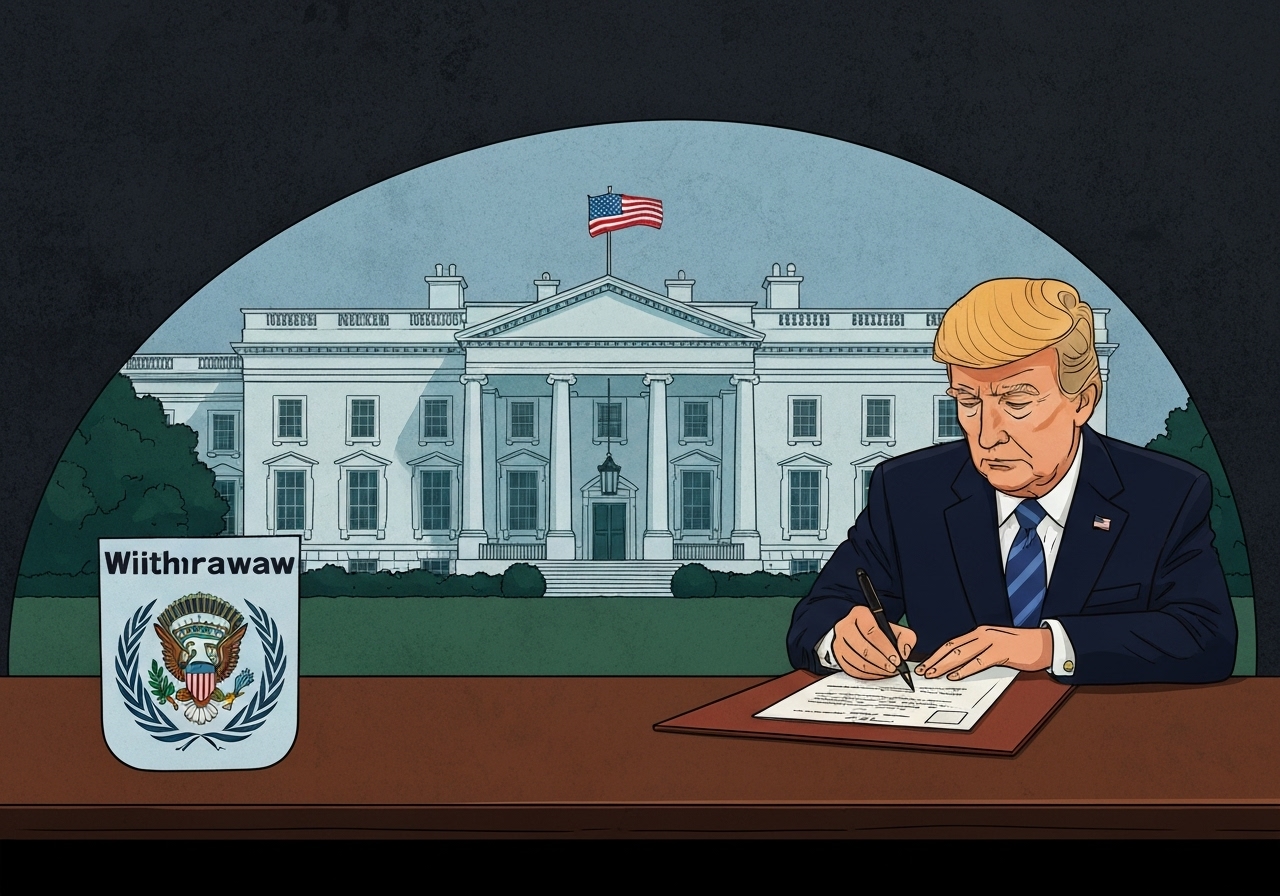
On January 7, 2026, President Donald J. Trump issued a memorandum directing all executive departments and agencies to begin withdrawing the United States from a list of 66 international organizations, UN entities, conventions, and related bodies deemed contrary to U.S. interests. The action follows Executive Order 14199 of February 4, 2025, and reflects a State Department review of U.S. membership and funding. The memorandum orders agencies to take immediate steps to cease participation or funding to the listed organizations to the extent permitted by law while noting further findings remain under review.
Key Takeaways
- The memorandum was issued on January 7, 2026, and signed by President Donald J. Trump, instructing immediate implementation by executive departments and agencies.
- It directs withdrawal from 35 non-UN organizations and 31 UN organizations and programs, for a total of 66 entities identified as contrary to U.S. interests.
- The directive implements findings from the Secretary of State’s review required by Executive Order 14199, originally issued February 4, 2025.
- For United Nations entities, the memorandum defines withdrawal as ceasing participation in or funding “to the extent permitted by law,” preserving legal and budgetary constraints.
- The memorandum preserves existing legal authorities of agencies and the Director of OMB’s functions related to budgetary and legislative proposals.
- Implementation is conditioned on applicable law and the availability of appropriations; the Secretary of State will provide additional guidance to agencies.
- The memorandum is explicit that it creates no private right or enforceable benefit against the United States, its officials, or agencies.
- The Secretary of State’s review remains ongoing and the memorandum authorizes further action as additional findings are developed.
Background
The memorandum builds on Executive Order 14199, issued on February 4, 2025, which required a comprehensive review of all international intergovernmental organizations, conventions, and treaties to which the United States belongs and provides funding or other support. That review was conducted by the State Department in consultation with the U.S. Representative to the United Nations and delivered findings to the President as directed by EO 14199. The White House memorandum states that, after Cabinet deliberations and consideration of the Secretary’s report, the President determined continued membership or support for the listed organizations is contrary to U.S. interests.
Historically, withdrawals or funding reductions from international bodies have prompted administrative transition plans, diplomatic notifications, and legal analyses to address treaty obligations and contractual commitments. Agencies routinely assess statutory obligations and the Federal Register process for formal notice; the memorandum explicitly authorizes the Secretary of State to publish the action in the Federal Register. The directive also reiterates that implementation must comply with existing law and appropriations constraints, a standard clause meant to signal administrative, budgetary, and legal guardrails.
Main Event
The memorandum names 35 non-UN organizations including the International Renewable Energy Agency, the Intergovernmental Panel on Climate Change, the International Union for Conservation of Nature, and the Venice Commission of the Council of Europe. It also lists 31 UN entities and programs, such as the UN Framework Convention on Climate Change, UN Population Fund, UN Human Settlements Programme, and UN Entity for Gender Equality and the Empowerment of Women. Agencies are directed to take immediate steps to effectuate withdrawal and to coordinate with the Secretary of State for implementation guidance.
For UN entities, the memorandum clarifies that withdrawal means ceasing participation or funding to the extent permitted by law, acknowledging statutory and treaty-based constraints. The directive preserves agency authorities and the Office of Management and Budget’s role on budgetary and legislative matters, signaling that existing legal responsibilities and budget processes must be respected during implementation. The memorandum also states that actions are subject to availability of appropriations and are not intended to create enforceable rights in law for any third party.
The Secretary of State is tasked with providing additional implementation guidance to agencies and is authorized to publish the memorandum in the Federal Register. The document asserts that further findings from the Secretary of State are ongoing, indicating the list could be revised or expanded as additional review results become available. Agencies will therefore face a sequence of administrative steps: legal review of obligations, interagency coordination, formal notices to international bodies, and adjustments to appropriations and program operations where permitted.
Analysis & Implications
The immediate policy implication is a substantial reorientation of U.S. engagement with multilateral institutions: 66 entities span climate, development, human rights, scientific cooperation, cultural preservation, and regional cooperation. Ceasing participation or funding could significantly reduce U.S. influence within those forums and shift the balance of leadership toward other member states that remain engaged. In areas like climate science (e.g., IPCC) and renewable energy cooperation, reduced U.S. involvement may limit U.S. access to shared data, consensus reports, and normative processes that shape global standards.
Economically and operationally, the withdrawal process will trigger legal and contractual reviews. Many programs operate under multi-year funding commitments, host-nation agreements, or treaty obligations; agencies must identify statutory limitations and any binding financial commitments before halting payments. The memorandum’s conditioning on appropriations means congressional action could block or delay significant funding changes if lawmakers oppose immediate withdrawal from specific bodies.
Diplomatically, partners and adversaries will respond. Traditional allies that co-lead multilateral initiatives may push back diplomatically or seek to preserve joint mechanisms without U.S. participation. Conversely, countries skeptical of U.S.-led institutions may welcome reduced U.S. engagement. Over the medium term, diminished presence in technical and normative forums could reduce U.S. capacity to shape rules on cyber, climate, migration, and trade-related standards.
Legal challenges are plausible. Domestic stakeholders, grantees, and foreign partners affected by abrupt funding withdrawals may pursue litigation, administrative appeals, or seek Congressional remedies. The memorandum’s explicit non-intent to create enforceable rights does not immunize it from lawsuits challenging agency actions that implement the directive in ways plaintiffs allege violate statutory duties or regulatory requirements.
Comparison & Data
| Category | Number of Entities |
|---|---|
| Non-UN organizations | 35 |
| UN organizations and programs | 31 |
| Total listed | 66 |
The 66 entities cover a broad policy spectrum, from scientific panels and energy agencies to cultural and regional cooperation bodies. By comparison, previous U.S. administration actions to withdraw from or defund specific UN bodies typically targeted a handful of agencies or programs; this memorandum encompasses a considerably larger and more diverse set. The scale suggests a strategic shift toward minimizing multilateral commitments across multiple policy domains unless otherwise reconciled by subsequent reviews or legal constraints.
Reactions & Quotes
The memorandum itself contains direct language directing agencies to act immediately; officials will use that text internally to coordinate steps. Below are short excerpts from the document used by agencies in initial briefings and public summaries.
I hereby direct all executive departments and agencies to take immediate steps to effectuate the withdrawal of the United States from the organizations listed in section 2 of this memorandum as soon as possible.
President Donald J. Trump (memorandum)
Agency counsel and career officials will likely cite the clause that conditions implementation on applicable law and appropriations when advising on next steps.
This memorandum shall be implemented consistent with applicable law and subject to the availability of appropriations.
Presidential memorandum (Section 4)
Early public and diplomatic reactions will shape the pace of change; the Secretary of State’s forthcoming guidance will be a focal point for partners and Congress to assess practical effects.
The Secretary of State is authorized and directed to publish this memorandum in the Federal Register.
Presidential memorandum (implementation instruction)
Unconfirmed
- The memorandum does not specify precise timelines for each listed organization’s disengagement; the exact dates for cessation of funding or participation remain unconfirmed.
- Whether Congress will approve or block proposed budgetary steps related to withdrawal is uncertain and may change implementation timing.
- The memo does not list specific legal analyses completed for each entity; the existence and conclusions of agency legal reviews are not publicly confirmed.
Bottom Line
This memorandum represents a major administrative directive to reduce or end U.S. participation in 66 multi- lateral and international bodies across climate, development, science, justice, and regional cooperation. While framed as an execution of Executive Order 14199 and a State Department review, practical effects will depend on legal constraints, contractual commitments, and the pace of interagency implementation guidance from the Secretary of State. Congress, courts, and international partners will be central actors in shaping the actual outcomes.
For stakeholders—domestic agencies, international partners, researchers, and civil-society organizations—the immediate priority is to track the Secretary of State’s implementation guidance and any OMB budgets or Congressional responses. Over the medium term, the U.S. decision could reduce American influence in technical and normative forums and shift leadership to other states unless subsequent diplomacy or legal processes modify the approach.