
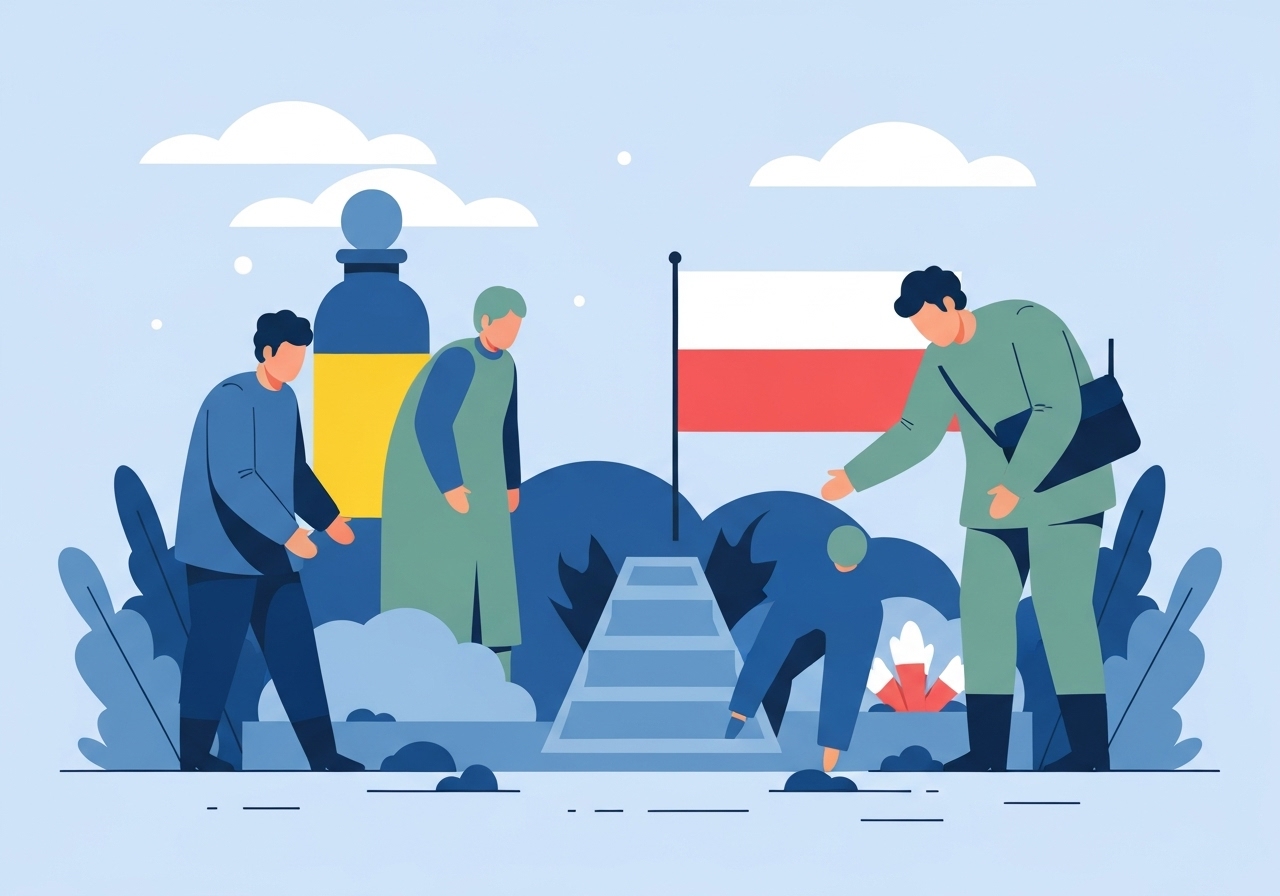
— In Puzhnyky, in western Ukraine’s Ternopil region, the remains of 42 people found in a mass grave were exhumed and reburied individually in ceremonies attended by Polish officials and clergy, a step intended to address a decades‑long World War II dispute between Ukraine and Poland.
Key Takeaways
- Forty-two sets of remains were reburied on Sept. 6, 2025, near the abandoned village of Puzhnyky, Ternopil region.
- The remains included adult men, women and 10 children and were placed in individual coffins with blue wildflowers.
- Polish officials Małgorzata Kidawa‑Błońska and Marta Cienkowska attended a joint Roman Catholic, Greek Catholic and Ukrainian Orthodox funeral mass.
- Ukraine has agreed to allow exhumations of sites believed to contain ethnic Polish victims; remains will be sent to Poland for identification and then returned for reburial.
- The move is aimed at defusing a long-running historical dispute that risked straining relations vital for military and logistical support during the current war with Russia.
- Another nearby site was exhumed the previous week, and Ukrainian officials say a dozen more exhumations are planned.
Verified Facts
On Sept. 6, 2025, a burial ceremony near Puzhnyky marked the conclusion of an exhumation that found 42 people interred in a single grave. Each set of remains was reburied in its own coffin; family members and representatives from Poland attended the service. Photographs published from the site show priests from the Roman Catholic, Greek Catholic and Ukrainian Orthodox churches taking part.
Historical investigation of the site found personal effects such as uniform buttons and medals among the remains. Ukrainian historians describe Puzhnyky as having been a center where members of a Polish underground group cooperated with Soviet security forces then known as the N.K.V.D.; Ukrainian Partisan Army forces attacked the village on Feb. 13, 1945. Polish historians have long characterized similar events in the region as massacres of civilians.
Under a new policy, Kyiv will permit exhumation work at sites in Ukraine believed to contain ethnic Polish victims. The protocol calls for remains to be transported to Poland when identification is possible, then returned to Ukraine for reburial near former Polish villages, many of which were emptied after the postwar population transfers.
Context & Impact
Disputes over wartime killings in western Ukraine have strained relations between Warsaw and Kyiv for decades. Poland has pressed for full investigation and commemoration of victims it says were ethnically targeted; some Ukrainian narratives have elevated wartime nationalists as independence figures.
The pause in exhumations that began in 2015 followed mutual accusations and concerns about vandalism and politicization. Kyiv’s decision to resume cooperation—formally approved last year—reflects priority given to maintaining Polish support and the security corridors that help deliver Western aid and materiel.
For descendants of the dead, individual burials provide closure and a clear record for future identification. For both governments, the work is a confidence‑building measure intended to reduce historical friction that could be exploited by external actors.
“The only country that will be happy with tensions between Ukraine and Poland is Russia,”
Andriy Nadzhos, Deputy Ukrainian Minister of Culture
Unconfirmed or Disputed Points
- Precise attribution of responsibility for the Puzhnyky killings remains contested among historians; exhumation yielded evidence consistent with multiple interpretations.
- Not all remains at exhumation sites have been positively identified; further forensic work in Poland is planned but outcomes are pending.
- The full scope and number of additional sites linked to the same events are still being surveyed.
Bottom Line
The reburials in Puzhnyky are a concrete, symbolic effort to settle a painful chapter of mid‑20th century history and to stabilize a crucial bilateral relationship during an ongoing war. Continued forensic work, transparent records and cooperative commemoration will be needed to translate this gesture into lasting reconciliation.