
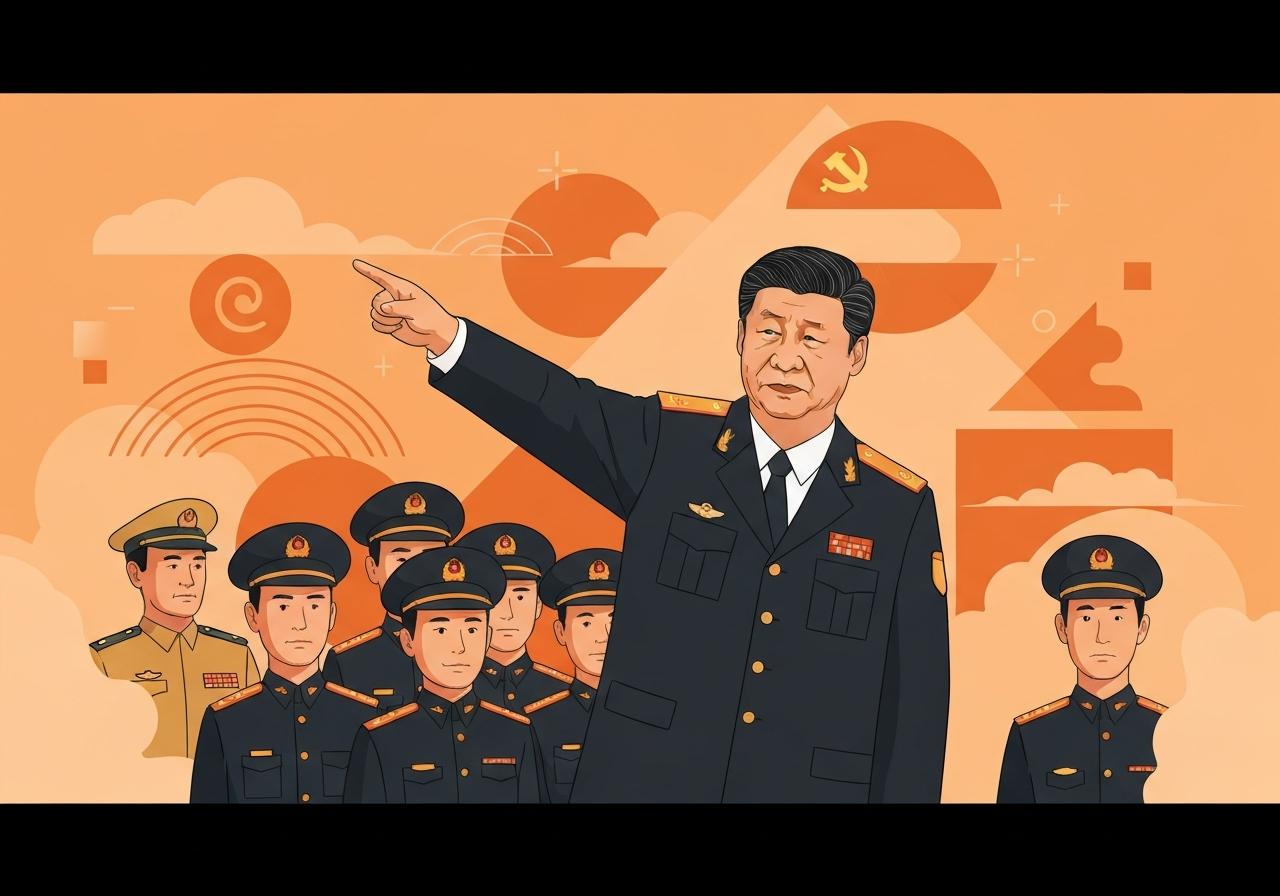
Chinese President Xi Jinping told delegates at the annual national parliamentary session on March 7, 2026, that the armed forces must not protect corrupt or disloyal personnel, reinforcing a sweeping anti-corruption campaign in the military. The remarks came amid what Chinese and foreign reporting describe as the largest purge of military officials in roughly half a century, and were delivered to representatives from the People’s Liberation Army and the People’s Armed Police Force. Xi framed the effort as necessary to preserve Party control and institutional integrity, urging continued investigations and discipline. The address marks a high-profile moment in a broader effort to tighten oversight of security institutions.
Key Takeaways
- On March 7, 2026, President Xi Jinping addressed PLA and PAP delegates during the annual parliamentary session and warned against shielding corrupt or disloyal officers.
- Domestic and international reporting characterizes current dismissals and probes as the biggest military purge in roughly 50 years; Chinese authorities have not published a comprehensive count of personnel affected.
- Xi said there must be “no room in the military for those who harbor disloyalty toward the party, nor any place for corrupt officials to hide,” signaling zero tolerance for both political dissent and graft.
- The remarks were made publicly at the national legislature’s session (commonly known as the NPC) on March 7, 2026 at 12:14 PM UTC, drawing attention from both state and international media.
- The campaign targets personnel across the People’s Liberation Army and the People’s Armed Police Force, reflecting an institutional focus rather than an isolated unit-level investigation.
- Observers see the purge as part of a longer-term trend toward centralizing command and disciplining the officer corps that accelerated over the past decade.
Background
Since taking central leadership, Xi Jinping has repeatedly emphasized political loyalty within the Party and its armed wings, linking personnel discipline to the Chinese Communist Party’s broader governance priorities. Anti-corruption work inside the military has been a stated focus of Beijing for years, with periodic campaigns to remove officers implicated in graft, nepotism or factionalism. The current wave of actions has been described by numerous outlets as more extensive than recent rounds, drawing comparisons to large-scale personnel shifts in prior decades. Military reform and professionalization measures have also changed promotion pathways, increasing the Party’s leverage over officer appointments and internal discipline mechanisms.
China’s People’s Liberation Army (PLA) and the People’s Armed Police (PAP) occupy an elevated role in national security and internal order; changes within their leadership ripple across domestic stability and regional military posture. The annual national parliamentary meeting provides a prominent public platform for Party leadership to restate priorities; Xi used this venue to reinforce the message that political fidelity and probity are non-negotiable for those who command or serve. While the Party emphasizes rule-bound procedures for discipline, transparency remains limited and many specifics—timelines, names, and counts—are withheld from public release. That opacity complicates external efforts to quantify the full scope and institutional impact of the purge.
Main Event
On March 7, 2026, during the legislative session attended by delegates from the PLA and PAP, President Xi reiterated that the armed forces must not provide shelter to corrupt or disloyal officials. His remarks were reported across state and international media and were framed as a call to continue an intensified disciplinary campaign. Officials present described the talk as a directive to strengthen internal inspections and accelerate ongoing investigations into misconduct and political unreliability. The emphasis was on rooting out both financial corruption and any signs of factional allegiance that could undermine Party control.
State-facing channels highlighted the speech as reinforcing unity between the Party leadership and its security organs, stressing that disciplinary measures are essential to ensure a modern, reliable military. At the same time, international analysts noted that such public statements serve both an internal governance purpose and an external signaling function—demonstrating control over the armed forces to domestic and foreign audiences. The session did not publish a detailed list of personnel actions; instead, the leadership framed the steps as part of an ongoing, long-term effort to enforce standards.
Reports indicate the campaign has targeted officers at multiple echelons, though official announcements provide few specifics about individual cases or aggregate figures. The lack of comprehensive public data has prompted analysts to rely on piecemeal disclosures, official communiqués, and investigative reporting to assess scale and scope. That mosaic of sources points to a significant recalibration of military personnel management, but leaves key questions about timelines and institutional consequences open.
Analysis & Implications
The purge and Xi’s reiterated warning carry several interlocking implications for the Party, the armed forces, and regional security dynamics. Domestically, a vigorous campaign against corrupt or disloyal officers strengthens the Party’s command-and-control over the military, reducing the risk of autonomous power centers emerging within the officer corps. This consolidation can improve centralized decision-making and loyalty but may also narrow the pool of operationally experienced leaders if dismissals remove seasoned commanders.
Institutionally, sustained disciplinary pressure can reshape promotion incentives, rewarding political reliability alongside technical competence. Over time, that can alter organizational culture—encouraging risk-averse behavior among officers worried about political scrutiny. For military effectiveness, the net effect depends on how rigorously merit and expertise remain part of selection criteria; if political litmus tests dominate, capability could be affected in complex ways.
Regionally, observers will watch for how the personnel changes affect force readiness and command continuity. Neighboring states and external militaries often monitor leadership turnover for signs of instability or policy shifts. A high-profile purge can produce short-term uncertainty in planning and force posture, though Beijing’s emphasis on control suggests an intent to avoid operational disruption. Internationally, the action may be read as part of a broader pattern of centralization and discipline that shapes China’s external behavior.
Comparison & Data
| Event | Period | Reported Scale |
|---|---|---|
| Current purge | 2025–2026 | Described as the largest in roughly 50 years; official counts not released |
| Earlier military purges | 1960s–1970s (various episodes) | Widespread personnel changes in politically turbulent years; data contested |
Quantitative transparency is limited: Chinese authorities have not published a consolidated tally of officers removed, disciplined or investigated in the current campaign. Historical comparisons rely on scholarly reconstructions and contemporary reporting rather than current official aggregates. As a result, analysts caution against precise numerical claims and emphasize qualitative assessments—scale, institutional reach, and political intent—when evaluating the purge.
Reactions & Quotes
“There must be no room in the military for those who harbor disloyalty toward the party, nor any place for corrupt officials to hide.”
President Xi Jinping
“The measures are intended to tighten Party oversight of the armed forces and eliminate corruption that could undermine cohesion,”
Analysis reported by Bloomberg (media)
“State messaging frames this as a necessary step to protect unit integrity and command discipline,”
Commentary summarized from reporting (media)
Unconfirmed
- No official comprehensive count has been released; the exact number of officers affected by the campaign is unconfirmed.
- Allegations about the specific motives behind individual dismissals (personal rivalry versus documented corruption) remain unclear in many reported cases.
- Reports suggesting short-term degradation of operational readiness due to the purge are speculative and lack comprehensive verification.
Bottom Line
Xi’s public admonition to the military on March 7, 2026, signals an ongoing effort to enforce political loyalty and root out corruption within the PLA and PAP. The episode reinforces a multi-year trend toward tighter Party oversight of security institutions, with implications for promotions, command culture, and institutional behavior. Because official disclosure is limited, external observers must piece together the campaign’s true scale from sparse public statements and reporting.
For policymakers and analysts, the key variables to watch are (1) whether Beijing releases more granular data on personnel actions, (2) if the purge affects operational command continuity in ways evident to foreign militaries, and (3) how internal discipline reshapes officer incentives over the medium term. These outcomes will determine whether the campaign produces greater cohesion and control or unintended effects on expertise and readiness.
Sources
- Bloomberg (media report on parliamentary remarks and purge)