
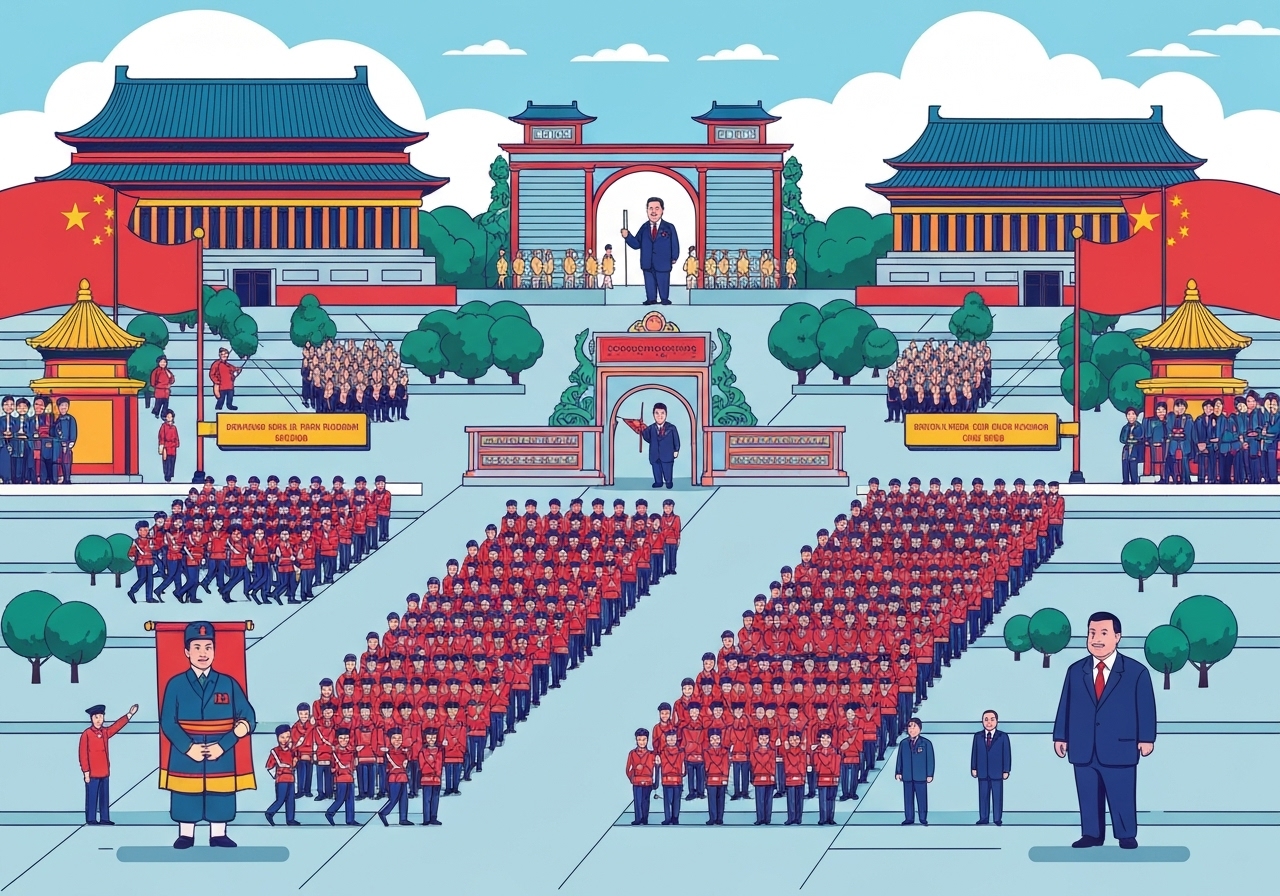
On Sept. 3, 2025, Chinese President Xi Jinping inspected People’s Liberation Army troops in Beijing at a high-profile military parade, and earlier this week he met Indian Prime Minister Narendra Modi in nearby Tianjin; together the events were widely seen as projecting to U.S. President Donald Trump that China and its regional partners can pursue strategic choices without U.S. approval.
Key Takeaways
- Xi presided over a military parade in Beijing on Sept. 3, 2025, inspecting PLA units.
- A summit in Tianjin this week brought Xi and Indian PM Narendra Modi together after a period of strain.
- The pairing of parade and summit conveyed a signal of confidence and independence to the United States.
- Energy cooperation was reported as a key topic during the Tianjin talks.
- Analysts say the events aim to reassure regional partners and influence U.S. perceptions of China’s strength.
- Markets and diplomatic observers are watching for concrete follow-up agreements from the summit.
Verified Facts
Xi Jinping inspected PLA soldiers at a military parade in Beijing on Sept. 3, 2025. Photographs of the inspection were distributed by international wire services and credited to Bloomberg photographer Qilai Shen.
Earlier in the same week, Xi and Indian Prime Minister Narendra Modi held a summit in Tianjin, described in reporting as a step toward mending ties and expanding cooperation. Coverage noted energy issues as a central element of the talks.
There was no immediate evidence that the events included formal security pacts; reporting and official readouts emphasized dialogue, cooperation and economic topics over new military commitments.
The sequence of a prominent domestic show of force followed by diplomacy with a major regional partner drew attention because it combined domestic signaling with international outreach.
Context & Impact
Combining a high-profile parade and a diplomatic summit is a familiar diplomatic tactic: the parade underscores military readiness and national unity, while the summit demonstrates willingness to engage with neighbors.
For Washington, the twin events are likely to be read as an assertion of strategic autonomy by Beijing and by Asian capitals balancing relations between the U.S. and China. That reading could influence U.S. policy calculations ahead of future meetings between leaders.
Possible implications include increased momentum for bilateral economic or energy deals, shifts in regional diplomatic posture, and market sensitivity to headlines that suggest deeper China–India cooperation.
- Diplomatic: May ease bilateral friction between Beijing and New Delhi, altering negotiation dynamics on trade and border issues.
- Economic: Energy cooperation discussions could lead to commercial agreements that affect regional markets.
- Strategic: The public optics reinforce China’s narrative of self-reliance and regional influence.
Reporting described the summit as constructive and focused on cooperation, with energy issues highlighted among agenda items.
Bloomberg reporting
Unconfirmed
- Whether the parade and summit were explicitly coordinated to target President Trump remains an interpretation rather than a documented directive.
- Specific commercial or military agreements announced as follow-ups have not been uniformly detailed in publicly available readouts.
Bottom Line
The combination of a Sept. 3 military parade in Beijing and a Tianjin summit with Narendra Modi projects a dual message of strength at home and pragmatic outreach abroad. While reporting highlights energy and cooperation, concrete outcomes will determine how materially the events reshape regional alignments or U.S. policy responses.