
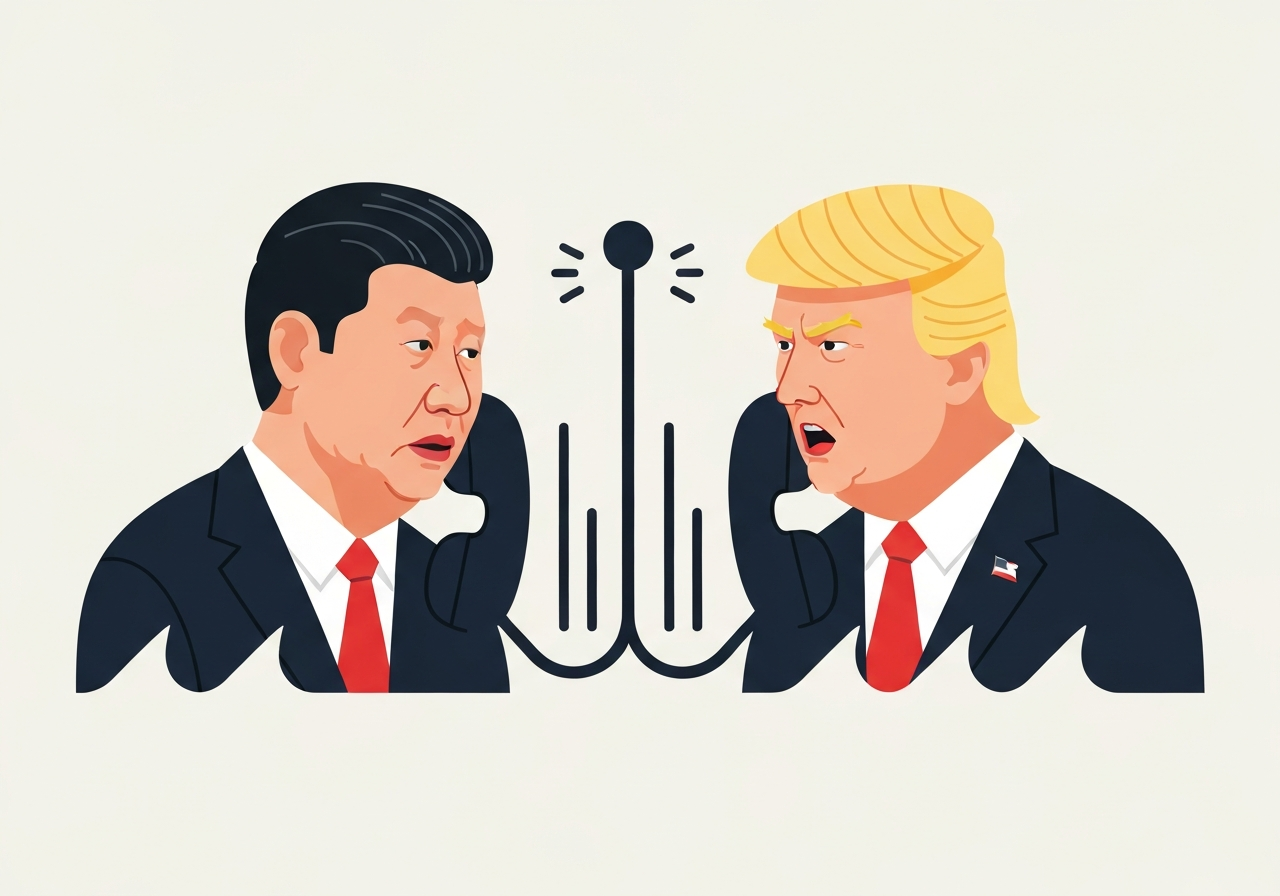
On Feb. 4, 2026, Presidents Xi Jinping and Donald J. Trump spoke by phone in a conversation that U.S. officials say ran nearly two hours and covered a broad agenda ahead of Mr. Trump’s planned April visit to China. Both sides framed the call differently: the White House highlighted a wide-ranging, productive discussion, while Chinese state outlets emphasized a stern warning from Mr. Xi about Taiwan. The exchange came as the two leaders try to stabilize ties after recent trade tensions and follow a meeting in October in South Korea where they agreed a yearlong trade truce. The call has immediate diplomatic implications for cross-Strait stability and for the agenda of the upcoming summit.
Key Takeaways
- The phone call took place on Feb. 4, 2026, and lasted almost two hours, according to people briefed on the conversation.
- Mr. Trump said the discussion covered Iran, the war in Ukraine, soybeans and his planned April trip to China, calling the call “excellent” in a social-media post.
- Chinese state media reported that President Xi framed the U.S. stance on Taiwan as the most important bilateral issue and reiterated that China will not accept Taiwan’s separation.
- The leaders last met in October 2025 in South Korea, where they agreed a yearlong pause in aggressive trade measures between the two countries.
- The exchange signals both an effort to manage tensions and potential flashpoints ahead of a high-stakes summit in April 2026.
Background
Relations between Washington and Beijing have fluctuated between engagement and confrontation in recent years. After an intense trade conflict early in Mr. Trump’s previous presidency, the two sides moved toward a truce last year during a meeting in South Korea. Beijing, which regards Taiwan as part of its territory, has steadily pressured the island and pushed the United States to clarify its commitments and red lines.
For the United States, Taiwan is a sensitive diplomatic and security issue that also figures into broader regional stability and alliance calculations in the Indo-Pacific. Mr. Trump’s announcement of an April visit to China follows months of lower-level diplomacy intended to reduce the risk of miscalculation on military, economic and technological fronts. Both capitals have incentives to show progress while signaling resolve on core interests.
Main Event
The Feb. 4 call was described to reporters as lengthy and substantive. U.S. officials emphasized the breadth of topics discussed, noting Iran, Ukraine, agricultural trade and preparations for the April summit among items on the agenda. Mr. Trump posted that the call was “excellent,” stressing the personal rapport he said he maintains with Mr. Xi and expressing optimism about outcomes over the next three years of his presidency.
Chinese state-controlled outlets, by contrast, highlighted Mr. Xi’s comments on Taiwan and characterized the conversation as focusing squarely on safeguarding China’s territorial claims. According to those reports, Mr. Xi told Mr. Trump that U.S. policy on Taiwan is the single most important issue in the bilateral relationship and warned against any steps toward formal separation.
Participants on both sides appear to have sought to manage public messaging: Washington underscored cooperation and a broad agenda, while Beijing emphasized sovereignty and red lines. The differing emphases reflect longstanding communication strategies in high-stakes diplomacy, where each capital signals priorities to domestic and international audiences.
Analysis & Implications
The prominence of Taiwan in post-call coverage underscores how central the island remains to U.S.-China strategic competition. If Taipei or external actors interpret the exchange as a sign Beijing will intensify pressure, the risk of regional escalation could rise. Conversely, if Washington perceives the call as a de-escalatory channel, it may use the April summit to formalize crisis-management measures.
Economically, stabilizing relations matters for supply chains and trade flows—soybeans were among the commercial topics reported—so a productive summit could ease market volatility. Yet sovereign and security issues like Taiwan are less amenable to short-term transactional fixes, meaning substantive friction could remain even if trade tensions recede.
Diplomatically, the contrasting public accounts may be purposeful: Beijing projecting firmness to domestic audiences while signaling to Washington its core demands; Washington emphasizing broad cooperation to reassure allies and markets. How both sides reconcile those messages in private summit negotiations will shape policy choices in the months ahead.
Comparison & Data
| Date | Location | Key Outcome |
|---|---|---|
| Oct. 2025 | Seoul, South Korea | Yearlong trade truce agreed |
| Feb. 4, 2026 | Phone call | Nearly two-hour discussion; Taiwan emphasized by Beijing |
| April 2026 (planned) | China (summit) | Leaders’ summit to address bilateral agenda |
The timeline shows a rapid sequence of high-level engagement: a trade truce in October, a long phone call in February, and a planned summit in April. That cadence suggests both capitals are prioritizing top-level management of disputes even where deeper policy divergence persists.
Reactions & Quotes
U.S. and Chinese public statements after the call reveal differing emphases and purposes.
“The relationship with China, and my personal relationship with President Xi, is an extremely good one,” Mr. Trump wrote on social media, adding he expected positive results during his presidency.
Former President Donald J. Trump (social post)
Trump’s post framed the call as broadly constructive and forward-looking, a message aimed at reassuring markets and supporters about diplomatic momentum.
Chinese state reports stressed that the Taiwan question is central to bilateral ties and warned against moves toward separation.
Chinese state media (report)
Beijing’s public line emphasized sovereignty and domestic messaging; state outlets sought to underline limits Beijing places on U.S. and Taiwanese actions.
Unconfirmed
- Reports differ on whether specific crisis-management mechanisms were agreed in principle during the call; no formal joint text has been released.
- There is no public confirmation of any new security guarantees or concessions related to Taiwan ahead of the April summit.
Bottom Line
The Feb. 4 phone call between Presidents Xi and Trump was simultaneously a sign of diplomatic engagement and a reminder of persistent fault lines, especially over Taiwan. While Washington framed the discussion as broad and productive, Beijing’s messaging focused on core sovereignty demands—setting different pressures on the upcoming April summit.
How the leaders convert talking points into tangible agreements will determine whether tensions ease or recalibrate toward new competition. Observers should watch for concrete summit deliverables, any change in military posturing around Taiwan, and follow-up readouts from both governments for a clearer picture.
Sources
- The New York Times — U.S. newspaper (report on call and accounts from both sides)
- Xinhua — Chinese state media (official reporting and commentary)