
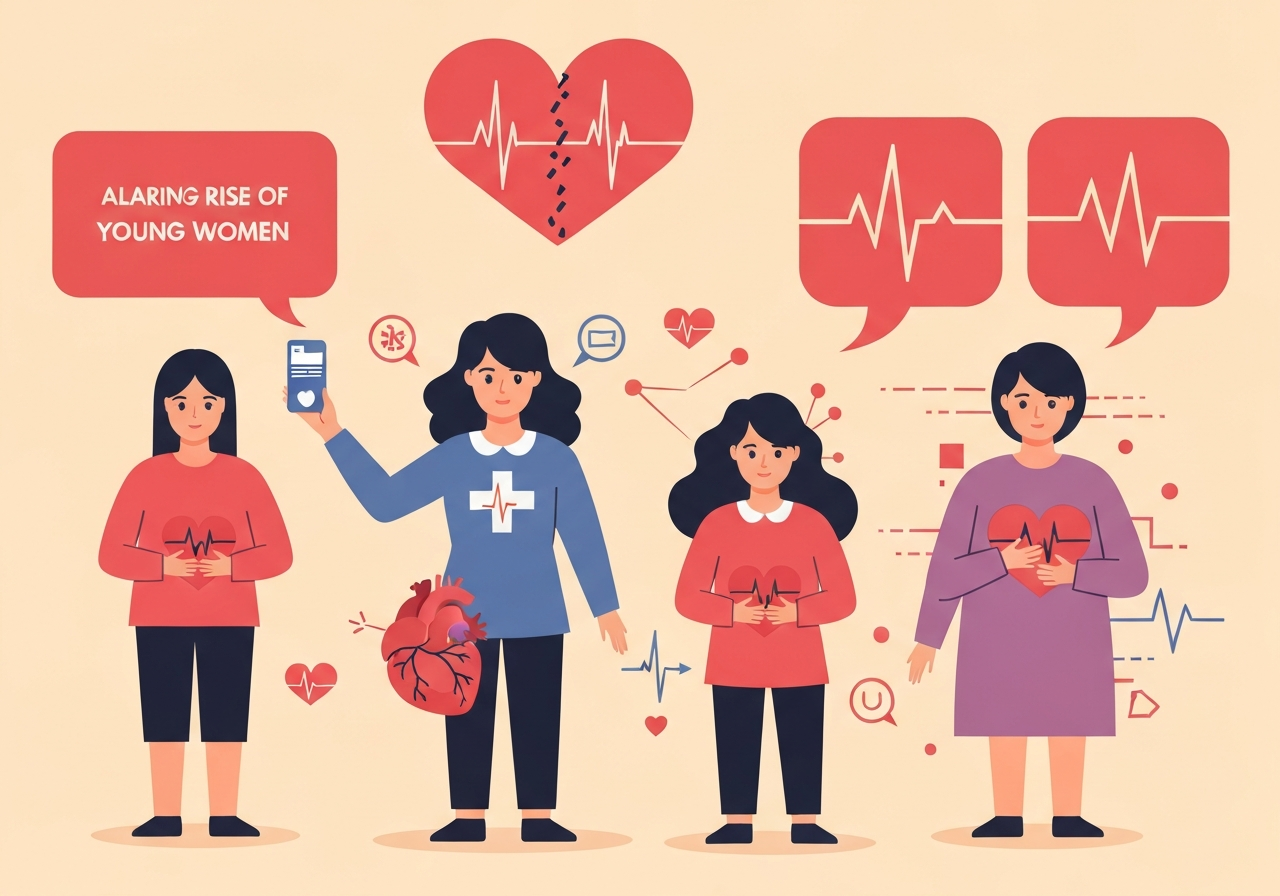
Lead: In the United States, heart disease remains the top cause of death for cisgender women, and recent projections show the number affected will climb through 2050, with more than 22 million women impacted and the steepest rise among ages 20–44. Awareness that heart disease is the leading killer of women fell from 65% in 2009 to 44% in 2019, and clinicians report frequent misdiagnosis of female patients. Experts say biological differences, gaps in research and medical training, and underpowered public outreach help explain why younger women are increasingly vulnerable. The result: warning signs are often missed by patients and providers, contributing to avoidable illness and death.
Key takeaways
- Projected burden: Models estimate over 22 million U.S. women will have heart disease by 2050, with the largest relative increases in ages 20–44.
- Awareness decline: Public recognition that heart disease is women’s No.1 cause of death fell from 65% (2009) to 44% (2019), per an American Heart Association survey.
- Misdiagnosis common: A 2025 cardiologist survey by the Women’s Health Alliance found 84% had treated women whose heart condition was previously misdiagnosed.
- Research gaps: From 2006–2016, 72% of preclinical animal studies used only male animals; in human trials from 2010–2017, women comprised about 38% of participants and postmenopausal women 26%.
- Unique female risks: Early menarche, irregular cycles, pregnancy complications (hypertension, gestational diabetes), and menopausal symptoms can raise long‑term cardiovascular risk.
- Symptoms differ: While chest pain remains important, women more often report shortness of breath, neck/arm pain, gastrointestinal symptoms, sweating, or extreme fatigue during cardiac events.
- Systemic shortfalls: More than three in four primary care clinicians report low confidence assessing cardiovascular risk in women, linked to limited gender‑specific training in medical curricula.
Background
Researchers first flagged a troubling sex gap in cardiovascular outcomes in the 1980s and 1990s, when men began to see clear mortality improvements that women did not. Since then, studies have identified physiological and pathological differences—microvascular disease, hormonal influences, and atypical presentation patterns—that make women’s heart disease both distinct and harder to detect with tests and algorithms built around male biology. Those insights have advanced, but the pipeline of basic and clinical research has lagged: animal studies, early-phase experiments, and many randomized trials historically under-enrolled women or excluded sex-specific analyses.
At the same time, public messaging and clinical education have not kept pace with the science. Large public campaigns have raised awareness of breast cancer effectively, creating symbols and outreach channels that reached broad audiences; comparable, sustained recognition for women’s heart health has been weaker and, according to survey data, declining. Medical training programs and continuing education frequently omit gender‑specific cardiac education—one survey found that over 70% of U.S. and Canadian medical schools lacked dedicated gender‑based cardiovascular content—so many clinicians enter practice without the tools to recognize or treat presentations that differ from textbook male patterns.
Main event
New projections and recent surveys have crystallized a worrying trend: younger women are experiencing rising rates of heart disease and worse outcomes after cardiac events. Modeling through 2050 projects that more than 22 million U.S. women will be living with heart disease, and the fastest relative increases are forecast among women aged 20–44. Clinicians report that heart attacks and other acute events in adults under 55 are becoming more lethal, and cardiologists increasingly see patients who lack traditional risk factors yet suffer severe cardiovascular events.
Practicing physicians describe frequent missed or delayed diagnoses when women present with nonclassical symptoms. For example, microvascular blockages or endothelial dysfunction can cause ischemia without obstructive large‑artery lesions on angiography, so a normal large‑artery test does not always rule out clinically important disease in women. Emergency evaluations can be complicated by factors such as atypical EKG findings when electrode placement is adjusted for breast tissue, and by clinicians who attribute women’s chest symptoms to stress or anxiety more often than they would for male patients.
Public awareness data show a drop in recognition of heart disease as the leading cause of death among women: the American Heart Association reported a fall from 65% awareness in 2009 to 44% in 2019. Separate 2025 clinician surveys highlight practical consequences: 84% of responding cardiologists said they had treated a female patient previously misdiagnosed. Together, these figures suggest both informational and clinical failures—patients unaware of risk and providers unprepared to interpret atypical signs.
Analysis & implications
The widening burden among younger women has several drivers that interact. Rising rates of obesity, diabetes, and sedentary lifestyles increase baseline cardiovascular risk across populations; when layered with female‑specific exposures—earlier menarche, hypertensive disorders of pregnancy, gestational diabetes, and menopausal vascular changes—the net effect is higher lifetime risk for many women. Because these female‑specific risks emerge at younger ages, they help explain the relative uptick in heart disease among women in their 20s to 40s.
Research and training shortfalls amplify the problem. Preclinical research biased toward male animals produces pathophysiological models that may not generalize; clinical trials with low female representation produce guideline recommendations that may underperform for women. In clinical practice, limited gendered training reduces clinicians’ ability to detect microvascular disease or interpret subtle symptom clusters, so the system systematically underdiagnoses and undertreats women.
From a public‑health perspective, declining awareness undermines prevention. Traditional messaging that frames heart disease as an older man’s disease fails to reach younger women, who often underestimate their risk. Messaging that connects cardiovascular health to outcomes women care about—preserving cognitive function, avoiding disability, maintaining functional independence—may engage different motivations and improve preventive uptake.
Policy and clinical remedies are available but require coordination: funders and regulators can insist on sex‑balanced preclinical and clinical research; medical schools and certification bodies can require gender‑specific cardiovascular training; and public health campaigns can be retooled to meet younger women where they are, using platforms and framing that resonate with their concerns.
Comparison & data
| Metric | Figure | Source (year) |
|---|---|---|
| Projected U.S. women with heart disease by 2050 | More than 22 million | Modeling cited in reporting (projection) |
| Public awareness that heart disease is women’s top killer | 65% (2009) → 44% (2019) | American Heart Association survey (2020) |
| Cardiologists reporting prior misdiagnosis of female patients | 84% | Women’s Health Alliance cardiologist survey (2025) |
| Preclinical animal studies using only male animals | 72% (2006–2016) | AHA/McKinsey report (June 2024) |
| Women in human cardiovascular trials | 38% overall (2010–2017); 26% post‑menopausal | Clinical trial analyses (2010–2017) |
These figures illustrate persistent gaps across research, clinician experience, and public understanding. The table is a synthesis of published surveys and reports referenced by clinicians and public health bodies; it is intended to show how underrepresentation in research and declining public awareness map onto clinical consequences such as misdiagnosis.
Reactions & quotes
Clinicians and advocates react to a landscape where the science has advanced but practice and public understanding lag. Below are representative remarks and the context that surrounds them.
“I’m just jealous of them. They’ve done a good job at getting out the message. We have not.”
Dr. Martha Gulati, cardiologist (commenting on breast cancer outreach vs. heart health outreach)
Gulati uses the contrast with breast cancer campaigns to underscore how branding and awareness campaigns have shaped public perception and fundraising. She and others argue that a clear, resonant symbol and sustained outreach could increase recognition of women’s cardiovascular risk.
“We have to do better. I try to integrate gender‑specific content into training wherever I can.”
Dr. Harmony Reynolds, cardiologist and researcher (on medical education)
Reynolds highlights education as a leverage point: paramedics, nurses, primary care physicians, and specialists all benefit from training that emphasizes how presentations can differ in women and how to interpret diagnostics accordingly.
“Younger people aren’t thinking deeply about these topics… messaging may need to shift to things like brain health.”
Dr. Mary Cushman, cardiologist and public‑health researcher (on outreach to younger women)
Cushman suggests reframing prevention — linking vascular health to risks of dementia and cognitive decline — to make messages salient to younger audiences who discount long‑term mortality warnings.
Unconfirmed
- Whether a single universal symbol or rebranding campaign would measurably raise sustained awareness and change clinical outcomes has not been demonstrated in randomized or large‑scale longitudinal studies.
- Early reports that GLP‑1 receptor agonists will substantially reduce cardiovascular events in younger women are promising but require longer follow‑up and sex‑specific outcome data to be conclusive.
- Some localized surveys suggest awareness trends differ regionally and demographically; comprehensive national post‑2019 data on public awareness are limited.
Bottom line
The core problem is not a single failure but a set of interacting gaps: biological differences that were historically understudied, clinical education and diagnostic pathways built around male norms, and public messaging that has not reached younger women. Those gaps help explain why heart disease is rising in younger female cohorts and why many cases are missed or misdiagnosed.
Addressing the trend requires changes at multiple levels: funders and regulators should require sex‑balanced research and sex‑specific reporting; medical education and continuing professional development should include gender‑specific cardiovascular training; and public campaigns should be reframed and delivered where younger women engage—linking vascular health to outcomes that motivate them, such as cognitive function and quality of life.
Meanwhile, patients should be empowered to advocate for themselves: use available risk tools before annual visits, bring questions about reproductive history and pregnancy complications to clinicians, and seek emergency care for concerning symptoms rather than assuming youth or stress explains them. Given current trends, greater awareness and clinician vigilance could prevent many avoidable events.
Sources
- Vox — original reporting on women’s heart disease trends and awareness (journalism)
- American Heart Association — public surveys and advocacy material on women’s heart disease (official association)
- McKinsey & Company — analysis referenced in AHA/McKinsey collaborative reporting on research and clinical gaps (policy/consulting)
- Women’s Health Alliance — cardiologist survey on misdiagnosis of female patients (professional alliance)
- American Heart Journal — peer‑reviewed research on sex differences in cardiovascular trials (academic journal)