
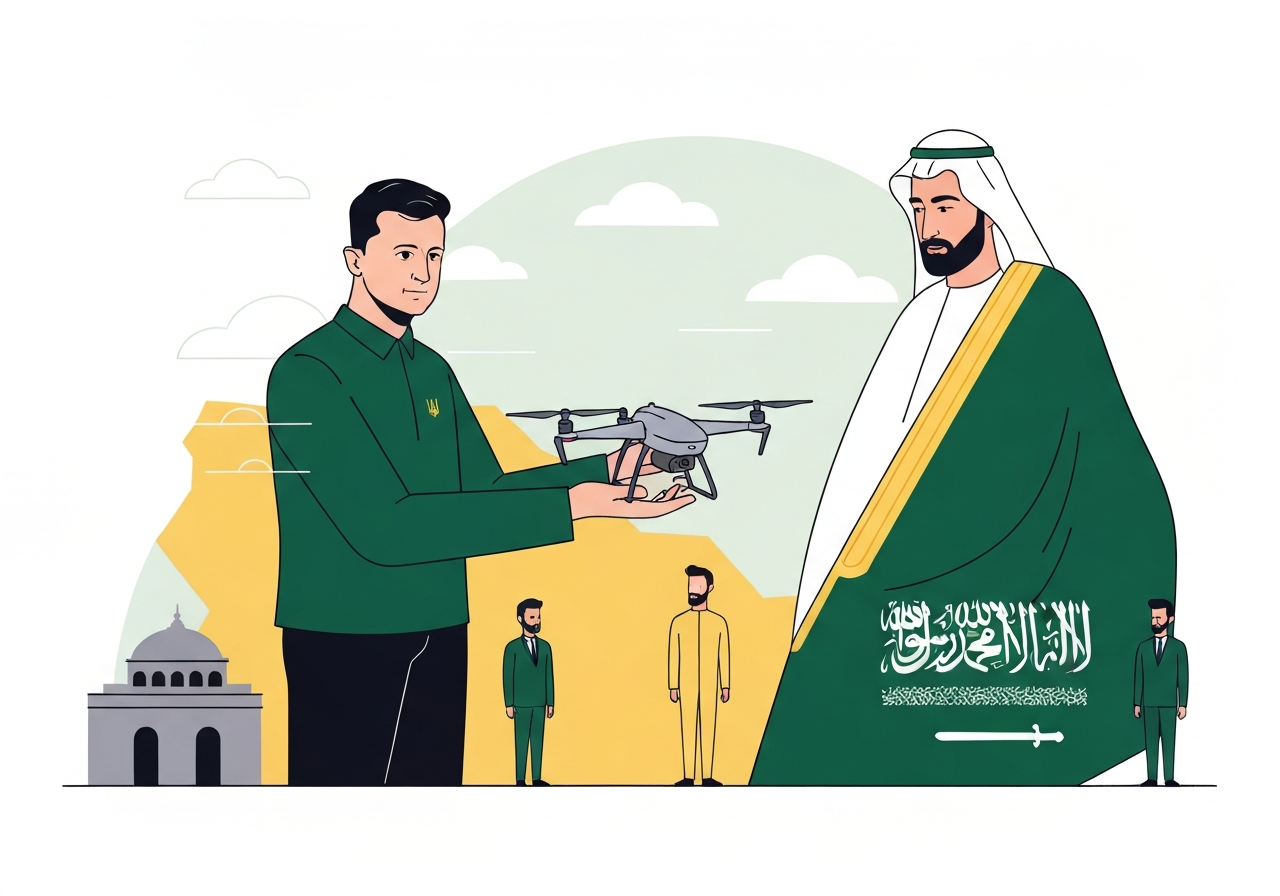
Lead: Ukrainian President Volodymyr Zelensky arrived in Saudi Arabia on Thursday after proposing that Ukraine share its combat drone experience with Gulf states to bolster regional security. He framed the offer as linked to global energy stability and Europe’s cost of living, and said talks in Riyadh will include defense cooperation. The visit comes as Ukrainian firms report approaches from Saudi and other Gulf buyers, though Kyiv has not yet approved exports. At the same time, reports say Washington is weighing redirecting some munitions to the Middle East, a development Kyiv views as making any drone agreements more strategically urgent.
Key Takeaways
- Zelensky arrived in Saudi Arabia on Thursday to hold “important meetings” focused on security cooperation and potential defense deals with Gulf partners.
- In a message to the Joint Expeditionary Force summit in Helsinki, he offered Ukraine’s practical drone experience and systems-integration expertise to improve Gulf air security.
- He signalled Kyiv would look for air-defence assistance in return, citing shortages of certain missiles needed to defend Ukraine against Russia.
- BBC reporting found that Ukrainian firms Kvertus and TAF Industries say they have been approached by Saudi Arabia, Kuwait, Qatar and the UAE, but are awaiting export approval from Kyiv.
- Kvertus’s CEO Yaroslav Filimonov said the company must coordinate exports with the Ukrainian government; TAF’s CEO Volodymyr Zinovsky echoed that national security guides any sale.
- The Washington Post reported Pentagon consideration of diverting weapons intended for Ukraine to the Middle East, a move President Trump described as a routine reallocation.
- If approved, transfers of Ukrainian drone expertise could affect Gulf air-defence postures and create new commercial and military ties between Kyiv and Gulf states.
Background
Since Russia’s full-scale invasion in 2022, Ukraine has rapidly developed and fielded a wide array of combat drones and electronic-warfare tools, gaining operational experience that Kyiv now describes as an exportable asset. The conflict has pushed Ukrainian industry into frontline innovation: small tactical drones, precision loitering munitions and anti-drone countermeasures have been iterated in real combat conditions. Gulf states face intermittent threats to maritime and energy infrastructure, making air-defence and counter-drone capabilities a high priority for regional security planners. For Kyiv, exporting know-how or systems could generate political leverage, revenue and reciprocal defense support, but it also raises export-control, political and operational risk questions that the government must assess.
Ukraine’s export decisions are sensitive because equipment and expertise can be re-exported, used against other partners, or compromise operational methods seen as essential to Kyiv’s defense. Past precedents—such as Western restrictions on certain missile and air-defence transfers—show how allies weigh battlefield needs against arms-proliferation concerns. Gulf partners have been diversifying their security relationships in recent years, buying systems and expertise from Europe, the US and now seeking new suppliers. Meanwhile, the US faces competing demands on its inventories due to rising tensions in the Middle East, which adds pressure to how and whether Western partners can supply Ukraine.
Main Event
Zelensky’s Thursday arrival in Saudi Arabia followed a public offer that Ukraine’s drone experience could help Gulf security. In a video address to the Joint Expeditionary Force meeting in Helsinki he stressed the operational side of Ukraine’s capability: not just hardware but integration with radars, aviation and air-defence networks. He linked that offer to broader economic stakes, saying stable Gulf energy supplies affect Europe’s cost of living and global markets.
In interviews and social posts, Zelensky said he appreciated partners “ready to work with us” and signalled that Kyiv seeks reciprocal assistance, notably air-defence missiles Kyiv lacks. In an interview with Le Monde he explicitly asked Middle Eastern states to consider allowing Ukraine to strengthen its defenses via access to certain systems. Ukrainian manufacturers contacted by the BBC confirmed they had received inquiries from Gulf representatives but have not received government export licenses.
Companies such as Kvertus, maker of anti-drone electronic-warfare systems, said they were approached by Saudi and Kuwaiti contacts but are awaiting state approval. TAF Industries’ CEO Volodymyr Zinovsky said his firm was similarly approached by Saudi, Qatar, the UAE and Kuwait and would defer to Kyiv for any deal. Ukrainian officials have not publicly announced approved agreements, and the BBC noted export approvals remain pending.
Analysis & Implications
Ukraine pitching its drone expertise to Gulf states is both a commercial and geopolitical move. Commercially, Ukraine’s wartime experience is a rare product: firms can offer proven doctrines, tactics, and integration know-how that off-the-shelf systems alone do not provide. For Gulf customers, this operational knowledge promises faster combat readiness than acquiring only hardware, which often requires years of doctrine development and testing.
Strategically, such transfers could deepen Kyiv’s ties with wealthy Gulf states, creating new diplomatic backchannels and potential sources of materiel or political support. However, exporting defense technologies entails risks: sensitive tactics or electronic-warfare methods could be exposed, and there is potential for regional proliferation or misuse. Kyiv’s need for air-defence systems in the fight against Russia also constrains what it can ethically and strategically hand over.
The reported US consideration of diverting arms from Ukraine to the Middle East compounds the calculus. If Washington reallocates critical munitions, Kyiv may seek alternative partners to secure the systems it needs; a deal with Gulf states could therefore be framed as mutual hedge. Conversely, any perception of Ukraine supplying technology that could shift regional balances may complicate relations with Western suppliers and raise export-control questions in NATO capitals.
Comparison & Data
| Item | Detail |
|---|---|
| Gulf states reportedly approached | Saudi Arabia, Kuwait, Qatar, United Arab Emirates (4 states) |
| Ukrainian firms mentioned | Kvertus (anti-drone EW), TAF Industries (UAV manufacturer) |
| Pending government approvals | Export licences not yet granted (company statements to BBC) |
The table summarizes on-the-record facts: four Gulf states and two Ukrainian firms cited in BBC reporting, and that companies say they are waiting for Kyiv’s permission. This contextualizes how nascent commercial discussions are distinct from signed government-level agreements; operational transfer of systems or know-how will require formal approvals and likely intergovernmental arrangements.
Reactions & Quotes
The announcements prompted a mix of official and public reactions. Officials in Kyiv have stressed coordination, while company executives emphasized national-security constraints on exports.
“We have this experience,”
Volodymyr Zelensky (President of Ukraine)
This succinct claim underscores Zelensky’s central point: Ukraine’s value lies in combat-tested employment of drones and integration with air-defence networks. He used it to justify offering expertise alongside requests for reciprocal air-defence assistance.
“We are waiting for approval to export any products,”
Yaroslav Filimonov (CEO, Kvertus)
Filimonov’s remark highlights the procedural reality: firms cannot unilaterally proceed. His comment frames the issue as both commercial and political, requiring Kyiv’s explicit authorization before any transfers.
“We do that all the time. Sometimes we take from one, and we use for another.”
Donald Trump (former US President)
Trump’s brief comment, cited in wider reporting about US reallocation practices, was offered when asked about media reports that the Pentagon may divert munitions. It reflects a public, if informal, acknowledgement that reallocation is a tool the US sometimes uses.
Unconfirmed
- The precise terms or existence of any signed agreement between Ukraine and Gulf states for drone technology or training remain unconfirmed; BBC reporting notes only inquiries and company statements.
- Reports that the Pentagon will divert specific munitions from Ukraine to the Middle East are based on unnamed sources reported by the Washington Post and have not been confirmed by an official Pentagon public release.
Bottom Line
Zelensky’s visit to Saudi Arabia and his offer to share Ukraine’s drone expertise reflect a pragmatic effort to convert wartime experience into diplomatic and material support, while addressing Gulf security concerns tied to energy stability. Ukrainian manufacturers report demand from Gulf buyers, but Kyiv’s export-licensing process and national-security priorities remain decisive constraints on any deals.
Any movement toward concrete agreements would reshape relationships: Gulf states could gain accelerated operational drone and counter-drone capabilities, while Ukraine could secure political backing or materiel support it currently lacks. However, export approvals, the risk of sensitive tactic disclosure, and broader Western supply dynamics—especially US munitions allocations—will determine whether such cooperation proceeds and on what terms.