
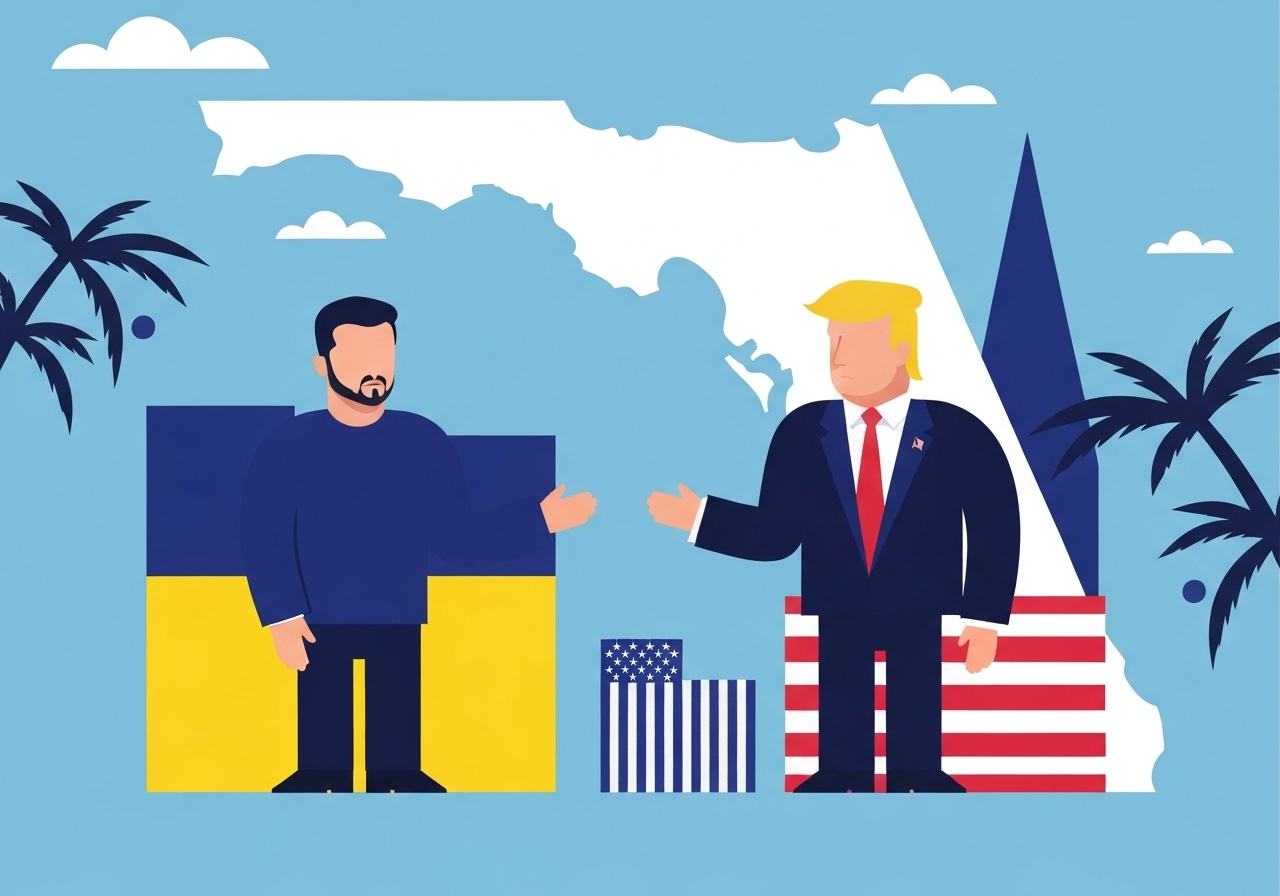
Lead: Ukrainian President Volodymyr Zelensky will meet former President Donald Trump at Mar-a-Lago in West Palm Beach on Sunday at 1 p.m. ET after weeks of intensified negotiations aimed at finalizing a peace framework. The meeting was announced two days in advance and follows intensive work by U.S. envoys to reconcile differences between Trump’s original 28-point plan and Ukraine’s 20-point revision. Kyiv is under ongoing Russian missile and drone strikes even as talks advance, underscoring the fragility of any progress. U.S. and Ukrainian officials describe substantial movement on many points, but key issues — notably territorial concessions and the fate of the Zaporizhzhia nuclear plant — remain unresolved.
Key takeaways
- The meeting is set for 1 p.m. ET at Mar-a-Lago and was arranged after calls involving Steve Witkoff and Jared Kushner, who are acting as U.S. intermediaries.
- Trump introduced a 28-point proposal last month; Ukraine trimmed that to a 20-point plan, with negotiators saying roughly 90% of terms were agreed earlier in December.
- The remaining roughly 10% centers on land concessions — including demands over the eastern Donbas — and security arrangements to prevent future Russian incursions.
- Russia staged a heavy attack overnight, launching 519 drones and 40 missiles, highlighting the gap between diplomacy and battlefield reality.
- Zelensky proposes a joint U.S.–Ukraine arrangement to operate the Russia-occupied Zaporizhzhia nuclear power plant and to split its power output; Moscow will not attend Sunday’s meeting.
- U.S. officials describe a proposed set of security guarantees — called the “platinum standard” — that could be presented to Congress for approval and would include deterrence and monitoring mechanisms.
- Trump has said outcomes depend on his approval; European leaders are not expected to attend the session.
Background
The meeting comes amid nearly four years of war after Russia’s large-scale invasion; Kyiv has sought international backing for a durable ceasefire and territorial security. Last month, former President Trump put forward a 28-point blueprint for ending the conflict; Ukrainian negotiators returned a streamlined 20-point version reflecting Kyiv’s priorities and constitutional limits on territorial changes. U.S. envoys, including Trump associates, have been working intensively to bridge the gap between Kyiv and Moscow on the most difficult issues.
Key stakeholders include the Ukrainian government, U.S. intermediaries (notably Steve Witkoff and Jared Kushner), NATO allies, and Moscow — which is not participating in the Florida meeting. A core legal constraint for Ukraine is its constitution, which requires a public referendum to approve territorial changes; that rule shapes Kyiv’s negotiating posture and public messaging. Domestic politics in all capitals — including Congressional approval in Washington and public sentiment in Kyiv — will influence whether any agreement can be implemented.
Main event
The Mar-a-Lago session was arranged after Zelensky held an hourlong call late last week with U.S. envoys. Trump is pausing his Palm Beach holiday — he has been in Palm Beach since December 20 — to host the meeting. U.S. officials say the goal is to close remaining gaps between the two governments’ plans and produce a framework that both Ukraine and, eventually, Russia can accept.
Many technical details reportedly have been resolved, and U.S. negotiators say roughly 90% of the deal’s terms had been settled earlier in the month. Officials caution, however, that the final 10% involves difficult political trade-offs, principally how much territory Kyiv may cede, the structure of security guarantees, and mechanisms for enforcement and verification.
Zaporizhzhia’s status is a flashpoint: Zelensky has proposed a joint U.S.–Ukraine enterprise to operate the plant and allocate roughly half its output to Ukraine, with the remainder managed by the U.S. side. Discussing nuclear safety and international oversight is likely to be a sensitive and technically complex element of the talks.
Moscow is not expected at the meeting, and Russian officials have continued to signal willingness to press war aims if Kyiv does not accept terms. Russian state outlets quoted President Vladimir Putin warning that military options remain on the table if diplomacy stalls. Meanwhile, battlefield activity — the 519 drones and 40 missiles reported overnight into Saturday — has continued, complicating the window for ceasefire negotiations.
Analysis & implications
If the meeting narrows the remaining differences, it could produce a concrete framework that Washington would present to Kyiv and Moscow and potentially bring before the U.S. Congress. Officials describe the security package as the most robust set of protocols yet proposed by the U.S., intended to deter further Russian aggression and create monitoring and consequence mechanisms if violations occur. Congressional scrutiny will be a major next step; lawmakers’ willingness to endorse new guarantees could determine whether the package is credible to Kyiv and Moscow alike.
Territorial concessions are the most sensitive element. Any agreement that alters Ukraine’s borders must, under the Ukrainian constitution, be routed to a referendum. That requirement gives Kyiv leverage but also constrains negotiators, who must balance territorial compromise with domestic legitimacy. Russia’s maximal demands — including claims on the Donbas — remain a major sticking point; Moscow’s acceptance is not assured and could depend on incentives beyond the security package, such as economic or political terms.
The Zaporizhzhia proposal aims to address both safety and sovereignty concerns: joint operation could reduce the risk of escalation at Europe’s largest nuclear plant but would require intense technical, legal and diplomatic cooperation. International monitoring and clear dispute-resolution clauses would be essential to prevent the plant from becoming a bargaining chip or a site of renewed conflict.
Comparison & data
| Topic | Trump 28-point plan | Ukraine 20-point revision | Status |
|---|---|---|---|
| Security guarantees | U.S.-led protocols proposed | Seeking NATO-like assurances | Mostly agreed (framework) |
| Territorial issues | Concessions outlined | More restrictive; requires referendum | Disputed (part of the 10%) |
| Zaporizhzhia plant | Not fully specified | Joint U.S.–Ukraine operation proposed | Unresolved |
| Ceasefire timing | Conditional on terms | Requires enforceable monitoring | Pending |
| Economic arrangements | Broad proposals | Open to economic zones | Under discussion |
The table maps how the two documents align on major themes and where substantive gaps remain. While negotiators emphasize progress, the table shows unresolved items that could stall an overall settlement if not addressed in detail.
Reactions & quotes
U.S. and Ukrainian officials expressed cautious optimism but noted that hard choices lie ahead. European diplomats said the talks are productive but warned that any deal must be durable to withstand political shifts in participating countries.
“It isn’t easy. No one is saying that it will be 100% right away, but nevertheless, we must bring the desired result closer with every such meeting.”
Volodymyr Zelensky, President of Ukraine
Zelensky framed the meeting as one step in a series of talks intended to push a peace framework toward completion, while acknowledging domestic constraints such as the requirement for a referendum on territorial changes.
“I expect it to go good, but he doesn’t have anything until I approve it.”
Donald Trump, former U.S. President (Politico interview)
Trump emphasized his central role in approving any final arrangement emerging from his initiative, signaling that his personal endorsement would be decisive for U.S. backing.
“If Kyiv is not willing to resolve the matter peacefully, Russia will accomplish all the aims of the special military operation by military means.”
Vladimir Putin (quoted by TASS)
Russian state media published a message from President Putin that serves as a reminder Moscow retains military leverage and has not publicly signaled full acceptance of the negotiation track.
Unconfirmed
- Whether Russia will accept an immediate, enforceable ceasefire tied to the proposed package is not confirmed and remains subject to Moscow’s internal decision-making.
- The precise legal text and enforcement mechanisms of the so-called “platinum standard” security guarantees have not been published and their details are unverified.
- The earlier claim that 90% of terms were settled is based on officials’ statements and has not been independently verified against a final, published text.
Bottom line
The Florida meeting is a pivotal, high-profile effort to bridge the small but politically consequential gap that remains in a proposed Ukraine peace framework. Progress reported by negotiators suggests a majority of technical issues may be resolvable, but the remaining questions — especially territorial concessions, the Zaporizhzhia plant’s status and credible enforcement mechanisms — are politically fraught and could derail a deal if not resolved transparently.
Next steps include drafting concrete legal texts, securing international monitoring arrangements, and, for Ukraine, preparing the domestic process required by its constitution. Congressional review in the United States and Moscow’s response will determine whether any framework developed in Florida can move from diplomatic concept to enforceable agreement.