
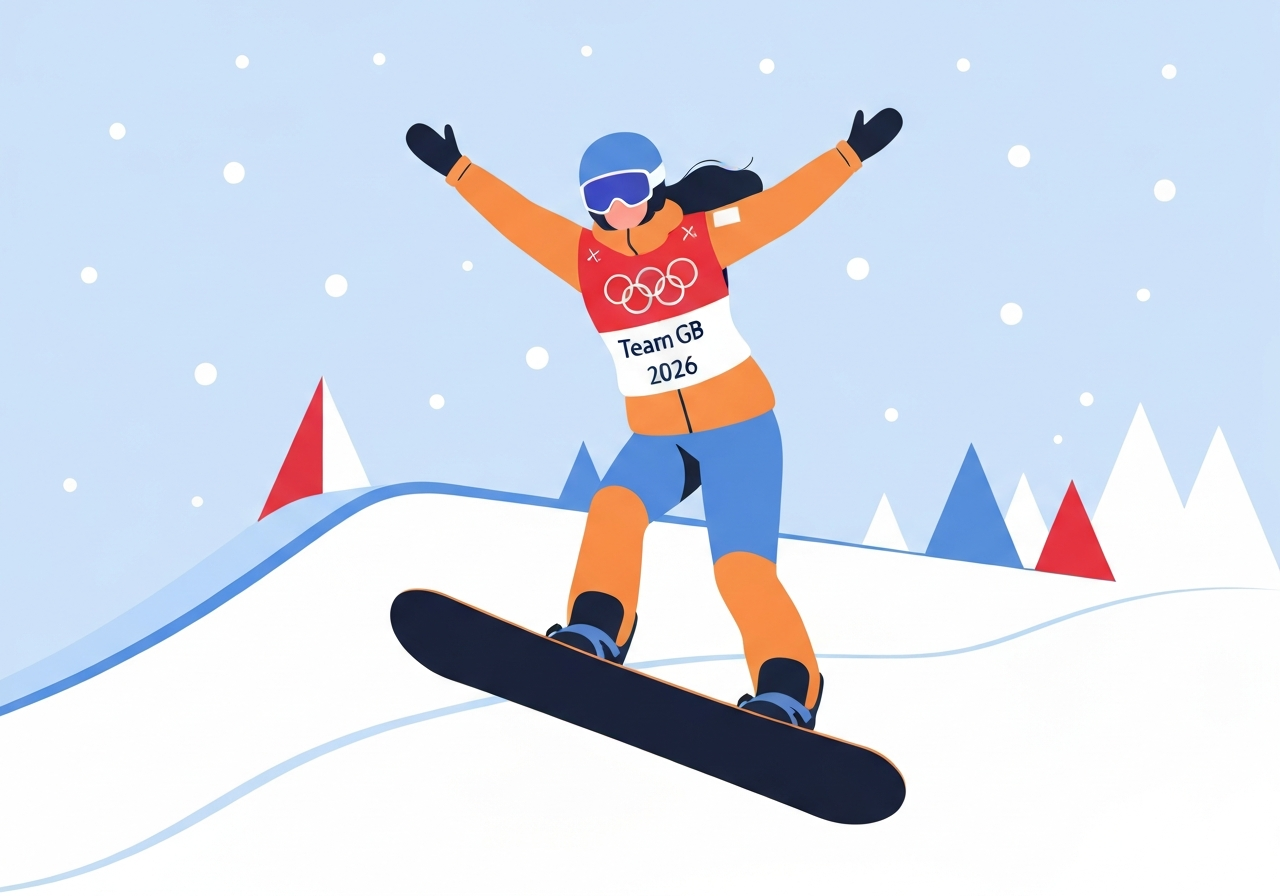
Zoe Atkin, 23, clinched Olympic bronze in the women’s halfpipe at Livigno on Sunday, delivering Team GB its fifth medal of the Milan–Cortina 2026 Games. The result completed a family arc: Atkin had watched her sister Izzy stand on the Olympic podium in 2018 and had long targeted the same finish. Atkin posted a final score of 92.50 on her closing run, enough for third behind Eileen Gu, who won gold with 94.75, and China team-mate Li Fanghui, who took silver. The podium marked the second time a British athlete has medalled on skis at a Winter Olympics, following Izzy Atkin’s 2018 slopestyle bronze.
- Zoe Atkin, age 23, scored 92.50 in the final run to secure Olympic bronze in Livigno for Team GB.
- Eileen Gu won gold with a 94.75; Li Fanghui claimed silver; Atkin improved from 90.50 to 92.50 on her last run.
- Atkin had already guaranteed a medal before her final run and raised her score with a pressure-free performance.
- This bronze is Team GB’s fifth medal at Milan–Cortina 2026, joining three golds and one silver to equal the team record from 2014 and 2018.
- The women’s halfpipe final was postponed to Sunday morning after heavy snowfall; Atkin had qualified top of the standings for the final.
- Atkin entered the Games as reigning world champion and fresh from X Games gold, improving on her ninth-place finish in Beijing 2022.
- Olympic halfpipes measure 6.7m in height; Atkin achieved more than 5m amplitude on her final runs, implying nearly a 12m drop to the pipe base if a trick goes wrong.
Background
The Atkin sisters grew up in the United States with a Malaysian mother and an English father, though much of their British family remains based in Surrey. Izzy Atkin won bronze in slopestyle at Pyeongchang 2018 when Zoe was 15, an experience Zoe says ignited her Olympic ambitions. Over the past eight years Zoe progressed through junior ranks to become X Games gold medallist and world champion, positioning her among the favourites for Milan–Cortina 2026. Team GB entered the Games with its most successful winter squad to date, achieving multiple firsts including never-before-seen double golds at a single Winter Olympics.
The wider context for freestyle skiing has been rapid technical advancement and rising global competition, especially from China and the United States. Eileen Gu remains a dominant figure in the discipline, entering Milan–Cortina with multiple Olympic medals and strong public profile. British skiing, by contrast, has produced relatively few Olympic ski medallists, so Atkin’s result is notable both for its rarity and for signalling growing depth in British winter action sports. Weather and venue conditions, including heavy snowfall that delayed the final, added an extra variable to performances in Livigno Snow Park.
Main Event
The halfpipe final was moved to Sunday morning after heavy snow fell the previous day, compressing the schedule and testing athletes’ adaptability. Atkin qualified first for the final and posted a 90.50 on her opening run, sitting atop the leaderboard while several top rivals faltered. Eileen Gu fell on her opening attempt, and Li Fanghui posted a solid second-run improvement that challenged the lead. Atkin fell on her second run, leaving her fate uncertain until the last rotation of the final.
With a medal already secured by virtue of earlier scores, Atkin dropped into the pipe for a final, composed run and pushed her total to 92.50, gaining two points and sealing bronze. Gu boosted her score to 94.75 on the third run to take gold, while Li’s performance earned silver. Atkin’s closed-run approach — relaxed, smiling at the top of the pipe — underlined the psychological shift that comes when podium math is resolved before the last effort.
The Livigno venue produced challenging technical conditions: icy pipe walls and large amplitudes amplified both scoring potential and risk. Atkin reached amplitudes above 5m on her final run, demonstrating height and control that judges rewarded. The event illustrated the fine margins in elite halfpipe competition, where a single fall or an extra trick can separate medal positions by points.
Analysis & Implications
Zoe Atkin’s bronze is significant for British winter sport because it continues a rare tradition of ski medalling and highlights successful athlete development outside traditional winter-power nations. Britain has typically excelled in sliding sports and snowboarding; podiums on skis remain uncommon, making this achievement both symbolic and practical for funding and interest in British freestyle skiing. The timing — following multiple GB golds earlier in the Games — reinforces a narrative of a step change in the country’s winter performance pipeline.
From a sporting-development perspective, Atkin’s pathway — growing up and training largely in the United States while representing Great Britain — underscores the hybrid trajectories increasingly common in elite winter sports. Access to North American training environments, combined with British support and selection pathways, creates opportunities that national federations can seek to replicate. If British ski bodies capitalise on this momentum, we may see increased domestic investment and talent identification programs aimed at freestyle disciplines.
For the discipline broadly, the result reaffirms Eileen Gu’s pre-eminence while signalling that the podium field is deepening. Judges rewarded amplitude, technical difficulty, and clean landings; Atkin’s final run combined amplitude and execution, granting her the podium spot despite earlier inconsistency. Looking ahead to World Cups and the next world championships, athletes who can consistently combine big amplitude with clean trick selection are likely to dominate.
Comparison & Data
| Winter Games | GB total medals | Golds | Notes |
|---|---|---|---|
| Milan–Cortina 2026 | 5 | 3 | Includes Atkin bronze; most successful GB winter showing to date |
| Sochi 2014 | 5 | 3 | Previous record-matching haul |
| Pyeongchang 2018 | 5 | 2 | Izzy Atkin bronze in slopestyle among medals |
This table places Atkin’s bronze in historical perspective: Milan–Cortina 2026 equals Great Britain’s best total medal count at Winter Games, while also setting a new high for golds in a single edition. The numbers suggest a short-term breakthrough rather than a single-event anomaly, though sustained progress will depend on investment, participation, and competitive opportunities at elite venues.
Reactions & Quotes
Atkin described the moment as the culmination of years of work and a personal arc that began with watching her sister win in 2018. Her comments convey relief and pride after a tense final.
After watching her win it was always a huge goal for me. It’s a real full-circle moment because she was here supporting me.
Zoe Atkin
Izzy Atkin, present in Livigno with family, framed the result as vindication of long-term commitment by both sisters and highlighted the emotional weight of the achievement.
I’m so, so proud of her. I know how much time and effort and grit and hard work she’s put into it.
Izzy Atkin
Team and event officials noted the technical standard on display and the impact of weather on scheduling; commentators praised Atkin’s composed final run as evidence of mental resilience.
She put two runs down under pressure and then delivered a relaxed, high-amplitude final — that blend won her a place on the podium.
Event analyst, Livigno Snow Park broadcast
Unconfirmed
- Any formal claim that Atkin’s family is the first in British Olympic history to produce two ski medallists has not been independently verified here and requires archival confirmation.
- Precise final scores for Li Fanghui beyond her silver placing were not specified in the source material provided and should be confirmed against official results for accuracy.
Bottom Line
Zoe Atkin’s bronze at Livigno is both a personal milestone and a meaningful moment for British ski sport. It cements a rare family legacy of Olympic skiing medals for Great Britain and adds momentum to the team’s most successful Winter Games performance. The result also highlights the importance of cross-border training pathways and psychological preparation in action sports at the highest level.
For Team GB, sustaining this breakout will require targeted investment, talent pathways, and continued access to world-class facilities. For Atkin, the combination of academic study in cognitive mechanisms and elite sporting execution suggests a thoughtful approach to sport psychology that may inform training methods for other athletes. The coming world circuit and World Championships will show whether this podium signals a sustained shift in competitive balance or an outstanding individual peak.