
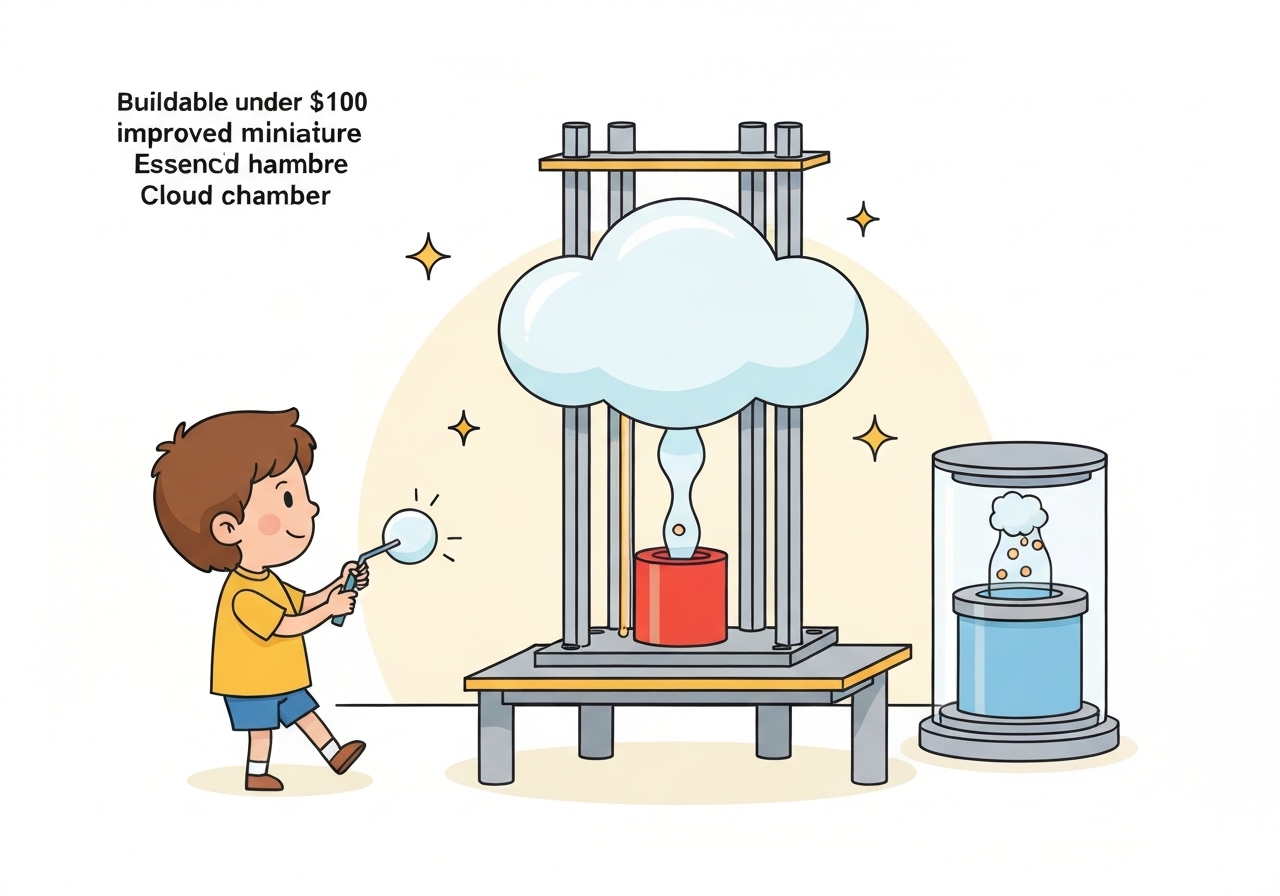
Who: maker known as “Curious Scientist”; When: project posted on ; Where: documented on Hackaday; What: an improved, compact cloud chamber built from a 3D-printed housing and common components; Result: a working particle-visualization device that the author says can be assembled for under $100 and powered from a 12V supply. The build replaces bulky lab refrigeration with a Peltier module and a CPU cooler, uses an aluminum cold plate and headlight film for insulation, and sources high voltage from a repurposed mosquito swatter to seed condensation tracks.
Key Takeaways
- Total parts cost reported under $100, with the entire device powered from a standard 12V supply.
- Cooling is provided by a Peltier thermoelectric module mated to a CPU-style heatsink and fan, stabilizing a chilled aluminum plate as the cold surface.
- Optical and insulation elements include headlight film and an aluminum plate with thermal paste to optimize conduction.
- High-voltage ionization is generated using the transformer from a common mosquito swatter, rather than a purpose-built HV supply.
- The chassis and mountings are 3D-printed; the builder has not released the CAD files but shared enough photos to reproduce or adapt the design.
- The design leans on established Peltier cloud-chamber approaches that have circulated in maker communities rather than novel physics innovations.
- The author cautions builders to adapt dimensions for their own jar and emphasizes expectation management for visual performance.
Background
The cloud chamber was first developed scientifically by Charles T. R. Wilson in 1911 as a way to make ionizing radiation visible by producing trails of condensed liquid droplets in a supersaturated vapor. Charged particles passing through the chamber ionize gas molecules, which then act as nucleation sites for condensation, leaving visible vapor tracks. Over the past decade makers and educators have adapted the concept into compact, affordable versions that trade complex vacuum and refrigeration systems for thermoelectric (Peltier) cooling and simpler enclosures. Those adaptations have broadened access to a device that was once confined to well-equipped laboratories, making it a popular hands-on demonstration for classrooms and hobbyists.
Peltier-based chambers, while more accessible, bring trade-offs in thermal efficiency and stability compared with liquid-nitrogen or compressor-cooled systems. Builders must manage heat rejection on the hot side, typically with CPU coolers, and ensure a sufficiently cold, uniform plate on the inside to maintain a stable supersaturated layer. Safety concerns—especially when repurposing high-voltage components—are prominent in community guides and should be addressed before attempting construction.
Main Event
The maker outlines a compact assembly: a 3D-printed housing sized to fit a mason jar, an aluminum plate thermally affixed to a Peltier unit with thermal paste, and a CPU-style heatsink and fan mounted on the Peltier’s hot side. Headlight film is used as a light-diffusing and insulating layer; the visual field is illuminated so droplet trails are visible against a dark background. The author reports powering the whole assembly with any 12V supply, which runs the Peltier and the fan together.
For ionization, the build reuses the transformer and electrode arrangement from a discarded mosquito swatter to produce the localized high voltage needed to seed condensation trails. According to the post, that approach reduces cost and uses readily available scrap parts, but it also concentrates the project’s safety considerations since the HV circuitry was not originally intended for this application. The builder documents assembly with multiple photographs and step notes but has not published the 3D CAD files.
Operation reportedly produces visible tracks as charged particles traverse the supersaturated vapor layer above the cold plate. The author advises that visual results depend on jar size, ambient temperature, alcohol purity, and plate uniformity, so most users will need to iterate geometry and insulation to optimize performance. The post also compares this build to simpler bottle-and-dry-ice versions, noting that Peltier systems avoid single-use consumables like dry ice at the cost of somewhat lower cooling power.
Analysis & Implications
This build illustrates how iterative maker improvements continue to lower the practical and financial barriers to scientific demonstration equipment. A sub-$100 price point and use of a 12V supply make the chamber accessible for schools, hobbyists, and outreach programs that lack lab refrigeration. That accessibility can strengthen physics education by enabling direct, repeatable demonstrations of ionization and particle interactions—concepts that are otherwise abstract for many learners.
However, the reliance on repurposed high-voltage parts and self-built enclosures raises safety and regulatory considerations. Educational institutions and public demonstrations should evaluate electrical insulation, grounding, and user protection; reusing a mosquito-swatther transformer requires careful reworking of electrodes and safe isolation to avoid shock or unintended discharges. The maker community can mitigate risks by providing clear wiring diagrams, fusing, and enclosures that prevent accidental contact.
From a scientific standpoint, compact Peltier chambers are best suited for qualitative demonstration rather than quantitative particle detection. They make cosmic-ray muons and background beta tracks visible but do not substitute for calibrated detectors when measuring flux, energy spectra, or particle identification. Still, they remain powerful pedagogical tools and low-cost platforms for exploratory tinkering and informal experimentation.
Comparison & Data
| Model | Cooling | Power | Typical Cost |
|---|---|---|---|
| Wilson (classical lab) | Liquid-nitrogen or compressor | High (lab infrastructure) | High (lab-scale) |
| Curious Scientist (Peltier) | Peltier module + CPU cooler | 12V, low power draw | Under $100 (reported) |
The table contrasts the historical laboratory-grade cloud chamber approach with the Peltier-based maker build. The Peltier solution reduces operating complexity and recurring consumables but provides less absolute cooling power and thus potentially fewer or fainter tracks. The practical trade-off is clear: lower cost and portability in exchange for limitations on sensitivity and stability.
Reactions & Quotes
Community response on the Hackaday post emphasizes enthusiasm for low-cost replication but also flags safety and documentation gaps. Several commenters noted the value of a complete parts list and more detailed wiring diagrams for the high-voltage module before attempting a build.
“The build uses a Peltier module, a CPU cooler, an aluminum plate, thermal paste, and headlight film; the high voltage comes from a sacrificed mosquito swatter.”
Hackaday summary of Curious Scientist
That summary concisely lists the key components and the unconventional HV source; it underlines why many readers find the design both clever and in need of caution. Makers and educators responding to the post urged that any reuse of a mosquito-swatther transformer should be accompanied by clear safety upgrades and tests.
“You can probably work it out yourself from the pictures, but you’ll almost certainly have to rework it for your particular jar.”
Post commentary attributed to Curious Scientist (as reported on Hackaday)
This practical note frames the design as iterative: the author did not publish CAD files and expects builders to adapt dimensions to their own containers, which both encourages learning and increases variability in outcomes.
Unconfirmed
- The exact performance metrics (track rates per minute, detection sensitivity) for this specific build are not published and remain unverified.
- The builder has not released 3D CAD files, so precise dimensions and mounting details must be inferred from photographs and may not match the original design.
- Long-term reliability and safe operation when using a repurposed mosquito-swatther transformer have not been independently validated.
Bottom Line
This Peltier-based miniature cloud chamber is a practical, low-cost path to visualizing ionizing particles for education and hobbyist investigation. By leveraging a 12V supply, a thermoelectric cooler, and commonly available parts, the design reduces recurring consumables and can be assembled for under $100, according to the builder. The absence of published CAD files means builders must adapt the layout for their own jars and tolerances, which can be an opportunity for hands-on learning but also a source of variability.
Crucially, reuse of high-voltage components like a mosquito swatter’s transformer reduces cost but raises safety responsibilities. Educators and makers should prioritize electrical insulation, clear documentation, and conservative testing before demonstrating the device in public or classroom settings. For those who respect those constraints, this design extends accessibility to an iconic physics demonstration with modest resources.