
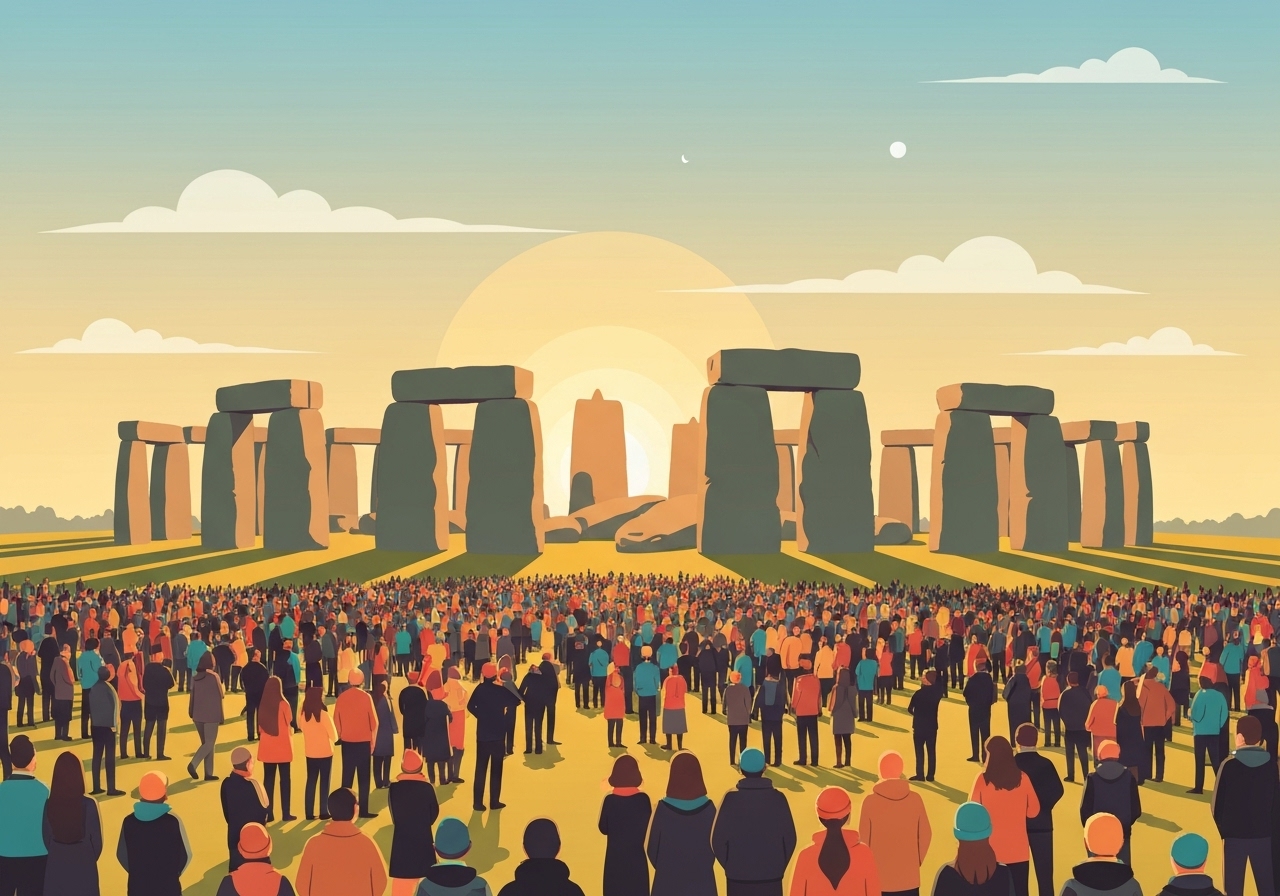
At dawn on the winter solstice, thousands gathered at Stonehenge in southwest England to watch the sun rise over the prehistoric circle. The crowd — many in costumes and carrying drums or lanterns — waited through the cold before cheering and dancing as the light reached the stones. For many attendees the moment was framed as a spiritual pilgrimage tied to the monument’s ancient solar alignment, built between 5,000 and 3,500 years ago. The event marked the shortest day of the year in the Northern Hemisphere and the traditional start of astronomical winter.
Key Takeaways
- Thousands of people assembled at Stonehenge before dawn to witness the winter solstice sunrise, with organizers and media describing a large, festive crowd.
- Attendees included people in costume who sang, played drums and reflected quietly among the stone pillars, blending celebration and contemplation.
- Stonehenge was erected between 5,000 and 3,500 years ago and intentionally aligns with the sun on solstices, a fact noted by archaeologists and heritage authorities.
- The winter solstice is the shortest day north of the equator; after the solstice the sun’s daily arc begins to climb and daylight gradually increases.
- The event drew both regular pilgrims who visit each solstice and first-time visitors, sustaining a long tradition of seasonal gatherings at the site.
- Access and crowd management around the monument are overseen by heritage authorities to balance public access with preservation of the ancient stones.
Background
Stonehenge sits on Salisbury Plain in southwest England and has long been a focal point for solstice observances. Archaeological evidence places construction phases between about 5,000 and 3,500 years ago, and studies show the monument was sited to mark solar events, notably the summer and winter solstices. Over centuries the site has attracted a mix of ritual, scientific and touristic attention; in modern times it is managed to allow public access while protecting the fragile archaeology. Each year, thousands of people travel to the site for the two solstices, continuing a pattern of pilgrimage that combines heritage interest with contemporary spiritual practices.
Winter solstice gatherings at Stonehenge reflect broader cultural practices tied to seasonal change, especially in agrarian histories where solstices marked key points in the agricultural calendar. The solstice itself occurs when the sun makes its lowest arc across the sky in the Northern Hemisphere, producing the year’s shortest daylight period. For many modern visitors the event is less about strict ritual and more about personal renewal or communal celebration as daylight hours begin to lengthen. Local authorities and heritage bodies manage the site to mitigate wear and ensure safety during large gatherings.
Main Event
Attendees started arriving in the hours before dawn, assembling in the surrounding fields and walking toward the monument as light crept over the horizon. Some participants carried drums and sang; others stood quietly between—or near—the massive upright stones to watch the horizon. When the sun crested the skyline, the crowd reacted with cheers, applause and spontaneous dancing, a response captured by journalists and onlookers. Organizers and stewards worked to maintain clear paths and protect the inner circle, allowing many to observe the alignment without disturbing the stones.
Many visitors described the moment as meaningful: for repeat pilgrims it reaffirms a seasonal tradition, and for newcomers it can feel like a rare, communal experience. The event blended informal celebration with solemn observation, as people took photos, embraced, or simply watched the changing light. Authorities tasked with conservation reiterated that while public access is encouraged, the site’s archaeology requires care and coordination. Weather and visibility can shape the experience dramatically; clear skies highlight the solar alignment, while overcast conditions mute the visual drama.
Stonehenge’s design intentionally frames the sunrise at solstices, a feature that has drawn both curiosity and formal study. That alignment is a central reason the monument continues to attract crowds on the shortest and longest days of the year. The site’s status as a protected monument means visitor flows are planned, and the winter solstice remains one of the most visible moments when ancient architecture, public ritual and modern tourism intersect.
Analysis & Implications
Stonehenge gatherings reveal a persistent public appetite for ritual experiences tied to natural cycles. The solstice observation offers participants a tangible link to prehistoric people who also oriented the monument toward the sun; this continuity bolsters public interest in archaeology and heritage conservation. For local economies, solstice events bring visitors and media attention, which can translate into tourism revenue across nearby towns. However, increased visitation also raises conservation concerns: foot traffic, temporary structures and celebratory activities require management to prevent damage to the archaeology and landscape.
From a cultural perspective, the event illustrates how ancient sites are repurposed within modern rituals: what once had specific, possibly agricultural functions now accommodates diverse meanings, from spiritual renewal to social festivity. That plurality complicates heritage management because authorities must respect public access while enforcing rules that protect the monument. The tension between access and preservation is not unique to Stonehenge and echoes debates at other world heritage sites where ritual and tourism overlap.
Looking ahead, climate and crowd-management trends could shape future solstice gatherings. Clear winters enable dramatic sunrises, but unpredictable weather may affect turnout and safety planning. Heritage organizations may increasingly rely on timed entry, remote viewing options or expanded stewarding to accommodate demand without compromising the site. The widespread attention around solstices also offers opportunities for public education about archaeology, the monument’s origins and the scientific basis for its solar alignments.
Comparison & Data
| Hemisphere | Day Characteristics on Solstice | Season Starts |
|---|---|---|
| Northern Hemisphere | Shortest day; sun follows its lowest arc | Astronomical winter begins |
| Southern Hemisphere | Longest day; sun follows its highest arc | Astronomical summer begins |
The table summarizes how the solstice has opposite effects in the two hemispheres: when north of the equator experiences its shortest day, the south experiences its longest. That contrast helps explain why solstice observances appear in many cultures worldwide, though their dates and traditions differ by region. At Stonehenge, the winter solstice specifically marks a turning point in daylight that has symbolic resonance for attendees and scholars alike.
Reactions & Quotes
Visitors and on-site stewards described a mix of celebration and quiet reflection as the sun rose. Journalists on scene noted lively costumes and drumming, balanced by people who paused alone near the stones to watch the light change. Heritage officials reminded attendees of rules designed to protect the monument while allowing public access.
“It’s a moving moment to see the sun meet the stones — many people said they felt connected to the past and to each other.”
Visitor (on-site account)
Some visitors framed the experience as personal renewal rather than a reenactment of prehistoric rituals, while others emphasized community and tradition. Staff and volunteers highlighted the importance of observing site guidelines so that the monument remains intact for future solstices.
“The alignment with the solstice is one reason Stonehenge draws so many people; we balance welcoming visitors with protecting the archaeology.”
Heritage steward (site management)
Officials reiterated that stewardship measures — including stewarding and limited access to the stone circle itself — are necessary for conservation. Local businesses and tourism bodies also acknowledged the event’s economic and cultural value to the region.
Unconfirmed
- Exact attendance numbers remain approximate; reports describe “thousands” but no precise headcount was published at the time of reporting.
- Individual motivations among attendees vary and are based on self-report; broad characterizations of spiritual versus touristic intent reflect observed trends rather than systematic polling.
Bottom Line
The winter solstice gathering at Stonehenge is both a continuation of ancient astronomical associations and a contemporary public event that blends ritual, tourism and communal celebration. The monument’s deliberate solar alignments help explain why crowds gather on the shortest day of the year to witness the sunrise strike the stones. That public interest supports heritage organizations’ educational missions but also underscores ongoing tensions between access and conservation.
Moving forward, stewardship and management choices will shape how future solstices are experienced: timed access, clearer guidance for attendees and expanded interpretation can preserve the site while maintaining the communal character that draws many to the plain. For visitors, the solstice remains a visible reminder of seasonal cycles and a rare opportunity to participate in a cross-temporal moment at one of the world’s most studied prehistoric sites.
Sources
- Associated Press (news agency) — original reporting on the solstice gathering at Stonehenge.
- English Heritage (official site) — site guidance, visitor information and conservation notes for Stonehenge.
- UNESCO World Heritage Centre (international heritage body) — designation and background on Stonehenge’s global significance.