
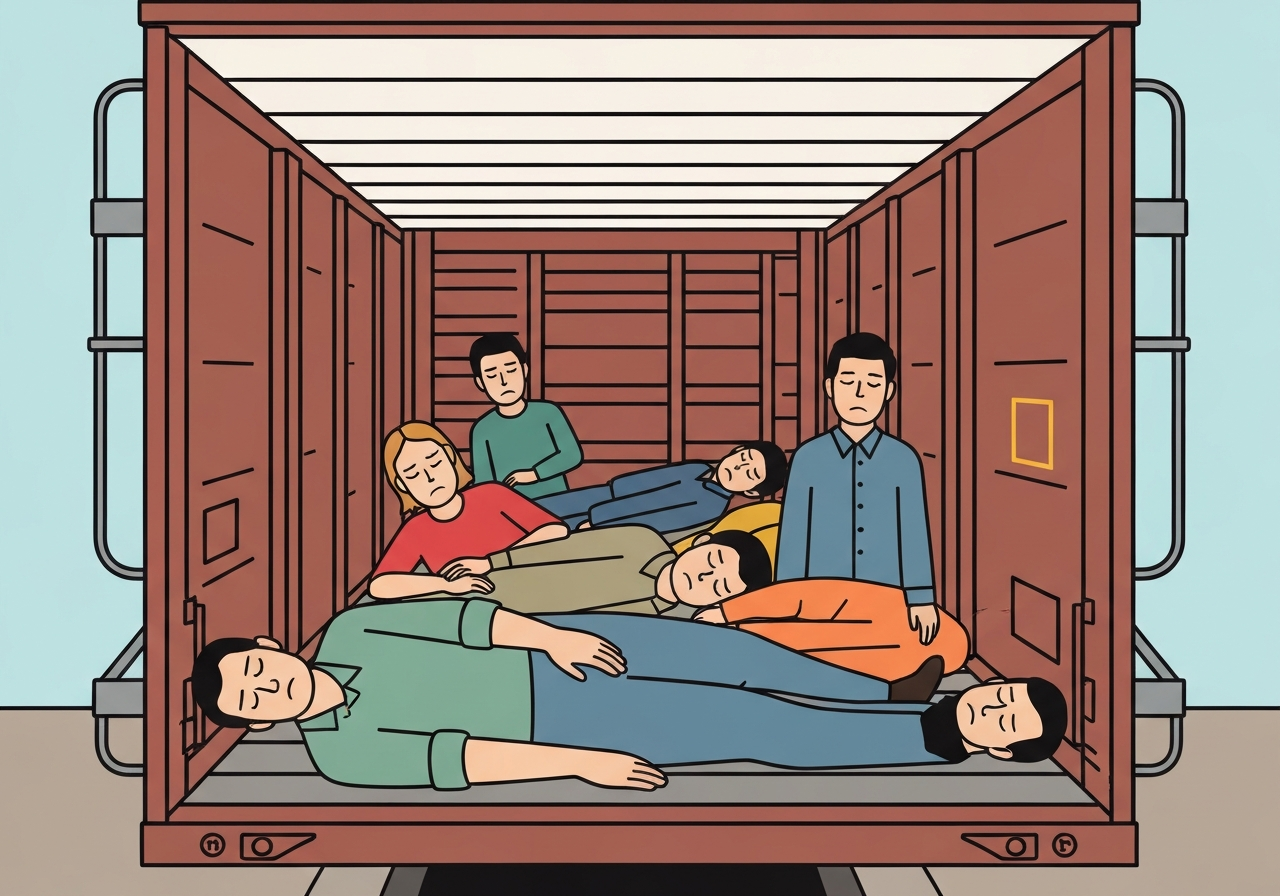
Lead: On Sunday afternoon, six people were discovered dead inside a cargo train boxcar at a rail yard near Laredo, Texas, after a Union Pacific employee reported multiple casualties at about 3 p.m. Local authorities and the Webb County medical examiner responded; preliminary findings point to heat stroke amid temperatures that hit roughly 105°F. Officials have not released victims’ names, ages or the train’s origin and are working with consular offices to identify the deceased. Law enforcement described the investigation as ongoing and fluid.
Key Takeaways
- Six deceased were recovered from a boxcar near a Laredo rail yard on Sunday; the Webb County medical examiner confirmed five males and one female.
- The discovery was reported around 3 p.m. local time by a Union Pacific employee who found the trailer boxcar containing multiple casualties.
- Preliminary cause of death is heat stroke; regional temperatures reached as high as 105°F on the day of the incident.
- Victims remain unidentified; fingerprints are being scanned and all phones were turned over to authorities for potential identification data.
- Officials said the victims are believed, but not confirmed, to be from Mexico or Honduras; consular contacts are underway.
- Port Laredo handles a major share of Texas land trade—reported as 62% of the state’s land port trade valued at nearly $340 billion as of 2024—underscoring the volume of rail and freight activity in the area.
- Union Pacific issued a statement saying the company is saddened and is cooperating with law enforcement in the investigation.
Background
Laredo sits on the U.S.–Mexico border and hosts one of Texas’s largest land ports of entry, serving as a major hub for cross‑border freight and rail operations. Large rail yards there function as logistical nodes where hundreds of freight cars are loaded, unloaded and staged—facilities officials described as being miles long and comparable to a seaport loading dock for trains. High summer temperatures in South Texas can create lethal conditions inside enclosed metal cars, a well‑known public health risk for anyone trapped without ventilation or water.
Rail yards along major trade corridors routinely see transient personnel, commercial crews, and sometimes unauthorized passengers near rolling stock; law enforcement and industry stakeholders have long cited the challenge of monitoring sprawling yards. The interplay of high freight traffic, complex yard layouts and extreme heat raises both operational safety and humanitarian concerns when people are found inside rail equipment. Local agencies, rail operators and consulates typically coordinate when casualties involve non‑U.S. nationals to establish identities and notify next of kin.
Main Event
Authorities said a Union Pacific employee discovered multiple bodies inside a boxcar at a Laredo rail facility and called police at about 3 p.m. on Sunday. Officers and the Webb County medical examiner responded; first reports to investigators described a single trailer boxcar containing several casualties. The medical examiner later confirmed recovery of five males and one female, and noted fingerprints are being processed to assist identification.
Investigators said the rail yard where the boxcar was found is extensive; Jose Baeza, an investigator with the Laredo Police Department, described it as akin to a seaport loading area for trains, where cars are routinely loaded and unloaded across many miles. All recovered phones have been turned over to authorities for potential data to aid identification, and local officials reported they are in contact with consular offices for Mexico and Honduras as part of those efforts.
Preliminary determinations by the Webb County medical examiner list heat stroke as the likely cause of death, a finding consistent with the region’s extreme heat that day. Officials cautioned that cause of death remains subject to final autopsy and toxicology results. Union Pacific issued a brief statement saying it was saddened by the incident and is cooperating closely with law enforcement while the inquiry continues.
Analysis & Implications
The immediate public safety implication is clear: enclosed freight cars can become lethal environments during extreme heat, and existing monitoring measures in sprawling rail yards may be insufficient to prevent human harm. If the preliminary heat‑related cause is confirmed, it will reinforce the need for stronger detection, worker training and yard access controls to reduce the risk of people being trapped in rolling stock.
From a border and migration perspective, the discovery raises questions about how the occupants boarded the train and whether criminal networks were involved. Authorities have not alleged a specific criminal scheme; investigators must determine movement patterns, the train’s itinerary and whether the victims entered the boxcar voluntarily or were transported. Any link to human smuggling would trigger broader law enforcement and prosecutorial responses across jurisdictions.
Operationally, incidents like this can affect rail operators and supply chains by prompting immediate inspections, temporary yard closures or enhanced security procedures. For Laredo—where a large share of state trade passes—the reputational and logistical impacts are potentially significant even if disruptions are localized. Additionally, the case underscores diplomatic and consular burdens: identifying non‑U.S. nationals, coordinating repatriation and supporting families involve multiple agencies and can take considerable time.
Comparison & Data
| Data point | Reported value |
|---|---|
| Number of victims | 6 (5 male, 1 female) |
| Recorded high temperature (Sunday) | About 105°F |
| Port Laredo share of Texas land port trade (2024) | 62% (nearly $340 billion) |
These figures highlight two intersecting realities: the human vulnerability to extreme temperatures in enclosed vehicles and Laredo’s role as a high‑volume freight hub. The temperature cited aligns with known heat‑stress risk thresholds for enclosed metal spaces, while the trade statistics illustrate why rail yards in the area are busy and geographically extensive.
Reactions & Quotes
The discovery drew prompt statements from local investigators and the rail operator; each remark framed the incident in operational and humanitarian terms.
“Imagine a loading dock at a seaport, but for trains. This is where they load and unload a lot of rail cars.”
Jose Baeza, Investigator, Laredo Police Department
Baeza used the comparison to convey the scale and complexity of the yard where the bodies were located, emphasizing how a single boxcar can be one small element within a vast facility.
“We are saddened by this incident and are working closely with law enforcement to investigate.”
Union Pacific spokesperson (company statement)
Union Pacific’s comment signaled corporate cooperation with authorities while acknowledging the human toll; the company did not release operational details about the train or yard staging.
“It is believed that, although not confirmed, all the victims are from either Mexico or Honduras.”
Webb County Chief Medical Examiner (statement to media)
The medical examiner’s remark framed nationality as a working lead rather than a confirmed fact and underscored the role of fingerprinting and phone data in formal identification.
Unconfirmed
- Nationals: Reports state victims are believed to be from Mexico or Honduras, but nationality remains unverified pending formal identification.
- Ages and train origin: Officials have not released victims’ ages or the train’s point of origin; both are described as central questions in the investigation.
- Cause of death: The medical examiner listed heat stroke as the preliminary cause, but final autopsy and toxicology results are pending.
- Criminal involvement: It is not yet established whether human smuggling, criminal coercion or accidental entrapment played a role in how the victims came to be inside the boxcar.
Bottom Line
The discovery of six people dead in a boxcar near Laredo highlights acute humanitarian and operational vulnerabilities at major freight hubs, especially during extreme heat. Immediate priorities are identification of the victims, full medical determinations of cause of death and a fact‑based investigation into how they entered the car and whether criminal activity was involved.
Beyond this case, officials and rail operators face policy choices about yard monitoring, trespass prevention and coordination with border and consular authorities to prevent future tragedies. Observers should watch for formal autopsy findings, law enforcement conclusions on how the individuals accessed the car, and any regulatory or industry responses designed to reduce risk in high‑traffic rail facilities.
Sources
- NBC News (media report summarizing official statements and medical examiner comments)
- Texas Comptroller of Public Accounts (government source for Texas port trade data)