
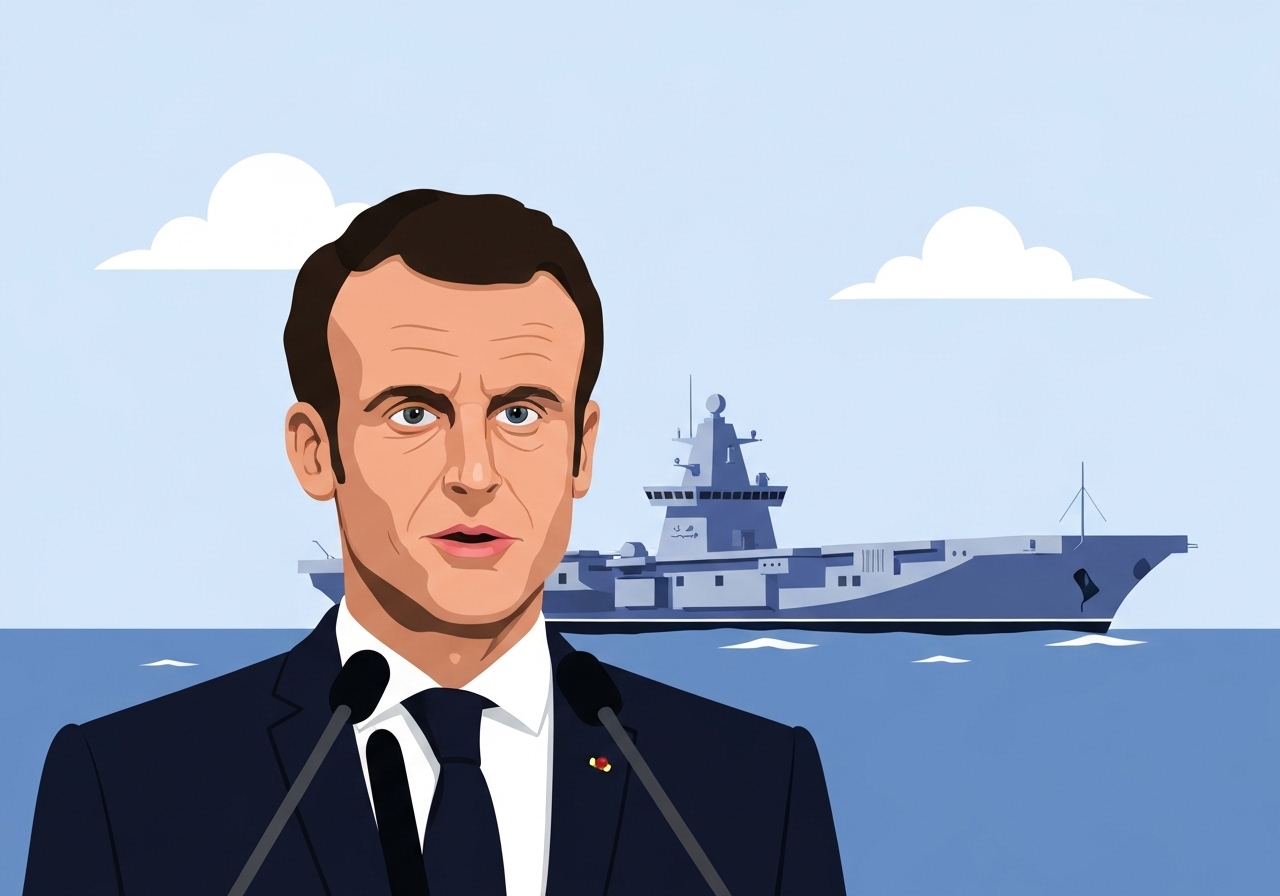
Lead: French President Emmanuel Macron announced on Sunday in Abu Dhabi that France will build a new aircraft carrier to replace the nuclear-powered Charles de Gaulle, which is expected to retire by 2038. The programme, called the New Generation Aircraft Carrier (PANG), is budgeted at about €10.25 billion ($12 billion) and is planned for commissioning in 2038. Macron made the declaration near the Strait of Hormuz as part of a visit to a French military base in the United Arab Emirates. The move is framed by Paris as a step to strengthen maritime power projection amid heightened European defence focus after Russia’s invasion of Ukraine.
Key Takeaways
- France has announced the PANG (New Generation Aircraft Carrier) programme with an estimated cost of around €10.25 billion ($12 billion).
- The new carrier is intended to replace the Charles de Gaulle and is planned for commissioning by 2038, the year the current carrier is expected to retire.
- PANG is projected to accommodate about 30 fighter jets and roughly 2,000 crew members, indicating a substantial operational scale.
- Design targets include a length of about 310 metres (1,007 feet) and a beam of 85 metres, making the platform significantly larger than its predecessor.
- Macron announced the decision on location in Abu Dhabi, underscoring France’s defence-industrial links with the UAE and the strategic setting near the Strait of Hormuz.
- France remains the only EU member to operate a nuclear-powered carrier and, alongside the US, one of two countries worldwide with that capability.
Background
France has maintained a carrier-centric maritime strategy since the Cold War, using the Charles de Gaulle as a national flagship and a platform for global deployments. The current carrier has been a central pillar of France’s ability to project air power from the sea and to support expeditionary operations, coalition missions and nuclear deterrence postures. Growing geopolitical tensions — notably Russia’s full-scale invasion of Ukraine in 2022 — have prompted several European states to reassess force structure, procurement and collective readiness. Within that context, Paris has pursued both enhanced defence spending and industrial programmes to preserve sovereign capabilities in shipbuilding, aviation and nuclear propulsion.
Domestically, the decision links to long-term defence procurement cycles and parliamentary budget planning that typically span decades. French naval shipbuilders, defence contractors and unions have a vested interest in large-vessel programmes for industrial employment and technological continuity. Internationally, aircraft carriers serve diplomatic and operational roles: they are symbols of strategic reach and provide flexibility for crisis response in distant regions, from the Mediterranean to the Indo-Pacific and the Gulf. The announcement in Abu Dhabi also reflects longstanding arms and statecraft ties between France and Gulf partners.
Main Event
On Sunday at a French military base near the Strait of Hormuz, President Macron declared that he had decided to “equip France with a new aircraft carrier” and that the decision to launch the PANG programme was taken that week. The venue underscored the carrier’s strategic purpose: to operate in contested maritime spaces and to protect sea lines of communication critical for global energy flows. Official projections presented alongside the announcement estimate the vessel will house some 30 fighter jets and around 2,000 crew members, and the ship is to measure approximately 310 metres in length and 85 metres in width.
French officials conveyed a timeline aiming for commissioning in 2038, corresponding with the planned retirement of the Charles de Gaulle. The programme is publicly estimated to cost about €10.25 billion (roughly $12 billion), a figure that will be subject to detailed budgetary approval and periodic review. Army Minister Catherine Vautrin described the vessel as a future “centerpiece” of French naval power, reflecting official framing of the carrier as vital to high-seas power projection. The announcement did not release full technical specifications such as displacement, propulsion details beyond nuclear-power continuity, or construction phasing.
The timing aligns with broader European efforts to bolster military capabilities after 2022, when many EU members signalled increased defence spending and cooperation. France’s industrial base — shipyards, systems integrators and aviation firms — will play a central role in translating the PANG design into a deliverable asset. Procurement experts note that large naval programmes often face schedule shifts, cost overruns and technical trade-offs as design matures and operational requirements are finalized.
Analysis & Implications
Strategically, a new carrier preserves France’s ability to operate independent maritime air power and to contribute high-end capabilities to coalition operations. A carrier with a 30-aircraft air wing and a 2,000-strong complement would sustain carrier strike, air defence, maritime security and expeditionary support missions at significant range. Retaining a nuclear propulsion capability would maintain endurance and sortie generation advantages over conventionally powered carriers, though it also carries higher industrial and lifecycle responsibilities, including specialized maintenance and nuclear expertise.
Economically and industrially, the PANG programme represents a major investment in France’s defence sector and shipbuilding capacity. The headline cost of €10.25 billion will be scrutinized in parliamentary budget debates and could rise as design and systems are specified. Programme timelines that extend to 2038 will require long-term workforce planning and supply-chain coordination, and will intersect with other naval procurements (frigates, submarines, carrier air wing modernisation) competing for funding.
Geopolitically, the announcement sends a signal that France intends to remain a naval power with global reach, reinforcing its role in NATO, EU security initiatives and partnerships in the Indo-Pacific and Gulf regions. It may prompt strategic recalibrations among European peers and partners regarding carrier operations, basing access and joint exercises. However, the operational impact will depend on the carrier’s final air-wing composition, supporting escorts, and sustained political commitment across successive governments.
Comparison & Data
| Feature | Charles de Gaulle | PANG (projected) |
|---|---|---|
| Propulsion | Nuclear-powered (current flagship) | Planned nuclear propulsion |
| Commissioning / Retirement | Current ship in service; planned retirement by 2038 | Planned commissioning in 2038 |
| Air group | Operational air group varies by deployment | ~30 fighter jets (projected) |
| Crew | Existing complement for carrier operations | ~2,000 crew (projected) |
| Dimensions | Not specified in announcement | ~310 m long, 85 m wide (projected) |
| Estimated cost | — | €10.25 billion (~$12 billion) |
The table summarizes factual points released with the announcement and marks where PANG projections differ from the operational Charles de Gaulle data that were not fully enumerated in the public statement. Full technical and cost breakdowns are expected as programme planning moves from political decision to detailed design and budgetary appropriation.
Reactions & Quotes
French officials framed the decision as a necessary investment in national defence and global influence. The president’s comments were given a strategic context by citing current regional tensions and long-term force-planning needs.
“In times of aggression, we must be strong to be feared. I have decided to equip France with a new aircraft carrier.”
Emmanuel Macron, President of France
This remark, delivered in Abu Dhabi, was presented as a rationale linking deterrence, credibility and power projection. It underscores the political impetus behind PANG and situates the choice within broader statements on national readiness.
“A future centerpiece of our armed forces, it will ensure power projection from the high seas, with commissioning planned for 2038.”
Catherine Vautrin, Army Minister (post on X)
Minister Vautrin’s words emphasize how the vessel is intended to function within France’s force structure. Her public post highlights ministerial endorsement but does not substitute for the technical, budgetary and parliamentary steps required to deliver the programme.
Unconfirmed
- The €10.25 billion estimate is an initial projection; final programme costs may change during detailed design and procurement phases.
- Full technical specifications (displacement, exact propulsion architecture details, defensive systems) have not been released and remain to be confirmed by official design documents.
- The 2038 commissioning date is a planning target that could shift due to budgetary decisions, industrial timelines or technical challenges.
Bottom Line
France’s announcement to build a New Generation Aircraft Carrier marks a strategic choice to retain high-end maritime power projection into the 2030s. The PANG programme signals continued French emphasis on independent naval capability, nuclear propulsion expertise, and industrial investment in shipbuilding. While headline figures — €10.25 billion, 30 jets, 2,000 crew, 310 m length and 2038 commissioning — frame the ambition, the eventual operational impact will depend on detailed system choices, supplementary escorts and sustained funding.
Observers should watch for forthcoming budgetary debates, detailed design releases and industrial contracts that will determine the programme’s cost, schedule and operational profile. The announcement reinforces France’s role as a maritime power in Europe and globally, but it also initiates a long procurement path with technical and political hurdles still to resolve.
Sources
- Deutsche Welle (Media: news report)