
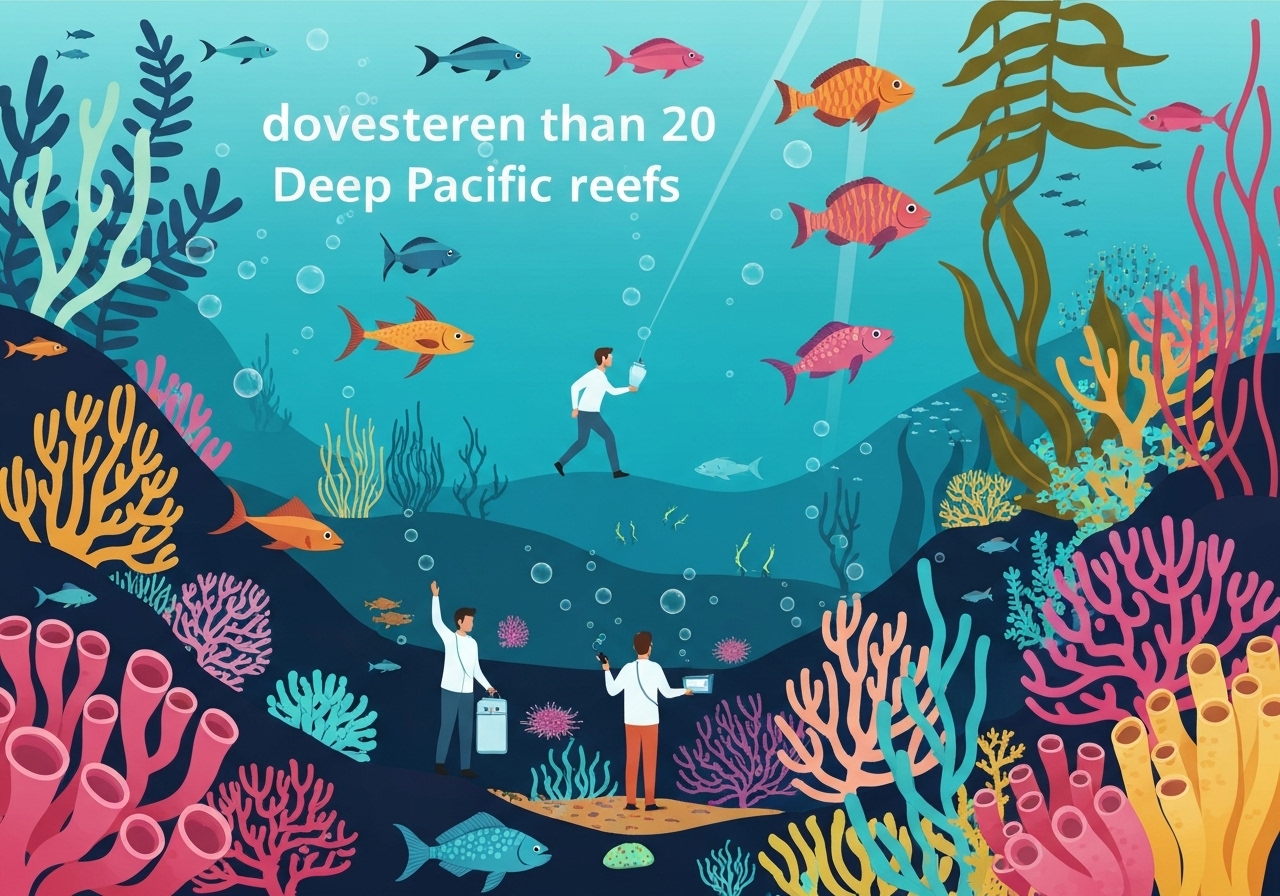
Scientists from the California Academy of Sciences say that after retrieving autonomous reef monitoring structures from deep coral reefs off Guam, they collected 2,000 specimens over two weeks in November and identified 100 species in the area for the first time. Preliminary analysis and DNA sequencing indicate more than 20 of those organisms may be new to science. The devices—13 ARMS units placed as early as 2018—were positioned in the upper mesopelagic “twilight” zone at depths of roughly 180–330 feet, a region where low light and pressure complicate study. Researchers expect further genetic work to change counts and reveal additional new taxa as the team continues a multi-year Pacific expedition.
Key Takeaways
- 13 ARMS devices placed off Guam since 2018 were retrieved during a two-week November operation, producing 2,000 physical specimens for study.
- Researchers cataloged 100 species in that reef area for the first time; genetic sequencing suggests more than 20 may be previously undescribed.
- The sampling targeted the “upper twilight” mesopelagic zone between about 180 and 330 feet, a depth range that requires specialized diving and equipment.
- Potential new forms include crabs, sponges, ascidians (sea squirts) and gorgonians (a coral group); one unusual hermit crab was observed inhabiting a clamshell rather than a snail shell.
- The work is part of a broader two-year effort to retrieve 76 additional devices across the Pacific—including Palau and French Polynesia—to map deep-reef biodiversity.
Background
Deep coral reefs in the mesopelagic “twilight” zone have long been understudied because light levels, pressure and logistical constraints make them difficult to sample. Scientists first began deploying standardized autonomous reef monitoring structures (ARMS) to provide repeatable, comparable collections of small and cryptic organisms in deeper reef zones. The California Academy of Sciences and partner teams placed the 13 ARMS units near Guam starting in 2018 to fill a regional knowledge gap in Pacific deep-reef biodiversity.
Prior surveys in shallower reefs have documented many species, but the upper mesopelagic region (commonly defined between roughly 180 and 330 feet) remains a frontier for species discovery and ecological study. Fisheries managers, conservationists and regional governments have growing interest in these deeper habitats because they can host unique communities and may act as refuges or migration corridors for shallower species. The California Academy-led program combines standardized devices, diver retrievals and genetic sequencing to produce both morphological and molecular inventories.
Main Event
Over a concentrated two-week period in November, divers and research teams recovered 13 ARMS units that had been collecting organisms on frames and settlement plates since their deployment. The ARMS are designed to attract small invertebrates and sessile organisms; once brought to the surface, scientists sorted, cataloged and preserved material for morphological identification and DNA analysis. The immediate sorting produced roughly 2,000 specimens representing 100 species not previously recorded at the deployed sites.
Luiz Rocha, the Academy’s ichthyology curator who participated in placing and retrieving the units, emphasized that morphological inspection is followed by genetic confirmation. Early lab sequencing has already suggested that more than 20 specimens represent species that are new to science, though formal descriptions and peer-reviewed names will follow additional analysis. Field notes and photographs also highlighted unusual behaviors, notably a hermit crab using a clamshell as a home—an adaptation Rocha described as surprising and intriguing.
The team has launched a two-year campaign to retrieve 76 more ARMS units across the Pacific, targeting sites in Palau, French Polynesia and other island systems. That broader sampling aims to establish baseline biodiversity metrics for deep reefs across multiple ecoregions and to compare species composition, endemism and community structure across distance and depth gradients. Researchers expect subsequent retrievals and sequencing to expand the tally of potentially undescribed species.
Analysis & Implications
The discovery of dozens of candidate new species in a single, limited set of ARMS highlights how underexplored upper mesopelagic reefs remain. If genetic confirmation bears out, the findings would add materially to species inventories for the western Pacific and shift estimates of regional biodiversity. For conservation planners, these inventories provide evidence that deep-reef habitats harbor distinct communities that may not be protected by policies focused only on nearshore, shallow coral systems.
Scientifically, the combination of standardized settlement devices and DNA barcoding accelerates detection of cryptic or small-bodied taxa that traditional surveys often miss. The approach helps break down sampling biases toward larger, conspicuous taxa and enables more rapid cross-site comparisons. For taxonomy and systematics, an influx of candidate species will require curated type specimens, formal descriptions and integration into reference genetic databases to support future monitoring.
There are policy and resource implications as well. Additional confirmed new species could strengthen arguments for extended marine protected areas or tailored management in deep-reef zones, but translating scientific inventories into regulation requires stakeholder consultation across local, national and regional authorities. The logistical costs of deep-reef study and enforcement remain high, so prioritization frameworks that weigh endemism, connectivity and human pressures will be necessary to guide protection efforts.
Comparison & Data
| Metric | Value |
|---|---|
| ARMS units recovered (Guam) | 13 |
| Specimens collected | ~2,000 |
| Species newly recorded at site | 100 |
| Potentially undescribed species (genetic evidence) | More than 20 |
| Depth range sampled | 180–330 feet |
The table above summarizes the core field metrics from the Guam retrieval. While 100 species were newly recorded at the sampled sites, the number of species genuinely new to science depends on ongoing DNA sequencing and taxonomic review. Comparable ARMS deployments in other regions have yielded variable discovery rates; standardized devices allow more meaningful cross-region comparisons once additional Pacific retrievals are completed.
Reactions & Quotes
Researchers and conservationists have described the findings as a reminder that major portions of ocean biodiversity remain undocumented.
“It’s probably going to be higher than that because one of the things we do is we confirm everything with genetics.”
Luiz Rocha, Ichthyology Curator, California Academy of Sciences
This comment accompanied Rocha’s explanation of the lab workflow: morphological sorting is only an initial step, and DNA barcodes sometimes reveal cryptic species boundaries that morphology alone misses. The team cautioned that formal species descriptions will follow exhaustive sequencing and peer review.
“They should be protected and should have importance because they are home to hundreds of thousands of different species.”
Luiz Rocha, Ichthyology Curator, California Academy of Sciences
Rocha framed the discovery in conservation terms, arguing that documented biodiversity strengthens the case for extending protections or designating management zones for deeper reefs. Local and regional managers will have to weigh scientific findings against socioeconomic factors when considering policy responses.
Unconfirmed
- The exact number of species that will be formally described as new remains pending pending complete genetic sequencing and taxonomic review.
- Whether the hermit crab observed using a clamshell represents a broadly distributed behavioral adaptation or a rare local occurrence is not yet determined.
- The broader two-year retrieval campaign may yield substantially different discovery rates across Pacific sites; those regional differences are not yet confirmed.
Bottom Line
The California Academy of Sciences’ retrieval of ARMS units off Guam produced a large and unexpected yield of species, including more than 20 candidates that genetic analysis suggests may be new to science. These results underscore how much biodiversity in the upper mesopelagic remains undocumented and how standardized sampling plus DNA confirmation can rapidly expand our knowledge of hidden reef communities.
As sequencing continues and additional ARMS are retrieved across the Pacific, researchers expect the roster of candidate new species to change and grow. For managers and policymakers, the findings make a pragmatic case for incorporating deep-reef data into conservation planning, but translating discoveries into protection will require sustained funding, stakeholder engagement and legal frameworks that recognize deeper reef ecosystems.