
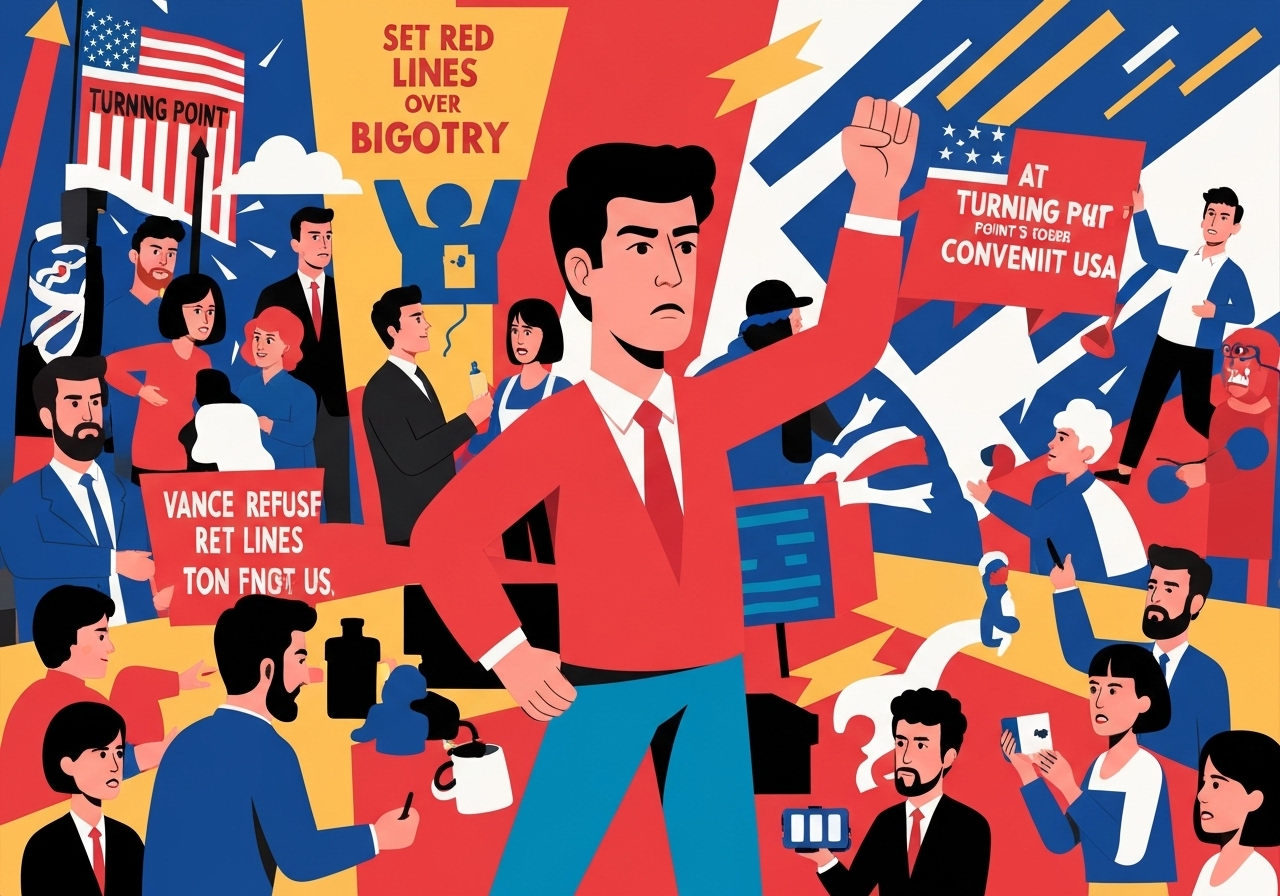
Lead: Vice President J.D. Vance, speaking at Turning Point USA’s AmericaFest in Phoenix on Dec. 21, 2025, declined to name or exclude individuals accused of bigotry, saying the conservative movement should welcome anyone who “loves America.” His remarks came amid sharp debate over antisemitic voices such as Nick Fuentes and a broader tussle over who will control the post‑Trump Republican coalition. Turning Point leader Erika Kirk publicly backed Vance, underscoring the group’s influence in early nominating states and the political stakes of the dispute.
Key Takeaways
- On Dec. 21, 2025 in Phoenix, Vice President J.D. Vance rejected formal “purity tests” for conservatives, saying he did not bring a list of people to denounce or de‑platform.
- Turning Point USA, led by Erika Kirk, endorsed Vance as a potential future nominee; the group mobilizes a national volunteer network influential in early primaries.
- Debates at AmericaFest centered on antisemitism, Israel policy and cultural issues, with prominent figures—Ben Shapiro, Tucker Carlson and others—publicly clashing over standards for inclusion.
- Vance affirmed cultural positions: opposing diversity, equity and inclusion programs and asserting Christianity as a central national creed; he said Americans “don’t have to apologize for being white anymore.”
- Critics like Ben Shapiro called out commentators he labeled “grifters” and warned against normalizing conspiracism; Tucker Carlson dismissed talk of a Republican civil war as exaggerated.
- The gathering highlighted a strategic choice for the GOP: whether to police extremist rhetoric or to prioritize coalition breadth as Republicans plan for a post‑Trump era.
Background
Turning Point USA’s AmericaFest is a high‑profile annual event that draws activists, donors and influencers from across the conservative movement. In 2025 the conference carried extra weight: it followed the assassination of Charlie Kirk, whose wife Erika Kirk now leads the organization and who offered an early endorsement of Vance. Turning Point operates an extensive volunteer apparatus in battleground and early primary states, a resource that prospective presidential contenders prize.
The Republican Party has spent a decade defined by former President Donald Trump, who remains a dominant figure even as he is constitutionally ineligible for a third consecutive term. With prominent media figures and factional leaders jockeying to shape what comes next, AmericaFest became a stage for testing competing visions—ranging from strict cultural and identity politics to appeals for a broader, less exclusionary coalition.
Main Event
Vance’s closing remarks at AmericaFest avoided drawing red lines around who belongs in the conservative movement. He said the only requirement was love of country and explicitly rejected a roster of individuals to be banned. His speech emphasized administration accomplishments on immigration and the economy and applauded rolling back diversity, equity and inclusion policies.
Remarks that touched on race and religion drew attention. Vance said Americans should not “have to apologize for being white anymore” and described the United States as a nation whose moral language has been rooted in Christianity since the Revolution. Those lines prompted cheers from elements of the crowd and concern from critics who say such rhetoric can embolden exclusionary actors.
Across the weekend, disagreements surfaced in sharp exchanges. Ben Shapiro used his platform to condemn what he called “charlatans” and warned against amplifying conspiratorial voices; he singled out colleagues who had given friendly interviews to figures like Nick Fuentes. Tucker Carlson, who has interviewed controversial guests, pushed back on the notion that the party faces an irreparable split and suggested attacks on Vance were politically motivated.
Erika Kirk framed internal disputes as a necessary airing of ideas, arguing that Turning Point’s openness helps the movement refine its direction. The organization also featured unexpected appearances—such as rapper Nicki Minaj—underscoring Turning Point’s efforts to expand cultural reach beyond traditional conservative circles.
Analysis & Implications
The episode at AmericaFest highlights a central strategic dilemma for Republican leaders: policing rhetoric to preserve mainstream acceptability, or tolerating a wider array of voices to maintain numbers and energy. Vance’s stance favors the latter approach, betting that constraining voices now would fracture a coalition that helped deliver recent electoral success. That calculation carries both short‑term benefits—retaining activists and volunteers—and long‑term risks: alienating moderate voters and independent donors in competitive general elections.
Turning Point’s endorsement matters because of its grassroots machinery. In early caucus and primary states a motivated volunteer base can deliver outsized influence. A Vance candidacy backed by Turning Point could translate into early momentum, particularly among younger, activist conservatives who attend events like AmericaFest.
But prominent conservative media figures are not unified. Shapiro’s rhetorical split with Carlson and others signals a possible media‑driven fragmentation of influence—multiple power centers that will compete to define acceptable conservative orthodoxy. This decentralization complicates any single candidate’s effort to consolidate the Trump coalition without alienating core subsets of voters.
Internationally, U.S. leaders’ handling of antisemitism and related rhetoric affects diplomatic posture toward Israel and relations with Jewish communities domestically and abroad. If mainstream conservative institutions fail to set firm boundaries, foreign and domestic partners may recalibrate engagement strategies and influence policy alignments.
Comparison & Data
| Actor | Stance on exclusion | Public posture at AmericaFest |
|---|---|---|
| J.D. Vance | Against formal bans | Rejected “purity tests,” emphasized patriotism |
| Ben Shapiro | Critical of conspiracy promoters | Called out what he called “grifters” and conspiracists |
| Tucker Carlson | Defensive of broad engagement | Dismissed “civil war” framing, defended coalition unity |
| Turning Point USA (Erika Kirk) | Open but influential | Endorsed Vance, urged grassroots mobilization |
The table summarizes stances voiced at the conference; it is a snapshot rather than a comprehensive polling of the conservative movement. The dynamics suggest a contested center of gravity rather than a single prevailing doctrine.
Reactions & Quotes
“I didn’t bring a list of conservatives to denounce or to de‑platform.”
J.D. Vance
Vance used this line to signal a refusal to adopt a blacklist approach, framing his view as one of maximized inclusion for those who affirm patriotic commitments.
“These people are frauds and they are grifters and they do not deserve your time.”
Ben Shapiro
Shapiro directed criticism at commentators he said traffic in conspiracism; his remarks were part of a broader push to delegitimize those he views as bad‑faith actors within the movement.
“There are people who are mad at J.D. Vance, and they’re stirring up a lot of this…”
Tucker Carlson
Carlson suggested criticism of Vance is politically motivated and downplayed predictions of an irreparable factional split in the party.
Unconfirmed
- Whether Turning Point’s endorsement will translate into decisive primary wins for Vance remains unconfirmed and depends on turnout and competing endorsements.
- The precise extent to which figures like Nick Fuentes will sway swing primary voters is not established and lacks consistent polling evidence.
- Any internal plans by media outlets or political operatives to formally rehabilitate or marginalize controversial commentators were not independently verified.
Bottom Line
The AmericaFest episode underscores a crossroads for the Republican movement: embrace a wide, ideologically mixed coalition or enforce clearer boundaries to preserve broader electoral appeal. Vance’s choice to avoid naming or excluding controversial figures signals a tactical preference for coalition breadth, relying on grassroots energy and cultural messaging to hold the coalition together.
That strategy may deliver strength in primary contests where activist turnout is decisive, but it carries risks in general elections where swing voters and minority communities may respond negatively to permissive stances on antisemitic or exclusionary rhetoric. As Republican leaders and media influencers continue to jockey for authority, the pathway to a unified post‑Trump coalition is likely to remain contested and consequential for the party’s electoral prospects.
Sources
- NPR (news media) — primary reporting on speeches and reactions at AmericaFest, Dec. 21, 2025.
- Associated Press (news agency) — photographer coverage and on‑the‑ground images from Phoenix.
- Turning Point USA (organization) — official statements and organizational background.
- Daily Wire (media) — public comments and commentary from Ben Shapiro referenced at the conference.