
Lead
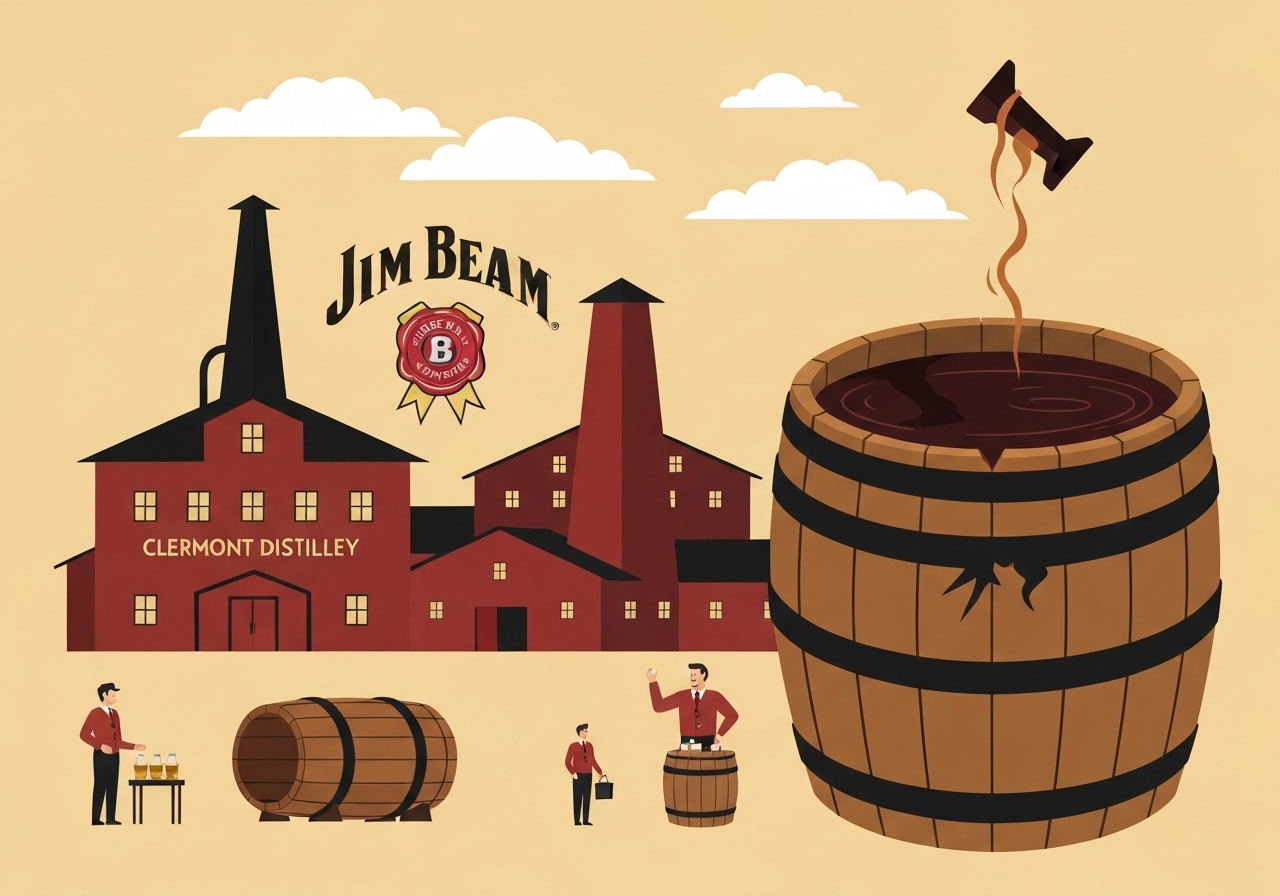
Jim Beam’s owner announced the company will stop production at its Clermont, Kentucky distillery for the entirety of 2026 to carry out site enhancements. The pause, described as an opportunity to invest in the facility, will not affect the company’s other Kentucky operations, including a second distillery, bottling and warehousing plants, or its visitor centre. The move comes amid broader industry headwinds—trade uncertainty from US tariffs and an unusually large bourbon inventory in Kentucky warehouses. The company said it is evaluating production levels and discussing workforce arrangements with its union while production is paused.
Key Takeaways
- Jim Beam will suspend distilling at its Clermont, Kentucky site for all of 2026 to perform site improvements.
- Other Kentucky operations — another distillery, bottling lines, warehouses and the visitor centre — will remain open throughout 2026.
- Kentucky Distillers’ Association reports more than 16 million barrels of bourbon currently aging in the state’s warehouses.
- The KDA warned distillers face roughly $75 million in state taxes on aging inventory this year.
- Jim Beam’s parent, Suntory Global Spirits, employed over 6,000 people worldwide and more than 1,000 across its Kentucky sites at the time of the announcement.
- The company said it is in talks with its workers’ union about how to deploy staff while Clermont is offline.
Background
Bourbon production and demand expanded sharply over the last decade, prompting large-scale barrel-aging programs and new distillery investment across Kentucky. That surge has produced an inventory build-up: trade group figures show more than 16 million barrels aging in Kentucky warehouses, a record high for the state. Kentucky levies taxes on aging barrels of spirits, and the KDA estimates that tax on current inventories will amount to about $75 million this year — a cost producers must carry on top of storage and insurance.
At the same time, international trade tensions and shifts in consumer behavior have injected uncertainty into export markets and domestic demand. US tariff policy this year created reciprocal actions in some foreign markets, and some Canadian provinces temporarily pulled American spirits from shelves in March in retaliation for US tariffs; many of those restrictions have since eased. Separately, declines in per-capita alcohol consumption in some markets add pressure on producers managing long lead times for aged whiskey.
Main Event
The company issued a statement saying it would close the Clermont distillery for 2026 to take “the opportunity to invest in site enhancements.” It framed the pause as part of routine volume and capacity assessments: leadership met with operations teams to review production plans for next year. The statement made clear other Kentucky facilities will continue normal operations and that the visitor centre will stay open to tourists and guests.
Jim Beam said it is evaluating how to allocate its workforce during the suspension and is in discussions with the plant’s union representatives about staffing options and potential reassignments. The announcement did not specify layoffs or permanent changes to employment headcounts at Clermont, only that arrangements are under review. Management emphasized the work is temporary and tied to facility improvement plans rather than an immediate strategic retreat from Kentucky.
Clermont is one of several major bourbon production sites in Kentucky and has been part of Jim Beam’s operating footprint since before Suntory acquired the brand in 2014. Suntory’s 2014 acquisition of Beam for $16 billion positioned the combined company among the world’s largest spirits producers and added roughly 1,000 Kentucky jobs to Suntory’s global headcount of more than 6,000 employees.
Analysis & Implications
The temporary closure signals how distillers are juggling capacity with a multi-year inventory of aging bourbon. With more than 16 million barrels in Kentucky warehouses, distillers face a years-long lag between production decisions and market outcomes; pausing at one site is a quick lever to reduce near-term output without writing down inventory. State taxation on aging barrels increases the cash cost of holding that inventory and may make temporary production reductions more attractive to companies seeking to manage tax exposure and working capital.
Trade tensions add a second layer of uncertainty. Tariffs implemented at the federal level have ripple effects on export demand and pricing in key markets, and retaliatory measures by some jurisdictions have intermittently reduced access to foreign retail channels. Distillers that had planned export-driven growth now face unpredictable demand and potential logistical headaches, which can lower the incentive to run at full capacity when domestic demand softens.
For the local economy in Clermont and surrounding communities, the pause creates immediate questions about employment and supplier contracts. Because Jim Beam intends to keep other local operations open, some staff may be reassigned, but ancillary vendors — from cooperages to trucking firms — could see reduced volume. Over the medium term, an investment-led pause could position the site for higher efficiency or new product lines when production resumes, but that outcome depends on the scale and focus of the enhancements.
Comparison & Data
| Metric | Reported Value |
|---|---|
| Bourbon barrels aging in Kentucky | More than 16,000,000 barrels |
| Estimated state tax on inventory (KDA) | Approximately $75,000,000 |
Those two figures — inventory and the tax liability on aging barrels — help explain the financial pressures distillers face this year. Holding inventory ties up capital and triggers state tax bills; when the barrels number in the millions, the aggregate tax burden becomes material. Cutting production temporarily reduces future inventory accumulation while allowing companies time to recalibrate sales, export strategy and site efficiency.
Reactions & Quotes
Company and trade-group responses framed the pause in operational and fiscal terms, while industry observers flagged structural pressures.
“We will pause production at Clermont to take the opportunity to invest in site enhancements.”
Jim Beam / Suntory (company statement)
Jim Beam presented the decision as an investment opportunity rather than a permanent shutdown. The company reiterated that most Kentucky operations will continue and that workforce discussions with the union are ongoing to manage the temporary pause.
“Distillers face a crushing $75m in taxes on aging inventory this year.”
Kentucky Distillers’ Association (trade body)
The KDA framed the state tax on aging barrels as a significant, industry-wide cost. That tax, combined with a record level of barrels aging in warehouses, helps explain why companies are reconsidering production pacing and inventory strategies.
Unconfirmed
- Whether tariffs were a direct causal factor in Jim Beam’s decision to pause Clermont production; the company did not explicitly link the closure to trade policy.
- The precise workforce outcomes at Clermont during 2026, including any temporary layoffs or the exact number of reassignments, remain under negotiation and unconfirmed.
- The full scope, timeline and budget for the planned site enhancements have not been disclosed publicly.
Bottom Line
Jim Beam’s pause of production at its Clermont distillery through 2026 is a tactical response to a mix of operational and market pressures: abundant aged inventory, a significant state tax on stored barrels, and uncertainty in key export markets. By keeping other Kentucky operations and the visitor centre open, the company aims to limit disruption while gaining time to invest in the facility and reassess volumes.
Watch for three near-term indicators of outcomes: announcements about workforce redeployment or permanent job changes, public details on the scale and objectives of the site enhancements, and any shifts in state tax policy or federal trade measures that would alter the financial calculus for producers. Those elements will determine whether the pause becomes a short-term adjustment or signals broader structural change for the bourbon industry.
Sources
- The Guardian — News report summarizing company statement, KDA figures and industry context
- Kentucky Distillers’ Association (KDA) — Industry/trade association, source for inventory and tax commentary
- Suntory Global Spirits — Corporate site for ownership and company overview