
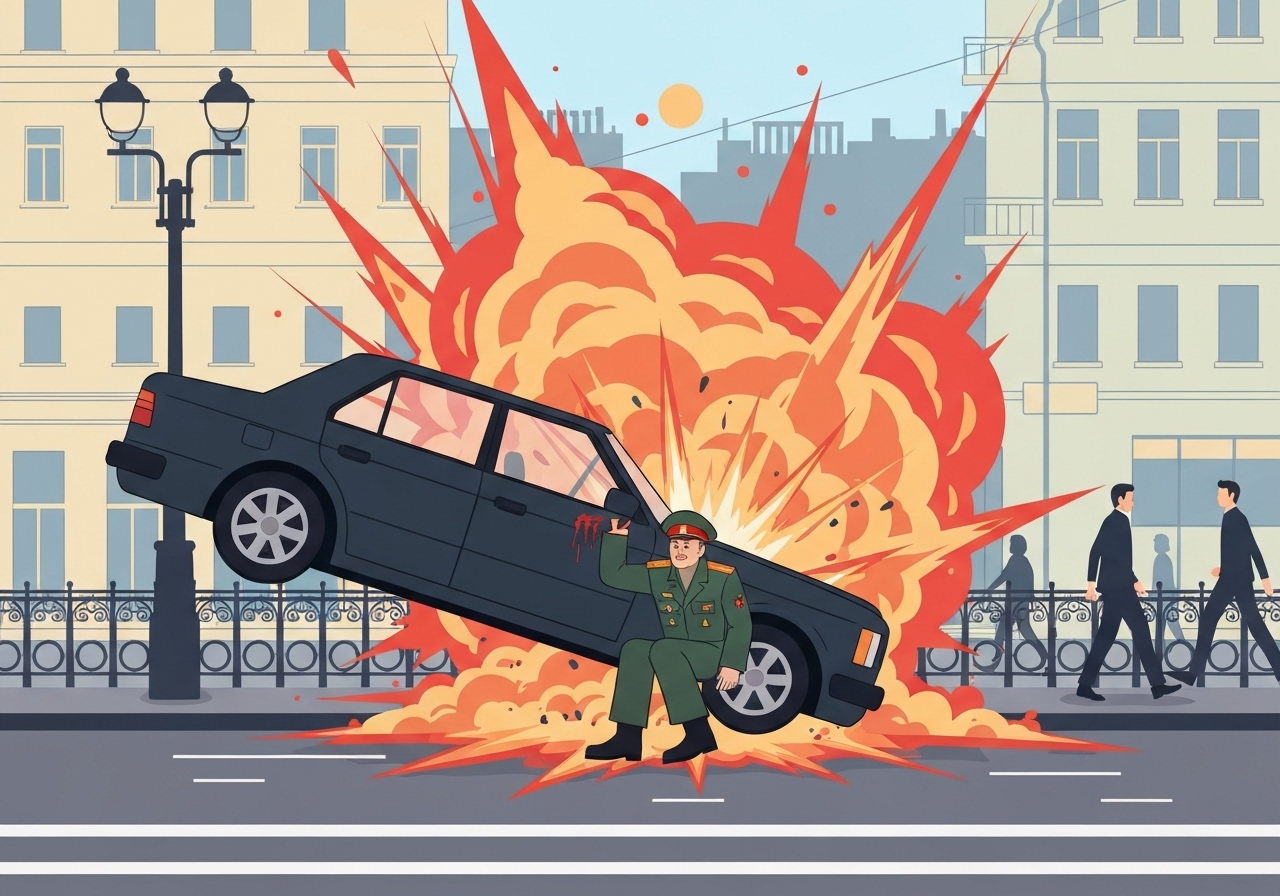
Lead: A senior Russian officer, Lt. Gen. Fanil Sarvarov, was fatally wounded by an explosive device placed under his car in Moscow on Monday, Russian investigators said. The death, confirmed by the Investigative Committee, marks the third killing of a high-ranking military officer in roughly a year. Authorities said one line of inquiry points to Ukrainian intelligence, though that claim has not been independently verified. President Vladimir Putin was reportedly briefed and the Defense Ministry noted Sarvarov’s prior service in Chechnya and Syria.
Key Takeaways
- Victim: Lt. Gen. Fanil Sarvarov, head of the Operational Training Directorate of the Russian Armed Forces’ General Staff, died from injuries after a device under his car detonated in Moscow on Monday.
- Investigation: Russia’s Investigative Committee said it is examining multiple leads and named Ukrainian intelligence services as one possible orchestrator; that allegation remains unconfirmed.
- Context: This is the third killing of a senior Russian military officer in about a year, following the attacks that killed Lt. Gen. Igor Kirillov and Lt. Gen. Yaroslav Moskalik.
- Official response: The Kremlin said President Putin was informed immediately; the Defense Ministry highlighted Sarvarov’s combat experience in Chechnya and Syria.
- Arrests in past cases: Authorities previously detained suspects quickly after the Kirillov and Moskalik attacks, including an Uzbek man charged in the Kirillov case.
Background
Since Russia launched its large-scale invasion of Ukraine nearly four years ago, Moscow has repeatedly attributed a series of killings and sabotage incidents inside Russia to Kyiv or to actors working on its behalf. Russian officials have cited alleged Ukrainian intelligence involvement in several high-profile assassinations of military officers and public figures, and Ukraine has in some instances claimed responsibility; in others it has not commented. The cycle of accusations has heightened security concerns among Russia’s security services and exposed vulnerabilities in how senior officials are protected in and around Moscow.
Previous incidents include the killing of Lt. Gen. Igor Kirillov more than a year ago, when an explosive concealed on an electric scooter detonated near his residence and also killed an assistant; Ukrainian intelligence publicly claimed responsibility for that attack. In April, Lt. Gen. Yaroslav Moskalik died after an explosive was placed in a parked car near his apartment, and authorities said they swiftly arrested a suspected perpetrator. Those events prompted criticism from President Putin about gaps in domestic security and calls for improved countermeasures.
Main Event
Russian investigators announced Monday that Lt. Gen. Fanil Sarvarov was mortally wounded after a device planted beneath his vehicle detonated in Moscow. Svetlana Petrenko, a spokeswoman for the Investigative Committee, said Sarvarov later died of his injuries; the committee said multiple investigative routes are open, including an alleged link to Ukrainian intelligence services. The specific time and exact location within Moscow were not detailed in the public statement released by investigators.
The Defense Ministry provided background on Sarvarov’s career, saying he had fought in Chechnya and participated in Russian operations in Syria. Officials did not release additional operational details about his role in the General Staff or whether his work might have been a motive. Security services in Moscow have intensified inquiries, searching for forensic traces and potential witnesses near the scene.
Russian authorities said they informed President Putin immediately. State bodies did not disclose whether any arrests had been made in connection with the Moscow explosion as of the public statements. Media accounts cited investigators’ intent to examine surveillance footage, communications records, and possible links to foreign intelligence but gave no timeline for definitive findings.
Analysis & Implications
The killing of a high-ranking officer inside Moscow challenges assumptions about the reach of hostile actors and the effectiveness of domestic protection measures for senior personnel. If investigative claims about outside intelligence involvement are substantiated, it would represent a significant escalation in cross-border targeting tied to the conflict. Even unproven allegations can strain diplomatic channels and feed domestic pressure on security agencies to demonstrate rapid results.
Operationally, such incidents may prompt immediate changes in how Russian military leadership travels and secures residences and vehicles, with potential cascading effects on internal force deployments and counterintelligence priorities. The perception of vulnerability within Moscow could lead to increased domestic surveillance and resources allocated to protective details, raising civil liberties concerns and logistical burdens for state security services.
Internationally, confirmation of a foreign intelligence role would likely trigger retaliatory or defensive measures, risking further escalation between Russia and Ukraine or their proxies. Conversely, unresolved or ambiguous findings can deepen mistrust, provide political cover for harsher internal security policies, and complicate third-party mediation efforts. The pattern of rapid arrests in prior cases will place public pressure on investigators to show quick progress, which can sometimes lead to contested or incomplete conclusions.
Comparison & Data
| Officer | Date (approx.) | Method | Location | Alleged 책임 |
|---|---|---|---|---|
| Fanil Sarvarov | Monday (reported) | Bomb placed under car | Moscow | Investigators named possible Ukrainian intelligence |
| Igor Kirillov | Just over a year ago | Explosive on electric scooter | Outside apartment | Ukrainian security service claimed responsibility |
| Yaroslav Moskalik | April | Explosive in parked car | Near apartment outside Moscow | Suspect arrested; attribution reported |
The table highlights a recurring pattern: senior officers targeted near or at residences using concealed devices. The similarities in method and victim profile inform investigators’ hypotheses but do not, on their own, prove a single orchestrator or chain of command behind the attacks. Analysts note that repeated successful attacks inside Russian-controlled territory indicate either operational sophistication by perpetrators or persistent security lapses.
Reactions & Quotes
“Investigators are pursuing numerous lines of inquiry regarding the murder. One of these is that the crime was orchestrated by Ukrainian intelligence services,”
Svetlana Petrenko, Investigative Committee spokesperson (official statement)
Petrenko framed the inquiry as multi-pronged while naming one possible external actor; her comment represents the official investigative posture but does not constitute independent verification.
“President Vladimir Putin was immediately informed about the killing,”
Dmitry Peskov, Kremlin spokesman (official statement)
Peskov’s brief statement confirmed Kremlin awareness and underscores the political salience of the incident for Russia’s leadership.
“Justice inevitably comes,”
Volodymyr Zelenskyy, President of Ukraine (previous public remark, referenced)
Zelenskyy’s prior comment, made after earlier attacks on Russian officers, was framed generally about accountability for Russian leaders and was not a direct admission related to the most recent death.
Unconfirmed
- The Investigative Committee’s claim that Ukrainian intelligence orchestrated the attack has not been independently verified by open-source evidence.
- No publicly released forensic report or surveillance footage linking specific individuals or organizations to the device placement has been disclosed.
- Motives tied to Sarvarov’s specific duties or recent activities have not been established in the public record.
Bottom Line
The killing of Lt. Gen. Fanil Sarvarov in Moscow underscores a troubling pattern of targeted attacks against senior Russian military personnel near their homes. While investigators have pointed to Ukrainian intelligence as one possible culprit, that attribution remains unconfirmed in open sources and should be treated as an allegation pending forensic and corroborative evidence.
Regardless of final findings, the incident will likely prompt a security clampdown around high-ranking officers, intensified counterintelligence efforts, and political messaging aimed at demonstrating control. For external observers, the case raises questions about escalation risks, the limits of domestic protective measures, and the challenges of independent verification in an environment saturated with competing official narratives.
Sources
- The Associated Press (news/press) — original reporting on the Moscow explosion and official statements