
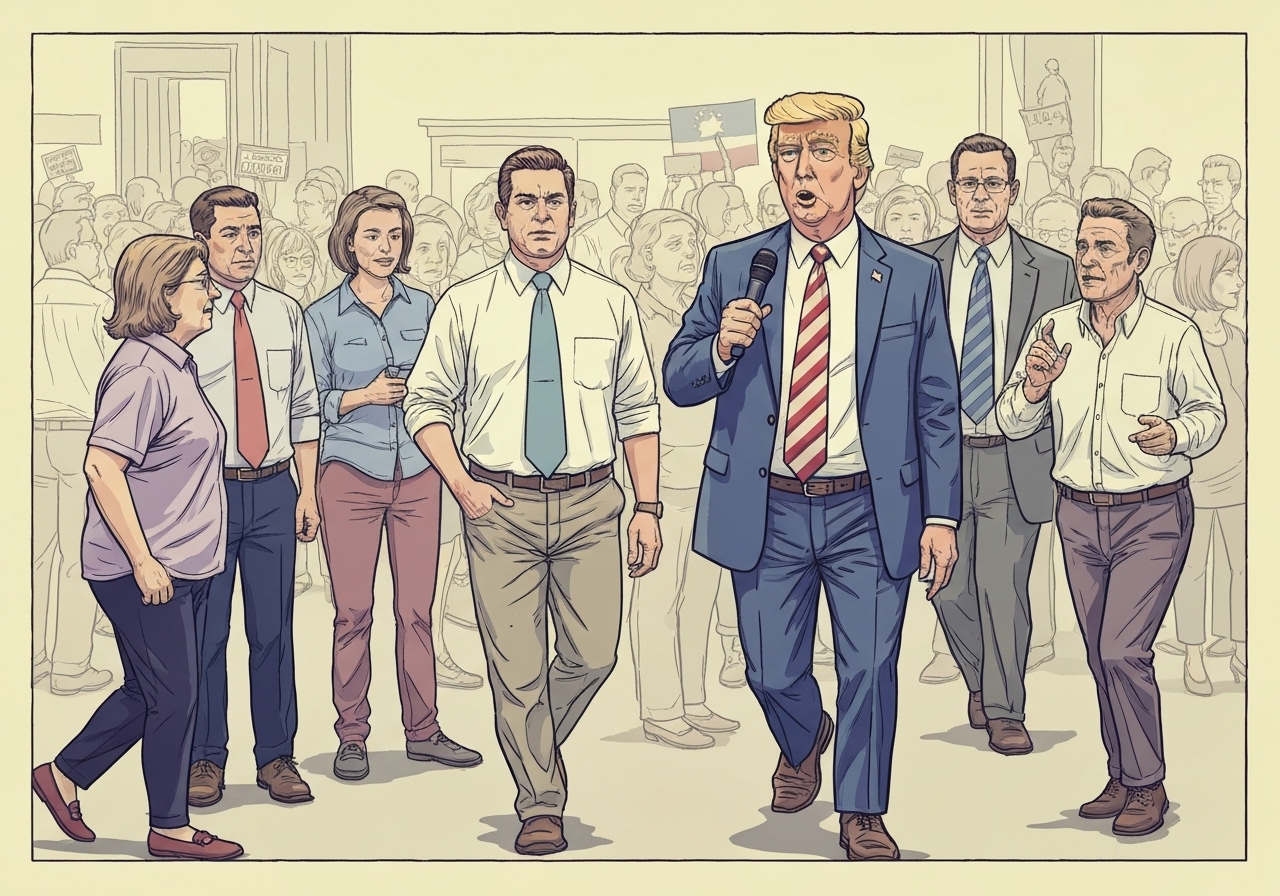
President Donald Trump paused his Florida holiday on Monday to press a tougher line on Venezuela, warning President Nicolás Maduro as U.S. forces pursued sanctioned oil tankers in the Caribbean. Surrounded by top national security aides including Secretary of State Marco Rubio and Defense Secretary Pete Hegseth, Trump said he was prepared to escalate a months‑long pressure campaign that began with efforts to stem drug flows but has broadened into actions targeting a so‑called Venezuelan “shadow fleet.” The U.S. Coast Guard continued a multi‑day pursuit of a vessel under a U.S. judicial seizure order, while the administration pointed to two earlier seizures as part of the same campaign.
Key Takeaways
- The U.S. Coast Guard is pursuing a sanctioned tanker in the Caribbean that the White House says is flying a false flag and is under U.S. judicial seizure.
- This pursuit follows two prior actions: the seizure of the tanker Skipper on Dec. 10 and the Saturday seizure of a Panama‑flagged vessel called Centuries.
- Trump said the Navy will build a new large warship and warned Maduro that further provocations would provoke a stronger response.
- U.S. officials describe the targeted vessels as part of a Venezuelan “shadow fleet” used to evade sanctions and move oil cargoes illicitly.
- At least 104 people have been killed in 28 U.S. strikes on small vessels since early September, according to U.S. officials; those operations have drawn congressional and human‑rights scrutiny.
- Russia began evacuating families of diplomats from Caracas starting Friday, signaling concern among foreign partners over rising tensions.
- Local residents near the El Palito refinery report fewer tankers and continued economic hardship, with Venezuela producing about 1 million barrels per day—roughly half levels seen in earlier years.
Background
The pressure campaign traces back roughly four months and was publicly framed by the U.S. as an effort to disrupt drug trafficking routes originating from Venezuela. Over time, that effort has expanded to include maritime actions aimed at vessels Washington says are helping Caracas evade sanctions by hiding ownership and registrations. U.S. officials use the phrase “dark fleet” or “shadow fleet” to describe tankers that allegedly operate with false flags or falsified documentation to move sanctioned oil.
The broader geopolitical context includes strained U.S.‑Venezuela relations since the Maduro government consolidated power and nationalized oil assets once controlled by foreign companies. The Trump administration has repeatedly said Maduro’s tenure is unsustainable and has sought to pressure Caracas through sanctions, maritime interdictions and diplomatic measures. Regional actors and outside powers, notably Russia, have responded with statements of support or concern.
Main Event
On Monday in West Palm Beach, Trump delivered a public warning to Maduro and announced plans related to new naval construction while flanked by Rubio and Hegseth. He framed the maritime operations as part of a concerted campaign and said the U.S. will continue to pursue vessels it deems in violation of sanctions. The White House characterized the tanker currently being chased as operating under a false flag and subject to a judicial seizure order.
The Coast Guard, assisted by the Navy, has now targeted at least three vessels in recent days: the earlier seizure of Skipper on Dec. 10, the Saturday seizure of the Panama‑flagged Centuries, and the ongoing pursuit announced Monday. U.S. officials say these actions aim to disrupt networks that reroute or hide Venezuelan oil to evade sanctions regimes.
In Venezuela, the presence of tankers near refineries such as El Palito was visible to local residents, who reported a smaller flotilla than in better economic times. While families gathered at a nearby beach for holiday recreation, sources on the ground described continued shortages and rising prices, and watchdog group Transparencia Venezuela identified at least one vessel tied to the shadow fleet near El Palito.
Analysis & Implications
The U.S. interdiction campaign signals a step up from financial and diplomatic pressure to active maritime enforcement. By pursuing and seizing ships alleged to be part of a network that disguises shipments, the administration is attempting to choke revenue streams that sustain Maduro’s government. However, shifting from sanctions and diplomatic isolation to physical interdictions raises legal and operational questions about jurisdiction, evidence standards, and risks of escalation at sea.
Domestically, the strikes and ship seizures may be presented by the administration as decisive action against illicit trade and drug trafficking, bolstering political messaging on national security. Internationally, they risk heightening tensions with countries that view aggressive interdictions as infringements on maritime freedom or as politically motivated. Russia’s reported evacuation of diplomatic families underscores how other states are already reacting to the heightened profile of the crisis.
Human‑rights and legal advocates have called for clearer evidence linking interdicted vessels to criminal activity; critics say some attacks on small vessels have resulted in civilian casualties with limited public proof. The reported toll—104 deaths across 28 strikes since early September—has prompted congressional inquiries and could affect U.S. ability to marshal broader regional support for sustained maritime operations.
Comparison & Data
| Vessel | Date/Status | Allegation |
|---|---|---|
| Skipper | Seized Dec. 10 | Part of shadow fleet carrying sanctioned cargo |
| Centuries | Seized on Saturday | Panama‑flagged; linked to Venezuelan shadow fleet |
| Unnamed tanker | Pursued (Monday) | Under U.S. judicial seizure; alleged false flag |
The table summarizes recent maritime actions the U.S. has cited as evidence of an organized effort to circumvent sanctions. Venezuelan oil production is reported at about 1 million barrels per day—roughly half of production in better years—reducing export volume and altering the pattern and number of tankers seen at refineries.
Reactions & Quotes
U.S. political and security leaders presented the actions as targeted enforcement:
If he wants to do something, if he plays tough, it’ll be the last time he’ll ever be able to play tough.
President Donald Trump
This comment came as Trump announced naval construction plans and framed the interdictions as part of sustained pressure on Maduro.
The targeting of tankers sends a message that illegal activity Maduro participates in cannot stand; he needs to be gone.
Homeland Security Secretary Kristi Noem
Noem linked tanker actions to broader claims about illicit activity and framed them as defending U.S. interests and citizens.
We reviewed the aggressions and flagrant violations of international law … the unlawful acts of piracy carried out by the United States government.
Venezuelan Foreign Minister Yván Gil
Venezuelan officials condemned the interdictions as illegal and said they discussed the issue with Russian counterparts, underscoring diplomatic friction.
Unconfirmed
- Precise owners and beneficial owners of the vessels in the shadow fleet remain opaque and unconfirmed in public records.
- Independent, publicly released evidence linking specific interdicted ships directly to Maduro or his inner circle has not been fully disclosed.
- Reports that Russian assessments of the situation in Venezuela are “very grim” come from an anonymous European intelligence official and have not been officially quantified by Moscow.
Bottom Line
The administration has moved from sanctions and diplomatic pressure to visible maritime enforcement, signaling an intensification of U.S. measures aimed at Venezuela’s oil lifelines. The seizures and pursuits are intended to cut revenues and signal resolve, but they also create legal and diplomatic challenges that could draw international criticism and complicate relations with Russia and regional partners.
For Venezuelans on the ground, the maritime actions intersect with a deeper economic crisis: refinery activity and tanker traffic have contracted as production sits near 1 million barrels per day, amplifying shortages and hardship. Watchers should expect continued maritime operations and heightened diplomatic exchanges in the near term, with potential congressional scrutiny of the evidence and legal basis for interdictions.
Sources
- Associated Press (news report)
- The White House (official statements/press briefings)
- U.S. Coast Guard (official agency)
- Transparencia Venezuela (NGO/watchdog)
- Russian Foreign Ministry (official)