
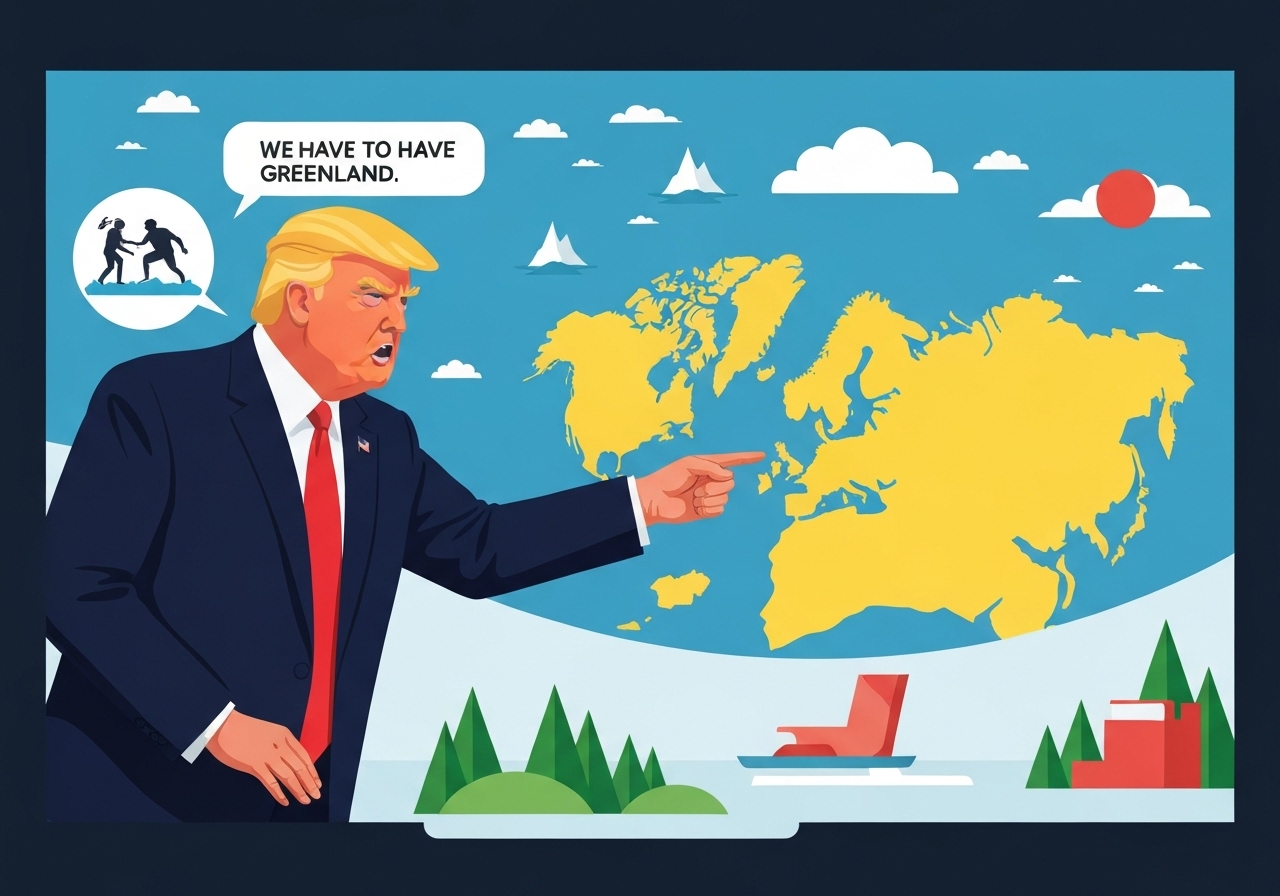
Lead: In August 2019, then-US president Donald Trump publicly revived an idea to acquire Greenland, saying “we have to have” the territory. The remark, made during a period of private and public discussion inside the US administration, provoked swift rejection from Denmark and raised questions about Arctic strategy and sovereignty. The exchange led to a diplomatic spat and the cancellation of a planned state visit, while underscoring growing international competition for Arctic resources and bases.
Key Takeaways
- Donald Trump publicly expressed interest in Greenland in August 2019, using the phrase “we have to have” to describe US aims toward the island.
- Denmark and Greenlandic authorities rejected the notion; Denmark’s prime minister stated Greenland was not for sale and a planned Danish state visit to Washington was called off.
- Greenland covers roughly 2.16 million km² but has a population of about 56,000, giving it outsized strategic importance relative to its population.
- The United States already maintains a military presence in Greenland (Thule Air Base), and the island sits along key Arctic shipping routes emerging due to climate change.
- No formal purchase offer or transfer process was advanced publicly; US officials described initial steps as exploratory rather than a concluded policy.
Background
Greenland is an autonomous territory within the Kingdom of Denmark with extensive self-rule over domestic matters; Denmark retains responsibility for foreign policy and defense. Its size, mineral potential, and Arctic location have made it strategically salient to multiple powers. The US historically has engaged in Greenland through military installations and Cold War-era agreements, most notably hosting Thule Air Base in the far north.
Interest in Arctic resources and new sea lanes has grown as climate change reduces ice cover, attracting attention from state and commercial actors. The idea of territorial acquisition is rare in the contemporary era, with the 19th-century purchase of Alaska by the United States often cited as a historical precedent, but modern governance, legal norms and the autonomy of local populations complicate any transfer today.
Main Event
In mid‑August 2019, public reporting and statements by the president indicated that White House advisers had discussed options regarding Greenland, including acquisition. The president’s comment — that the US “has to have” Greenland — crystallized those discussions into a headline-making remark. Administration officials subsequently described initial conversations as exploratory and lacking a formal purchase proposal.
Denmark responded publicly and promptly. Copenhagen’s political leadership, and Greenlandic officials, rejected the premise that the island could be sold. Denmark’s prime minister said the idea was “absurd” and affirmed Greenland’s status and the importance of consultation with Greenlanders on any matter affecting their future.
The unfolding exchange led the White House to cancel a planned state visit by the Danish prime minister. That cancellation further strained relations and highlighted how rhetoric on territory and sovereignty can have immediate diplomatic consequences, even absent concrete policy steps.
Analysis & Implications
Legally and politically, purchasing a modern, autonomous territory would require consent from multiple parties: the people of the territory, the administering state, and complex bilateral or multilateral approvals. Greenland’s degree of self-rule and the islanders’ distinct political identity make unilateral transactions highly improbable. Any realistic change in status would instead follow negotiated political processes within the Kingdom of Denmark and Greenlandic authorities.
Strategically, the episode amplified the Arctic’s prominence in US foreign policy debates. Greenland sits adjacent to trans‑Arctic routes and above potential mineral deposits, giving it defense and economic value. Even exploratory talk of acquisition signaled Washington’s desire to assert influence in the High North amid rising activity from Russia, and increasing commercial interest from China and others.
Diplomatically, the public nature of the comments damaged trust with an ally. Denmark is a NATO member and partner on defense issues; abrupt public proposals about territory can complicate cooperative planning and stationing of forces. The cancellation of high‑level visits illustrated how rhetoric can translate into immediate costs for bilateral ties.
Comparison & Data
| Item | Greenland | Alaska (for comparison) |
|---|---|---|
| Area (approx.) | 2.16 million km² | 1.72 million km² |
| Population (approx.) | 56,000 | 731,000 |
| Political status | Autonomous territory (Kingdom of Denmark) | US state since 1959 |
| Strategic notes | Arctic location, Thule Air Base | Resource-rich, Arctic access |
The table above places Greenland’s scale and demography alongside Alaska to show the difference between geographic size and human presence. Greenland’s sparse population and substantial landmass create governance and sovereignty dynamics distinct from more densely populated regions; these features shape both defense considerations and resource planning.
Reactions & Quotes
Denmark and Greenland reacted quickly and publicly, framing the idea as inconsistent with Greenlandic autonomy and modern diplomatic norms.
“Greenland is not for sale,”
Mette Frederiksen, Prime Minister of Denmark
Within the US, officials offered varied characterizations, from exploratory to unserious, reflecting internal uncertainty about whether the idea was a policy initiative or a rhetorical provocation.
“We looked into the idea, but there is no active purchase process,”
US administration official (summary)
Experts warned the episode could deepen Arctic contestation and make routine cooperation with allies more fraught.
“Public talk of buying territory raises the political temperature in a region already seeing heightened strategic competition,”
Arctic security analyst (academic)
Unconfirmed
- Whether formal purchase negotiations or price figures were ever seriously proposed by US officials remains unconfirmed.
- Reports that specific US cabinet members led a coordinated acquisition plan have not been fully corroborated in public records.
- Claims about direct offers from other states for Greenlandic assets or exclusive mining deals were reported in some outlets but lack definitive public documentation.
Bottom Line
The president’s declaration that the US “has to have” Greenland converted an internal policy conversation into a diplomatic incident, underscoring how leadership statements can rapidly affect alliances. The practical barriers—legal, political and ethical—to purchasing an autonomous territory make an actual transfer unlikely.
However, the episode served as a signal: the Arctic is a growing theatre of strategic competition and public diplomacy matters. Expect continued attention to Greenland from major powers, expanded Arctic policy debate in allied capitals, and calls for clearer mechanisms for cooperation that respect local autonomy and international norms.