
Lead
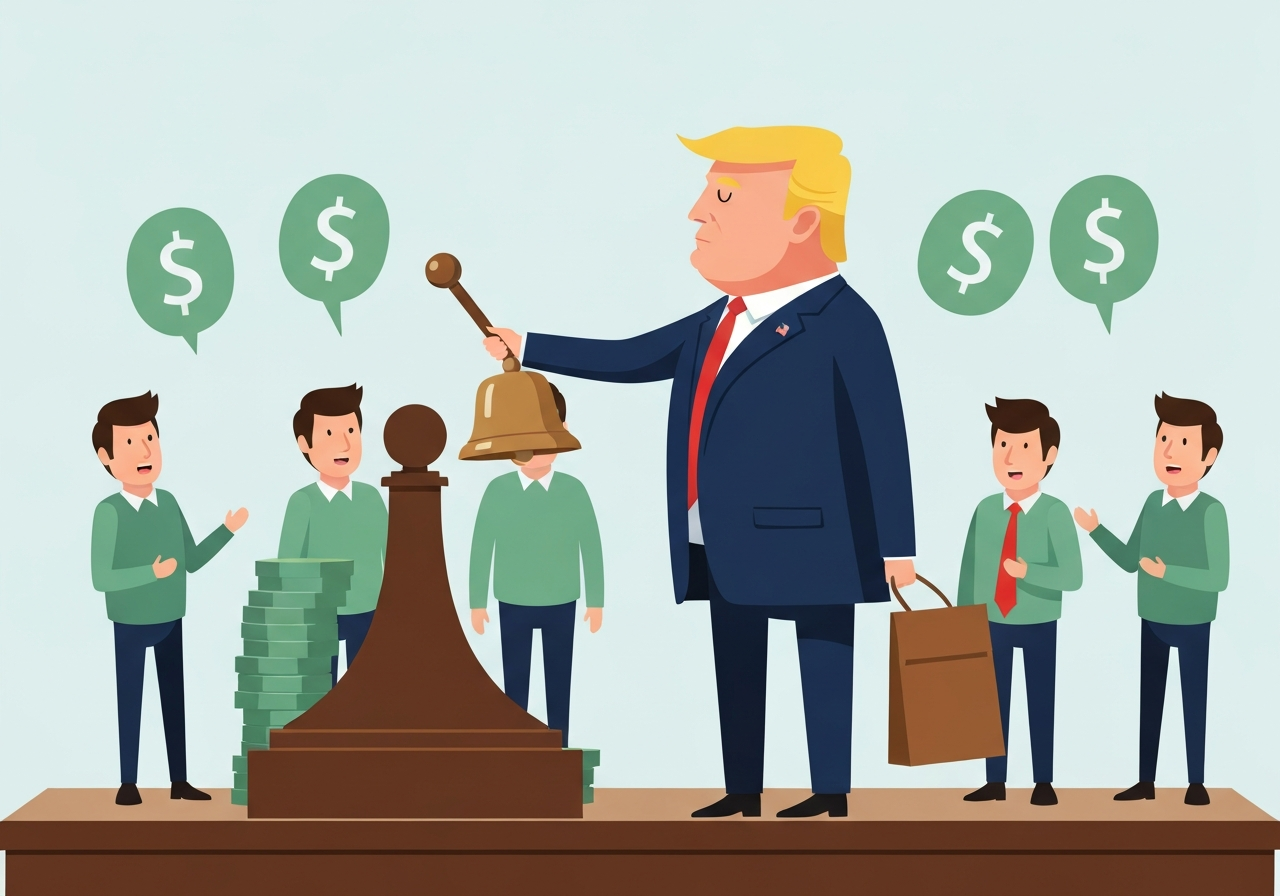
President Donald Trump on Monday rang the opening bells for the New York Stock Exchange and the Nasdaq from the Oval Office, an intentionally symbolic gesture to associate his presidency with recent stock-market gains. The event promoted a new program called Trump Accounts, presented as a way to expand stock ownership to children, and took place as high inflation has eroded public confidence in the administration’s economic stewardship. Trump framed market gains as evidence his policies deserve credit and predicted further upside as the November midterm elections approach. Polling shows only 33% of U.S. adults approve of his handling of the economy, suggesting the message may face limits with broad voters.
Key Takeaways
- Trump rang both the NYSE and Nasdaq opening bells from the Oval Office on Monday as part of a promotional event tied to his administration’s economic narrative.
- Administration officials promoted Trump Accounts, a provision in Republicans’ 2025 tax and spending cuts bill intended to let children hold indexed investments.
- Treasury Secretary Scott Bessent said 38% of American families have no exposure to equity markets, a key rationale offered for expanding access.
- The S&P 500 returned 17.9% in 2025 following gains of 25% in 2024 and 26.3% in 2023, and is up about 10% so far this year.
- Only 33% of U.S. adults approved of Trump’s economic leadership in a June AP-NORC survey, highlighting a gap between market performance and public sentiment.
- Inflation remains a political drag: the consumer price index rose 4.2% over the past 12 months, up from 3.0% in January 2025.
Background
U.S. presidents frequently point to stock-market performance as shorthand for economic competence, but stock ownership is unevenly distributed and can be a blunt political instrument. Wealthier households hold a disproportionate share of equities, while many middle- and lower-income families have limited direct exposure beyond employer-sponsored retirement plans. That distributional reality complicates efforts to convert market gains into broad voter approval.
Republican leaders included measures in their 2025 tax and spending cuts package intended to expand investment access; Trump Accounts are being billed as a vehicle to place index holdings in children’s names. Treasury officials and Republicans argue widening access will let more families benefit from long-term equity growth, but critics say the measures mostly favor those who already save for retirement or have discretionary income.
Main Event
The Oval Office event unfolded with a ceremonial ringing of trading bells for both exchanges, a visual linking the presidency to Wall Street. Trump used the occasion to argue markets would continue to rise, saying the market is ‘going to go through the roof’ as he launched trading. The staging underscored an effort to shift media and public attention toward retirement accounts and portfolio performance ahead of the midterms.
Treasury Secretary Scott Bessent, speaking before the bell-ringing, emphasized that 38% of American families reportedly have no direct stock exposure and framed Trump Accounts as a remedy. Administration officials said the accounts are meant to broaden ownership and make stock-market gains more tangible for ordinary families over the long term.
Critics raised two immediate objections: that stock-market gains are not evenly shared across the population and that recent returns were driven largely by market momentum and corporate earnings, not any single administration’s policies. Opponents also noted that trade decisions, geopolitical tensions and other factors can quickly reverse gains, complicating any simple causal claim.
Analysis & Implications
Linking a presidency to market performance is politically sensible only if voters equate market gains with their household finances. Because equity ownership is concentrated, especially outside of employer-sponsored plans, emphasizing the S&P 500 can resonate with affluent and retirement-ready voters while doing little for those facing immediate cost pressures. That gap helps explain why strong market returns have not translated into uniformly improved approval numbers for presidents in the past.
Inflation presents a central constraint. The consumer price index’s 4.2% 12-month increase undercuts messaging that market gains alone reflect economic relief for average households. For many voters, out-of-pocket costs for food, housing and energy exert more immediate influence on pocketbooks than abstract portfolio performance, weakening electoral benefits from market rallies.
Policy design will determine whether Trump Accounts shift ownership in a meaningful way. If the accounts primarily supplement savings for families already investing, the distributional balance will remain tilted toward higher-income households. Conversely, accompanied by outreach and subsidies for low- and middle-income savers, the accounts could broaden participation over the next decade but would take time to affect vote behavior in the near term.
Comparison & Data
| Measure | 2023 | 2024 | 2025 |
|---|---|---|---|
| S&P 500 annual return | 26.3% | 25.0% | 17.9% |
| Approx. YTD S&P change (2026) | ~10% year-to-date | ||
| Consumer Price Index (12-month) | 4.2% (most recent 12 months) | ||
The table shows a multiyear run of strong equity returns culminating in 17.9% in 2025 after unusually large gains in 2023 and 2024. Those market gains occurred alongside rising consumer prices; the CPI’s 4.2% annual increase signals persistent inflationary pressures that can blunt the political impact of equity gains. Short-term market swings and policy shifts such as tariffs or geopolitical events can quickly alter these figures.
Reactions & Quotes
White House and administration officials framed the event as a launch for wider investment access and a positive sign for retirement savers. Their messaging linked policy to market performance while acknowledging gaps in direct ownership.
It’s going to go up — I think the market’s going to go through the roof.
President Donald Trump
Before the bell, Treasury Secretary Scott Bessent emphasized the participation gap in equity markets as the rationale for Trump Accounts.
Thirty-eight percent of American families do not have any exposure to our great equity markets.
Scott Bessent, U.S. Treasury
Public-response data undercuts the notion that strong markets automatically equate to broad political support; the AP-NORC polling cited below shows low approval of Trump’s economic leadership despite recent gains.
Only 33% of U.S. adults approve of Trump’s economic leadership in the June survey.
AP-NORC Center for Public Affairs Research
Unconfirmed
- Whether recent stock-market gains are primarily caused by Trump administration policies is unproven; market returns reflect many factors including corporate earnings and global trends.
- The projected uptake and distributional impact of Trump Accounts remain uncertain pending finalized legislation and implementation details.
- Claims that emphasizing market performance will materially shift voter behavior ahead of the November midterms are speculative and depend on broader economic conditions and messaging effectiveness.
Bottom Line
The Oval Office bell-ringing was a carefully staged appeal tying the presidency to Wall Street gains and promoting a policy vehicle meant to broaden equity ownership. That linkage faces two powerful constraints: uneven stock ownership across households and persistent inflation that affects daily living costs more directly than portfolio returns.
In the short term, the event reinforces the administration’s narrative but is unlikely on its own to reverse low approval ratings on economic leadership. Over the long term, the political and economic effects will hinge on whether Trump Accounts expand genuine access to stock ownership for lower- and middle-income families and whether inflation falls to levels that reconcile market gains with household finances.
Sources
- The Associated Press — Original reporting on the Oval Office event and remarks (news)
- AP-NORC Center for Public Affairs Research — June approval polling (research)
- U.S. Bureau of Labor Statistics — Consumer Price Index data (official government)
- U.S. Department of the Treasury — statements and policy context (official)