
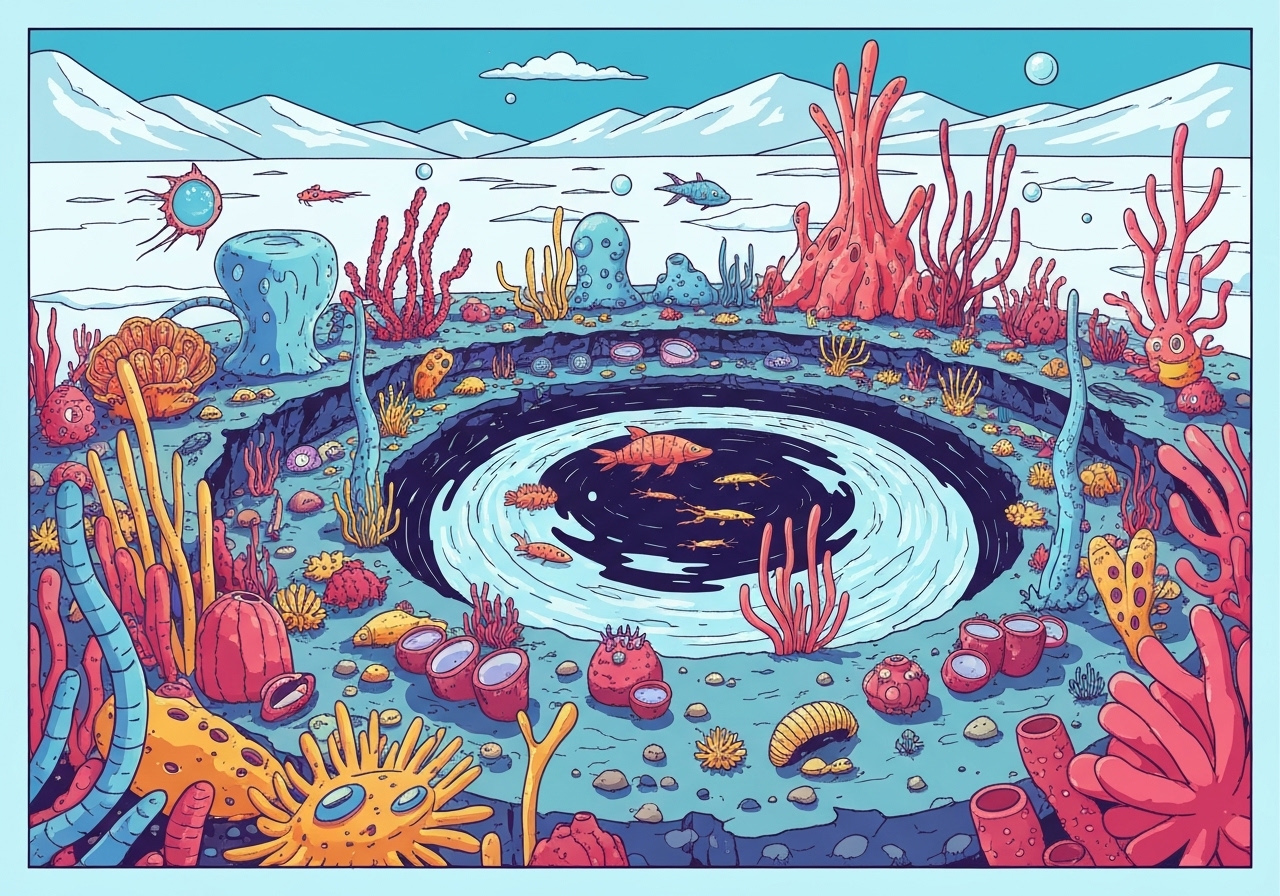
Lead: In May 2024, an international research team identified the Freya Hydrate Mounds, a system of gas-hydrate cold seeps beneath Molloy Ridge near Greenland at about 3,640 meters (nearly 12,000 feet). The site hosts the deepest gas-hydrate seep recorded and a record-setting methane gas flare rising roughly 3,300 meters (10,000 feet) through the water column. Researchers report abundant chemosynthetic communities—tubeworms, snails and amphipods—thriving without sunlight. A peer-reviewed paper describing the discovery appeared on 17 December 2025 in Nature Communications.
Key Takeaways
- The Freya Hydrate Mounds were discovered in May 2024 on Molloy Ridge, at about 3,640 m depth—the deepest known gas-hydrate seep to date.
- Investigators observed a methane gas flare extending approximately 3,300 m through the water column, the largest recorded vertical flare of its kind.
- Biological surveys found dense chemosynthetic assemblages including tubeworms, snails and amphipods, some related to hydrothermal-vent species.
- Geochemical dating indicates thermogenic gas and crude oil source material dating to the Miocene (roughly 5–23 million years old).
- Freya mounds appear morphologically dynamic: deposits form, destabilize and collapse over time in response to tectonics and subsurface processes.
- Before Freya, the deepest known seep measurements were around 2,000 m; Freya roughly doubles that depth, challenging models of hydrate stability in the Arctic.
- Researchers characterize the area as an “ultra-deep natural laboratory” for studying interactions among geology, chemistry and biology in a warming Arctic.
Background
Gas hydrates are crystalline solids in which water molecules trap gas—most commonly methane—under conditions of low temperature and high pressure on continental margins and in polar regions. When hydrates destabilize they can leak methane-rich fluids through fissures on the seafloor in features known as cold seeps. Cold seeps differ from hydrothermal vents in being colder, longer-lived and typically sourced from sedimentary hydrocarbons rather than magmatic heat.
Prior to the Freya discovery, documented cold seeps and hydrate systems in the Arctic and elsewhere were generally found at depths up to about 2,000 meters. That empirical ceiling informed models of hydrate thermodynamic stability and constrained expectations about biological communities that depend on chemosynthesis. The Molloy Ridge discovery therefore alters that empirical baseline and raises questions about where hydrates can form and remain stable beneath polar oceans.
Main Event
During an Arctic research cruise around the North Pole, the expedition mapped a seafloor fissure and surveyed what the team named the Freya Hydrate Mounds. Multibeam bathymetry, sub-bottom profiling and targeted sampling established the feature at roughly 3,640 m depth. Visual surveys with remotely operated vehicles (ROVs) revealed mound morphologies and active fluid expulsion from fractures in the sediment.
The team recorded a methane-rich gas flare rising an estimated 3,300 m through the water column—visible in acoustic data and ROV imagery. Chemical and isotopic analysis showed the gas had thermogenic signatures consistent with deeper petroleum-bearing strata, and sediment samples yielded hydrocarbons whose organic matter ages are consistent with the Miocene interval (about 5–23 million years ago).
Biological observations documented dense, patchy chemosynthetic communities clustered around seepage sites. The assemblage included tubeworms forming tube fields, seep-associated gastropods, and diverse amphipod populations. Genetic and morphological comparisons suggested many taxa are closely related to species found at hydrothermal vents, indicating ecological or evolutionary links across different seep and vent environments.
Researchers emphasized that the Freya mounds are not static. Repeated imaging and sediment observations indicate episodes of deposit growth and collapse, implying active geological forcing—such as tectonic activity, deep heat flux changes or sediment instability—is shaping the system over observational timescales.
Analysis & Implications
The discovery challenges prior assumptions about hydrate stability limits in the Arctic. Conventional hydrate phase models tie stability to combinations of pressure, temperature and gas composition; finding a stable hydrate seep at ~3,640 m implies local conditions—such as pore chemistry, fluid flow and geothermal gradients—can sustain hydrates deeper than previously confirmed. Models of Arctic carbon storage and release will need to incorporate these new parameter ranges.
Biologically, the presence of chemosynthetic communities at this depth broadens the known habitat envelope for life supported by chemical energy rather than sunlight. The observed affinities between Freya taxa and hydrothermal-vent relatives hint at dispersal pathways or convergent adaptations that enable organisms to colonize diverse, chemically driven seafloor ecosystems. Conservation planning for deep Arctic habitats should account for connectivity among seep and vent sites as well as vulnerability to human activities.
From a climate perspective, episodic methane venting from deep seeps has ambiguous net effects. Methane released at depth can be oxidized in the water column before reaching the atmosphere, but persistent or massive flares present a potential methane source to the ocean and, under some conditions, to the atmosphere. Quantifying fluxes from Freya-like systems is therefore important for Arctic carbon-cycle budgets and climate projections.
Finally, the Freya system offers an “ultra-deep natural laboratory” to study coupled processes—tectonics, fluid migration, hydrate formation and chemosynthetic ecology—under Arctic conditions. Because Arctic marine systems are changing rapidly with warming and ice loss, the site gives an opportunity to monitor how dynamic seep systems respond to environmental forcing over years to decades.
Comparison & Data
| Feature | Previously Typical Max Depth | Freya Hydrate Mounds |
|---|---|---|
| Recorded seep depth | ~2,000 m (6,500 ft) | ~3,640 m (11,942 ft) |
| Observed methane flare height | — (few hundred to ~1,000 m commonly) | ~3,300 m (10,000 ft) |
| Source-rock age (sediment) | Varied | Miocene (≈5–23 Ma) |
The table contrasts Freya with prior empirical records: Freya effectively doubles earlier maximum recorded seep depth and presents an unusually tall methane flare. These contrasts underscore why Freya requires revisions to regional hydrate stability assessments and motivates targeted monitoring to quantify flux magnitudes.
Reactions & Quotes
Lead author Giuliana Panieri framed the find as both geological and biological in significance, arguing the site forces a recalibration of Arctic deep-sea science:
“We found an ultra-deep system that is both geologically dynamic and biologically rich.”
Giuliana Panieri, Ca’ Foscari University (lead author)
A co-author and geochemist summarized the implications for carbon cycling and model constraints, noting that deep methane pathways alter assumptions about how and where carbon is stored and released in polar margins.
“These mounds rewrite the playbook for hydrate formation and carbon cycling in the Arctic.”
Research team statement, Nature Communications paper
Peer researchers not on the original team emphasized the scientific value while urging caution about extrapolating local observations to broader regional flux estimates.
“Exceptional local systems like Freya are invaluable, but we must measure fluxes over time before drawing climate-consequence conclusions.”
Independent deep-sea scientist (comment)
Unconfirmed
- Whether the observed methane flare results in measurable atmospheric emissions is not yet established; water-column oxidation could consume much of the methane before it reaches the surface.
- The degree of ecological connectivity between Freya communities and distant hydrothermal-vent faunas is inferred from morphological and genetic hints but requires broader population-genetic sampling to confirm.
- Long-term temporal dynamics of mound formation and collapse are inferred from repeat observations over a limited interval; multi-year monitoring is needed to quantify typical lifecycles.
Bottom Line
The Freya Hydrate Mounds extend the known depth range for gas-hydrate cold seeps and reveal an unexpectedly large methane flare and rich chemosynthetic life at ~3,640 m beneath Molloy Ridge. The findings force a reassessment of hydrate stability models, deep Arctic ecology and potential carbon-cycle feedbacks in polar margins. While Freya provides a uniquely informative site, critical uncertainties remain about methane fate, long-term system behavior and wider regional prevalence of similarly deep seeps.
Immediate next steps include quantifying methane fluxes from the site, expanding genetic and population studies of seep fauna to map connectivity, and deploying repeated monitoring to capture morphological and chemical change over time. Because the Arctic is undergoing rapid environmental change, Freya will be a priority location for researchers aiming to understand how deep-sea carbon and life interact under shifting climate conditions.