
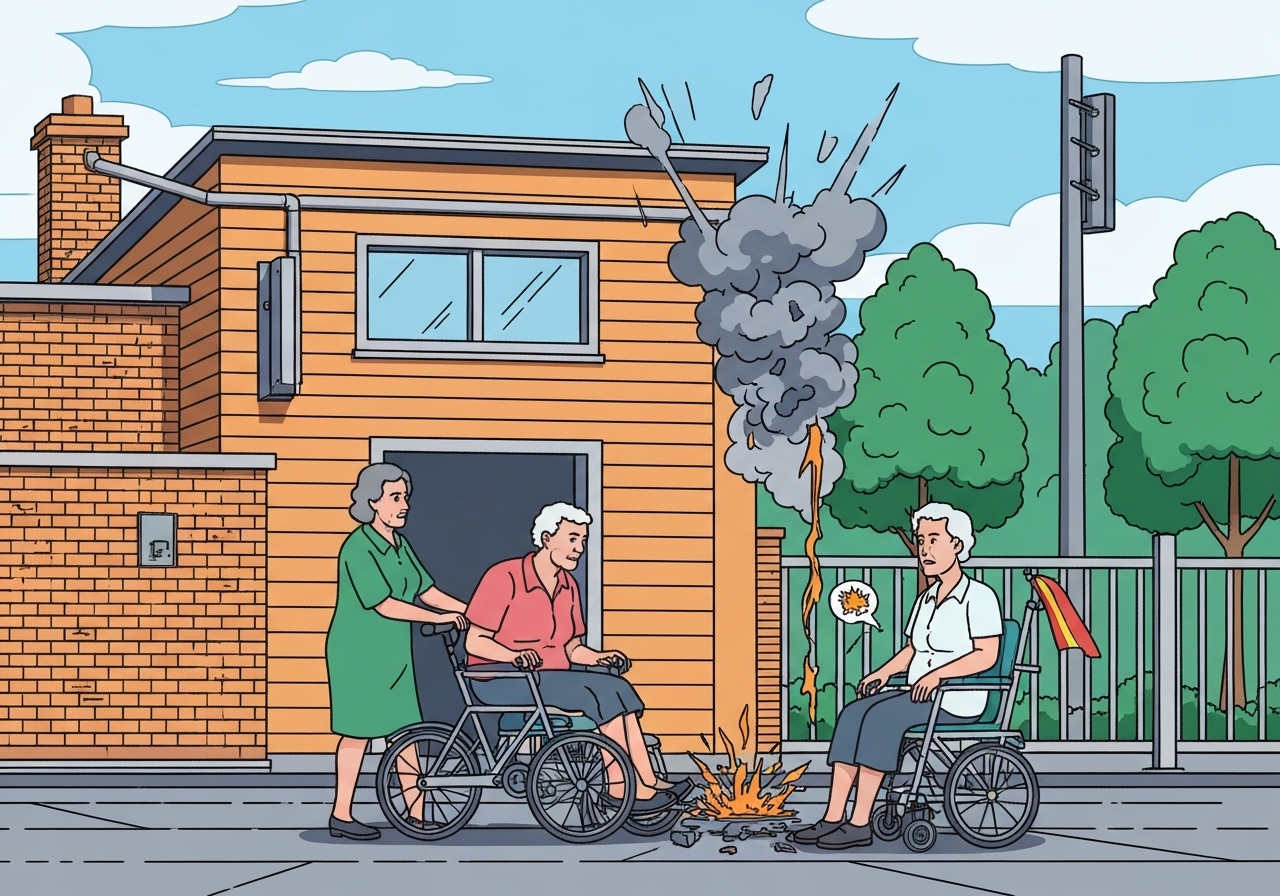
Lead: A powerful explosion Tuesday at Bristol Health & Rehab Center in Bristol Township, Pennsylvania, killed at least two people and left parts of the 174-bed facility collapsed, officials said. The blast occurred shortly after 2:00 p.m. while utility crews were on site investigating a reported gas odor. Emergency responders moved into “rescue mode,” evacuating residents and staff to hospitals and continuing hand searches, canine teams and sonar operations. Pennsylvania Gov. Josh Shapiro called for prayers for missing and injured residents and families ahead of the Christmas holiday.
Key Takeaways
- At least two people were confirmed dead after the explosion at Bristol Health & Rehab Center; officials have not released identities.
- The incident happened at about 2:17 p.m. on Tuesday as PECO crews responded to reports of a gas odor at the facility.
- Bucks County authorities reported a partial building collapse; crews remained in rescue operations roughly five hours after the blast.
- Fire Chief Kevin Dippolito said five people were unaccounted for at an evening briefing, though some may have left the scene with relatives.
- The 174-bed nursing home is about 20 miles (32 km) northeast of Philadelphia and is owned by Saber Healthcare Group.
- State inspection records show the facility had deficiencies noted in October, including problems with floor plans, stairway storage and smoke barriers.
- Medicare lists the facility’s overall rating as “much below average,” though a September 2024 fire-safety survey cited in the public record showed no citations.
Background
The facility involved, formerly known as Silver Lake Healthcare Center, is a 174-bed nursing home serving long-term care residents northeast of Philadelphia. Nursing homes are subject to state health inspections and federal oversight through Medicare and Medicaid; records cited by state agencies show recent compliance problems at this site, including fire-safety and storage concerns noted in an October state inspection.
Gas infrastructure and utility response are a recurring public-safety concern in populated suburban areas. Local utilities, including PECO, maintain crews to investigate odor reports and can shut off gas and electric service when safety risks are suspected. State regulators from the Pennsylvania Public Utility Commission also deploy safety-division investigators after incidents involving utilities or suspected leaks.
Main Event
Bucks County emergency management reported receiving the initial call about an explosion at roughly 2:17 p.m. Emergency units from across the region converged on the nursing home as a plume of black smoke rose above the building. Firefighters described intense smoke and flame conditions and reported parts of the structure had collapsed.
First responders carried out rapid evacuations of residents and staff, some removed through windows and stairwells while others were carried over responders’ shoulders to safety, according to accounts from local fire officials. Ambulances and waiting police officers received patients and transported injured people to area hospitals for treatment.
PECO said its crews were on site after reports of a gas odor and that they shut off natural gas and electric service to the facility to protect responders and neighbors. Investigators from the Pennsylvania Public Utility Commission’s safety division were dispatched to examine the scene and determine whether a gas leak caused the blast; officials described that finding as preliminary pending a close inspection.
Analysis & Implications
An explosion at a congregate-care facility raises immediate questions about emergency preparedness, building maintenance and utility coordination. If a gas leak is confirmed, regulators will examine whether detection, reporting and mitigation systems functioned effectively and whether any delays affected outcomes. Nursing-home residents are especially vulnerable in structural fires and explosions because of mobility limits and reliance on staff for evacuation.
The October state inspection cited several compliance gaps — including missing smoke-barrier partitions and improperly stored oxygen cylinders — that could magnify risk during a blaze by allowing smoke and fire to move more freely between floors. Investigators will need to determine how those deficiencies intersected with the timing and location of the explosion to assess liability and compliance failures.
There are broader policy implications for local oversight and utility protocols. Utilities routinely cut service when crews detect hazardous conditions; investigators will review communication logs, crew actions and the timeline to see whether the shutoff occurred before or after the blast and whether additional preventive steps were possible.
Comparison & Data
| Item | Detail |
|---|---|
| Facility size | 174 beds |
| Distance from Philadelphia | ~20 miles (32 km) northeast |
| Initial report time | Approximately 2:17 p.m. (Tuesday) |
| State inspection (Oct) | Multiple regulation violations noted |
| Fire-safety survey (Sept 2024) | No citations listed on public Medicare fire inspection record |
The table shows how recent public records paint a mixed picture: a formal fire safety survey in September 2024 registered no citations, while a separate October state inspection identified several compliance problems. That divergence will be part of investigators’ review as they seek to reconcile inspection timing, corrective actions and current conditions when the explosion occurred.
Reactions & Quotes
Officials and neighbors reacted with shock and urgent concern as rescue work continued into the evening.
“Please pray for this community, for those who are still missing, for those who are injured, and for those families who are about to celebrate Christmas with an empty chair at their table.”
Gov. Josh Shapiro (Pennsylvania)
Gov. Shapiro’s remarks framed the event as a community tragedy occurring on the eve of a major holiday and underscored state attention to the unfolding rescue and investigative work.
“It was nothing short of extraordinary.”
Fire Chief Kevin Dippolito (Bristol Township Fire Department)
Chief Dippolito used that phrase to describe firefighters’ efforts to extract residents from stairwells, elevator shafts and windows amid heavy smoke and structural collapse, and to highlight the rescue intensity required at the scene.
“While crews were on site, an explosion occurred at the facility. PECO crews shut off natural gas and electric service to the facility to ensure the safety of first responders and local residents.”
PECO (utility statement)
PECO’s statement confirms the utility’s presence at the site and the precautionary shutdown of services; investigators will review logs and crew reports to determine timeline specifics.
Unconfirmed
- Whether a gas leak is the definitive cause of the explosion remains unconfirmed pending a scene inspection by state safety investigators.
- The exact number and identities of injured persons and missing residents have not been publicly released and remain subject to confirmation by hospitals and authorities.
Bottom Line
The Bristol nursing home explosion is a tragic event with immediate human cost and broader questions about facility safety, emergency response and utility coordination. At least two people are dead and multiple residents were evacuated; search-and-rescue efforts and a formal safety investigation are ongoing.
Investigators from state and utility safety divisions will need to reconcile inspection records, crew actions and physical evidence to determine cause and accountability. Policymakers and regulators may face renewed scrutiny of nursing-home oversight and gas-safety protocols depending on the investigation’s findings.
Sources
- NPR — (News report; primary contemporaneous account)
- PECO — (Utility website / statement regarding crews and service shutoff)
- Pennsylvania Public Utility Commission — (State regulator; safety-division investigators)
- Medicare.gov — (Federal facility records and inspection summaries)