
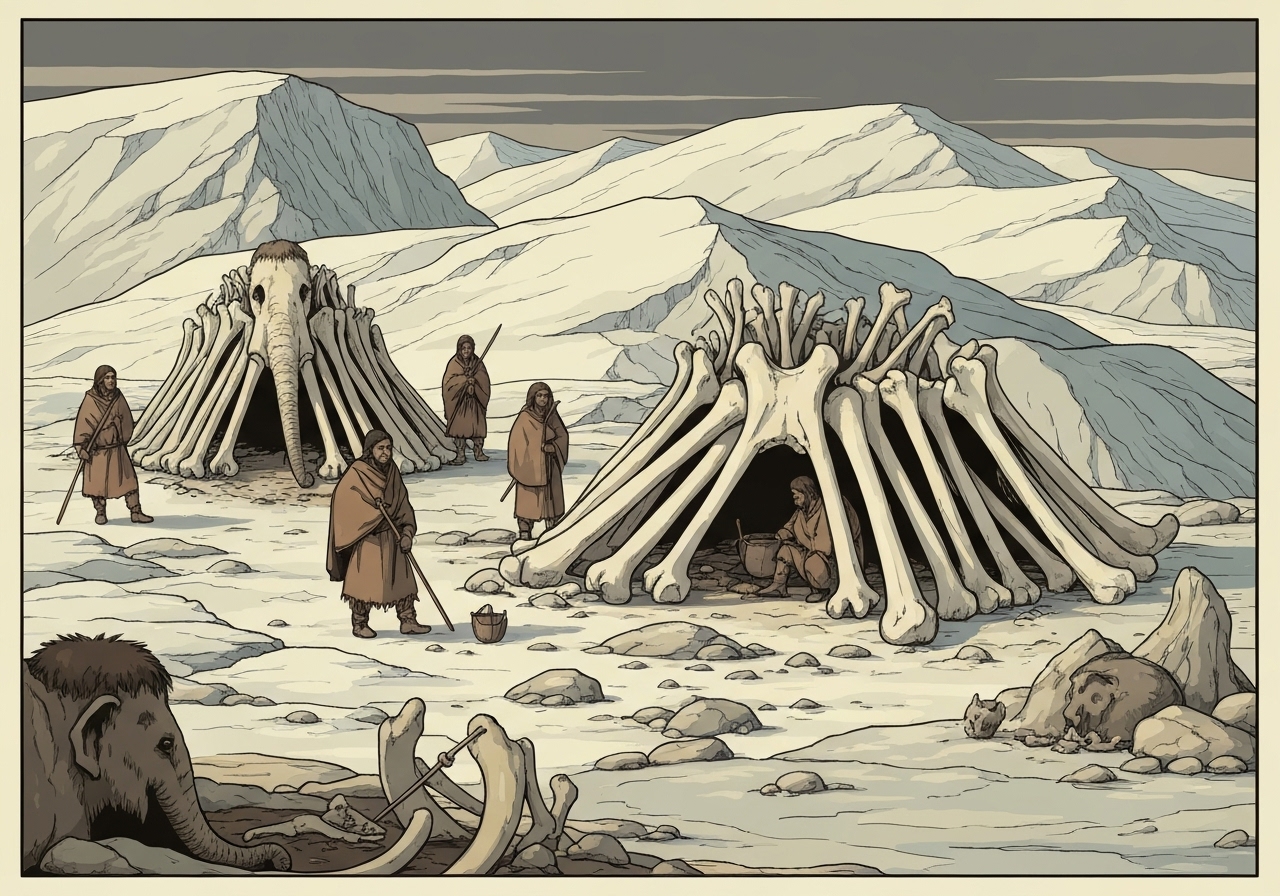
Lead: Around 18,000 years ago, people at the Mezhyrich site in what is now central Ukraine constructed parts of seasonal dwellings from the bones of woolly mammoths, according to a new reanalysis of radiocarbon dates. The largest structure at the site has been dated to between 18,323 and 17,839 years before present, placing its use just after the Last Glacial Maximum. Radiocarbon evidence and associated small-animal remains suggest these bone-built houses were reused intermittently — possibly for centuries — as practical refuges rather than permanent villages. The find illustrates how Late Pleistocene communities turned megafauna remains into engineered, weather-resistant architecture to survive extreme cold.
Key Takeaways
- The Mezhyrich site in Ukraine contains at least one large mammoth-bone structure dated to 18,323–17,839 years BP based on the authors’ radiocarbon analysis.
- Researchers dated remains from about a dozen small animals near the shelters to refine the site’s chronology and sequence of use.
- Estimated occupancy per shelter is roughly five to seven people, with evidence for activities such as flint knapping, hide processing and small-animal butchery inside.
- The team reports possible episodic use spanning up to 429 years, consistent with mobile hunter-gatherer reuse rather than year-round settlement.
- Architectural elements likely included vertically set skulls and long bones as foundations, tusks and flat bones as roof ballast and wind protection, plus a wooden frame and organic coverings.
- The paper was published on November 21 on Open Research Europe; archaeologist Pavlo Shydlovskyi is a co-author from Taras Shevchenko National University of Kyiv.
- External experts, including Francois Djindjian, urge additional radiocarbon dates across the site to confirm the proposed chronology and occupation phases.
Background
The Mezhyrich mammoth-bone installations were first documented decades ago and have long figured in debates about Late Upper Paleolithic life in Eastern Europe. Those earlier excavations recovered extensive accumulations of mammoth skeletal elements arranged in ringlike layouts, together with hearth features and dense artifact scatters. Because organic materials are rare or poorly preserved in many Pleistocene contexts, bone architecture provides unusually direct evidence for structural solutions in cold environments.
The new study sought to refine when and how long these bone-built shelters were used by re-evaluating radiocarbon dates from small faunal remains deposited in association with the structures. Placing the largest building at 18,323–17,839 BP situates its primary use immediately after the Last Glacial Maximum (26,500–19,000 BP), a climatically volatile interval when vegetation belts and megafaunal distributions were shifting. Stakeholders in interpreting the site include Ukrainian university archaeologists, the international Paleolithic research community, and heritage agencies concerned with conserving fragile open-air Pleistocene features.
Main Event
The team re-excavated selected loci and re-dated bone and charcoal fragments to tighten the temporal framework for Mezhyrich. Their analyses produced the cited date range for the largest structure and a set of supporting ages from associated small vertebrate remains. From spatial patterns and the bone architecture, the authors reconstruct foundations made from vertically set skulls and long bones, with tusks and broad flat bones applied higher in the shell to hold coverings and resist wind.
Field observations and artefact distributions indicate single structures housed small household groups of roughly five to seven individuals. Within those spaces archaeologists documented knapping debris, worked hides and cut marks on small mammal bones, supporting a picture of domestic and subsistence tasks carried out inside protected enclosures. The investigators propose that a timber frame would have been lashed to the bony plinth and then draped with hides, and perhaps birch bark where available, creating an insulated shelter suited to short-term occupation during winter or transitional seasons.
The study’s duration estimate — up to 429 years of episodic use — is derived from the spread of radiocarbon dates and stratigraphic relationships rather than continuous occupation. The authors emphasize intermittent reuse by mobile forager groups, who likely exploited mammoth remains both for resources and as construction material. Publication on Open Research Europe on November 21 makes the data and interpretations openly available for scrutiny and follow-up study.
Analysis & Implications
Structurally, the Mezhyrich examples show deliberate engineering: large bones arranged to resist wind and bearing loads, combined with organic and wooden materials for insulation and weatherproofing. This indicates sophisticated planning and knowledge of local resources, challenging simplistic portrayals of Late Pleistocene camps as unconstrained, temporary clusters of shelters. The bone-built houses represent adaptive architecture tailored to a subarctic or steppe-tundra environment immediately following peak glacial conditions.
Demographically, small household sizes align with expectations for mobile hunter-gatherer bands; five to seven occupants would permit cooperative tasks like carcass processing, tool manufacture and infant care within a single sheltered unit. Economically, using mammoth remains for construction is an efficient reuse of a large carcass — beyond food and fat, the bones themselves became critical building materials when wood was scarce or small in caliber.
Regionally, these findings refine our understanding of human resilience during rapid climatic transitions near the end of the last glacial cycle. If similar patterns of bone architecture are identified elsewhere with comparable dating, researchers could better map shifting settlement and resource strategies across Eurasia. However, the interpretation depends on continued, spatially comprehensive chronology-building at Mezhyrich and comparable sites; without denser dating, occupation models remain provisional.
Comparison & Data
| Feature | Date / Value | Notes |
|---|---|---|
| Largest Mezhyrich structure | 18,323–17,839 BP | Primary radiocarbon range reported by the authors |
| Last Glacial Maximum (LGM) | 26,500–19,000 BP | Climatic reference interval; Mezhyrich dates postdate the LGM |
| Estimated reuse span | Up to 429 years | Intermittent occupation inferred from date spread |
| Occupancy per shelter | 5–7 people | Inferred from floor area and artifact densities |
This table situates the Mezhyrich radiocarbon results against the broader glacial chronology and summarizes inferred human responses. The data support a model of seasonal or episodic occupation that exploited large carcasses as multipurpose resources, rather than the development of year-round, sedentary settlements. Future sampling across the site could refine these comparative values, reduce uncertainty about reuse intervals, and clarify whether different structures were contemporaneous or represent separate occupation phases.
Reactions & Quotes
Project co-author Pavlo Shydlovskyi described the architectural role of mammoth elements and how they likely contributed to stable foundations and wind protection. He framed the bone arrangements as intentional components of a composite shelter design combining bone, wood and organic covers.
The use of skulls and long bones set vertically created a plinth-like foundation, with tusks and flat bones serving as roof ballast and wind protection.
Pavlo Shydlovskyi, Archaeology Professor, Taras Shevchenko National University of Kyiv (co-author)
Not all specialists are fully persuaded by the chronology from the current sample set. Francois Djindjian, who has researched possible bone-structure sites elsewhere, emphasized the need for broader radiocarbon coverage across Mezhyrich before drawing firm conclusions about duration and contemporaneity.
More radiocarbon dates from different parts of the site would provide a clearer picture of when these structures were built and how long they were reused.
Francois Djindjian, Honorary Professor, University of Paris 1 Panthéon-Sorbonne (external expert)
Unconfirmed
- The precise duration and continuity of use for individual structures remain uncertain until additional radiocarbon samples from multiple loci are dated and modeled.
- Details about roofing materials (exact proportions of hide, birch bark, or wood) are inferred from ethnographic analogy and small-site evidence but cannot be confirmed without preserved organic fragments directly tied to structural elements.
- The extent to which Mezhyrich represents a local innovation versus part of a wider regional tradition of bone-built shelters is not yet resolved.
Bottom Line
Mezhyrich’s bone-built houses provide a direct window into how Late Pleistocene people engineered shelter under extreme conditions, converting mammoth remains into functional architecture. The dated range of 18,323–17,839 BP places these structures in the immediate post-LGM environment, highlighting adaptive strategies during a critical climatic turnaround.
While the current radiocarbon dataset supports episodic reuse by small household groups, fuller sampling across the site is necessary to confirm occupation rhythms and to test whether similar building strategies were synchronous regionally. Continued open publication of the data invites targeted follow-up work that can move interpretations from plausible to robust.
Sources
- Live Science — media report summarizing the study and author comments (journalism).
- Open Research Europe — academic publishing platform where the study was posted (academic/preprint platform).
- Taras Shevchenko National University of Kyiv — institutional affiliation of co-author Pavlo Shydlovskyi (academic institution).