
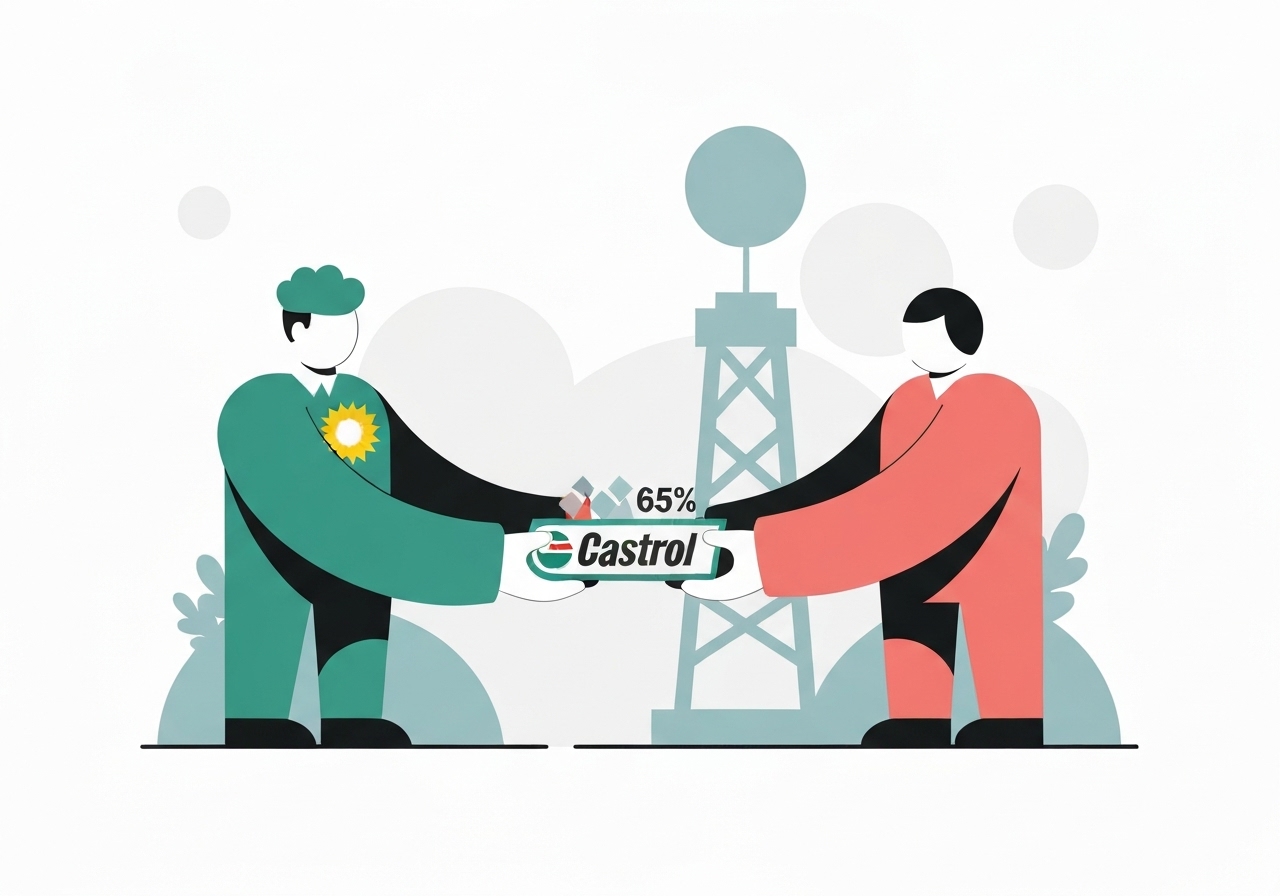
BP has agreed to sell a 65% stake in its Castrol motor oil business to New York investment firm Stonepeak for $6 billion, valuing Castrol at $10.1 billion. The transaction leaves BP with a 35% holding in the lubricants maker it acquired control of in 2000, and will free cash to cut debt and refocus the group. BP said the sale helps simplify the company and advance a wider program of asset disposals announced in February. The deal arrives as BP reshapes strategy and leadership ahead of a new chief executive taking office in April 2026.
Key takeaways
- Transaction size: Stonepeak buys 65% of Castrol for $6.0 billion, implying a total enterprise value for Castrol of $10.1 billion.
- BP retains 35% of Castrol and will use the $6 billion proceeds primarily to reduce indebtedness and streamline operations.
- Strategic context: the sale advances BP’s previously announced plan to divest about $20 billion of assets by 2027; the company says it is more than halfway to that target after recent disposals.
- Business scope: Castrol produces lubricants for cars, motorcycles and industrial applications and has been part of BP since 2000.
- Corporate shift: BP is narrowing its capital allocation toward oil and gas after cutting investment in some green-energy projects, following investor pressure and sector peers reevaluating their transition plans.
- Leadership timing: the move follows recent boardroom changes, including the appointment of Meg O’Neill as chief executive effective April 2026.
- Market reaction: BP shares opened higher on the news but later gave back most gains during the session.
Background
Castrol, founded in the early 20th century and long associated with automotive lubricants, became part of BP in 2000 when the oil major consolidated its downstream brands. Over the past decade Castrol has remained a steady contributor to BP’s lubricants, mobility and downstream earnings while facing industry pressures such as vehicle electrification and commodity-driven margins. In February, BP laid out a plan to sell around $20 billion of assets by 2027 to sharpen its portfolio and strengthen its balance sheet; today’s sale is part of that program.
The broader energy sector has been recalibrating capital plans amid shifting investor expectations and macroeconomic signals. Competitors including Shell and Equinor have trimmed some green-energy commitments, and political rhetoric encouraging increased fossil-fuel production has influenced investor sentiment. BP has previously sold businesses including its US onshore wind unit and a Dutch mobility and convenience operation as it prioritises core oil and gas cash flows.
Main event
Under the agreement, Stonepeak will acquire 65% of Castrol for $6.0 billion in cash, while BP will keep a 35% stake. BP said the proceeds will be allocated mainly to pay down debt and to reduce group complexity, supporting a narrower downstream focus on integrated businesses. The valuation places Castrol at approximately $10.1 billion, with BP describing the transaction as a milestone in its ongoing portfolio simplification.
The deal follows a series of disposals announced or completed by BP over the last year and comes as the group undergoes executive changes. Meg O’Neill was named BP’s first female chief executive and will assume the role in April 2026; the sale was announced shortly after that leadership decision and after a new chairman was appointed earlier this year. Interim chief executive Carol Howle framed the divestment as beneficial to stakeholders and consistent with the company plan.
Stonepeak, a US-based infrastructure investment firm, will hold operational and financial responsibility for the majority stake, with BP retaining a strategic minority interest. The firms said the transaction will support Castrol’s development under new ownership while maintaining BP’s exposure to lubricants’ long-term cash flows. The deal remains subject to customary closing conditions and any required regulatory approvals.
Analysis & implications
Financially, the $6.0 billion cash inflow provides immediate balance-sheet relief for BP, which has cited debt reduction as a priority after periods of heavy capital expenditure. By monetising a majority stake while retaining minority exposure, BP balances near-term deleveraging with the ability to participate in future upside from Castrol’s operations. The sale also reduces the company’s operational complexity in downstream segments that are not central to its chosen strategic focus.
Strategically, the transaction signals a clearer tilt back toward oil and gas production and traditional downstream integration, amid investor frustration over the pace and returns of prior green-energy commitments. The move will likely be interpreted by markets as management responding to calls for stronger cash returns and a simpler portfolio. That shift mirrors actions by some rivals, suggesting an industry trend toward pragmatic reallocation of capital.
For Castrol, ownership by an infrastructure-focused investor could mean investment geared to efficiency and market positioning rather than BP’s broader corporate objectives. Stonepeak’s resources and sector focus may aim to preserve and grow Castrol’s lubricant franchise, particularly in regions and product lines where margins remain attractive. The retained 35% stake gives BP a continuing interest in business performance without day-to-day control.
Comparison & data
| Item | Value |
|---|---|
| Deal proceeds to BP | $6.0 billion |
| Castrol implied valuation | $10.1 billion |
| BP ownership after deal | 35% |
| Stonepeak ownership | 65% |
| BP divestment target (announced Feb) | $20 billion by 2027 |
The table summarises the headline financials and ownership split. While $6.0 billion is a material cash inflow, BP has said the transaction, combined with prior disposals, places it more than halfway toward the $20 billion divestment goal announced in February.
Reactions & quotes
The company framed the deal as advancing its strategic plan and simplifying operations.
We are reducing complexity, focusing the downstream on our leading integrated businesses, and accelerating delivery of our plan.
Carol Howle, Interim Chief Executive, BP (official statement)
Market analysts highlighted the balance-sheet benefit and the speed toward the divestment target.
The significant proceeds will allow BP to make a decent dent in its onerous borrowings pile and move closer to its $20 billion divestment goal by 2027.
Russ Mould, Investment Director, AJ Bell (market analyst comment)
Unconfirmed
- Timing and scope of regulatory approvals remain unspecified and could affect the closing date.
- Detailed plans for operational changes or integration under Stonepeak have not been disclosed and are subject to future announcements.
Bottom line
The $6.0 billion sale of a 65% stake in Castrol to Stonepeak is a decisive step in BP’s portfolio reshaping, delivering cash to cut debt while allowing it to retain a meaningful minority interest. It underlines a strategic reorientation toward core oil and gas assets and away from some prior green-energy investments, mirroring moves by several peers.
Investors will watch how proceeds are deployed and whether further disposals accelerate. For Castrol, new majority ownership could mean a more focused drive on lubricants’ operational performance, while BP will monitor returns from its 35% stake as it pursues larger strategic goals through to 2027.
Sources
- BBC News (media — UK public broadcaster)
- BP press releases (official company announcement)